
A free virtual cabinet painting estimate can give you a solid ballpark number within minutes, using basic inputs like door count and finish type. It cannot replace an on-site inspection once repairs, hidden damage, or lead paint risk enter the picture. If the number you get lines up with your budget, the smart next step is booking an in-person visit to confirm it.
TL;DR:
- Count every door and drawer front separately, include pantry units and layout extras, and report damage, finish type, and add ons rather than rounding.
- Nationally, cabinet painting averages $1,390 to $3,353, with a typical bill of $2,164; prep needs, kitchen layout, and finish quality shift costs.
- Calculators price by door, linear foot, or kitchen size; Thumbtack lists rates of $45 to $55 hourly and $30 to $60 per linear foot.
- Book an in person inspection for peeling paint, water damage, structural repairs, or homes built before 1978, when lead safe work rules apply.
- Choose DIY only for a small kitchen in decent condition if you can manage multiple coats and cure times; sprayed professional finishes resist chipping better.
Table of Contents
- How a virtual estimator calculates cabinet painting costs
- Exactly what to measure and how to describe your cabinets for the most accurate virtual estimate
- Sample cost ranges and the primary drivers that change your estimate
- How to interpret the estimate when deciding between a pro and DIY
- What a shop-based, factory-finish refinishing service delivers after a virtual estimate
- Balancing speed and accuracy with virtual estimates
- How Cabinets Refinishing can help with your next step
- FAQ
- Sources
How a virtual estimator calculates cabinet painting costs
A virtual cabinet painting estimate works like a simplified pricing model. You feed it a handful of details, and it runs them against a pricing formula built from typical labor and material costs for jobs of similar size and complexity.
Most calculators ask for the same core inputs because each one changes the labor hours involved:
- Door and drawer count, since every panel needs sanding, priming, and at least two coats.
- Island presence, which adds surface area and often requires matching the surrounding layout.
- Glass-front doors, which take extra masking and careful handling.
- Finish type, because a sprayed factory-style finish costs more in labor than a brushed coat but lasts longer.
- Current condition, since peeling paint or water damage means more prep time before any color goes on.
Pricing bases vary by tool. Some calculators price per door, others per linear foot of cabinetry, and some bucket jobs into kitchen-size bands (small, medium, large). According to Thumbtack’s cost data, painters commonly charge $45 to $55 per hour, $30 to $60 per linear foot, or a flat rate per component, and any of those models can feed a calculator’s output.
The number you get is a ballpark, not a quote. Calculators cannot see cracked wood, moisture damage behind hinges, or how many coats your existing finish will actually need to cover. That is exactly where variance between your online estimate and your final price comes from.
Exactly what to measure and how to describe your cabinets for the most accurate virtual estimate
The accuracy of any virtual cabinet painting estimate depends entirely on what you tell it. Vague or rounded inputs produce vague, unreliable numbers.
- Count every door and drawer front separately. A single base cabinet with two doors and one drawer counts as three units, not one.
- Include pantry and oven cabinets. These are often tall, heavy pieces that take more prep time than standard uppers or lowers.
- Note layout extras. Flag an island, any tall cabinets, glass-front doors, open shelving, or built-ins, since each changes labor time differently.
- Describe the current condition honestly. Peeling paint, water stains, or a glossy factory finish all require different prep steps.
- Select your target finish and paint type. A hand-brushed look costs less than a sprayed, factory-style finish.
- Declare any add-ons upfront. Hinge replacement, soft-close upgrades, or glazing work should be listed separately, not assumed.
Pro Tip: Take photos in even daylight from a few feet back, straight on rather than at an angle, so the estimator and any contractor who reviews them later can actually see the condition of the wood and finish.
Before submitting your numbers, it helps to see what a written estimate should ultimately include. Our cabinet refinishing estimate checklist walks through the line items worth confirming once you move from a virtual number to a real quote.
Sample cost ranges and the primary drivers that change your estimate
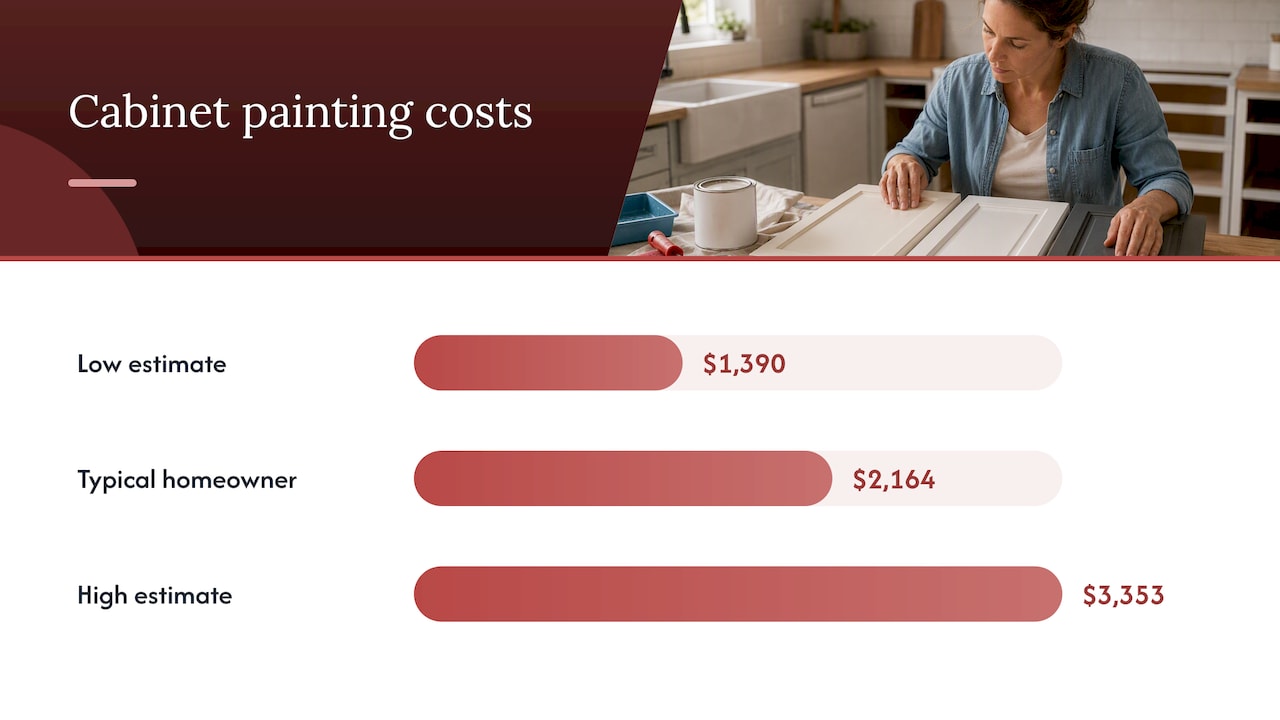
The national average to paint kitchen cabinets runs from about $1,390 to $3,353, with most homeowners paying around $2,164. That range reflects wide differences in kitchen size, cabinet condition, and finish quality.
A few factors consistently push an estimate toward the high end:
- Extensive prep work, such as stripping old paint, sanding glossy surfaces, or repairing water damage.
- Higher-grade paint or primer, which costs more per gallon but resists chipping and yellowing longer.
- Complex layouts, including kitchens with islands, glass fronts, or built-in cabinetry that takes extra masking.
- Structural repairs, like loose face frames or warped doors that need fixing before any paint goes on.
A professional quote typically bundles several steps a calculator cannot itemize individually: full surface prep, a sprayed or hand-applied finish, labor, cleanup, and often a warranty on the work. DIY material costs alone, by contrast, usually land far lower since they skip labor entirely, but they also skip the durability that comes from proper degreasing, sanding, and multi-coat application. Thumbtack’s pricing breakdown notes that per-linear-foot and per-hour rates both scale up quickly once a job requires more than a simple repaint.
How to interpret the estimate when deciding between a pro and DIY
A virtual estimate is most useful as a decision tool, not just a number. Once you have it, compare it against what you are actually willing to take on.
- Choose a pro when your kitchen has an island, glass doors, or visible damage, or when you want a sprayed finish and a warranty backing the work.
- Consider DIY for a small, simple kitchen in decent condition if you have patience for multiple coats and proper cure times.
- Weigh the durability gap. Sprayed finishes applied in controlled conditions resist chipping far better than brushed coats applied in a kitchen.
- Remember that calculators showing pro pricing already include labor, while a DIY material estimate reflects only paint, primer, and supplies, not your time.
For a closer look at what a sprayed, shop-based process actually involves, see our step-by-step cabinet painting process guide.
What a shop-based, factory-finish refinishing service delivers after a virtual estimate
Once your virtual estimate points toward hiring a pro, the full kitchen remodel services method matters as much as the price. A shop-based, factory-finish workflow means your cabinet doors and drawers come off-site, get sprayed in a controlled environment, and go through multiple protective coats before reinstallation, a process that commonly wraps up in 3 to 5 days.
- Full disassembly and shop spraying keep dust and fumes out of your kitchen during the job.
- Multi-coat protective finishes applied in a controlled setting tend to cure more evenly than in-home brushed work.
- A short reinstallation window means your kitchen is usable again within days, not weeks.
Virtual estimates translate reliably to final pricing when your cabinets are in fairly standard condition. They become less reliable once hidden damage, structural repairs, or lead paint risk are involved, since homes built before 1978 fall under federal lead-safe work practice rules outlined in the EPA’s Renovate Right guidance. An on-site visit is the only way to confirm those conditions before work begins. For more on how a dust-contained process compares to traditional on-site painting, see avoiding a dusty kitchen during cabinet painting.
Balancing speed and accuracy with virtual estimates
A virtual estimate is enough to set your budget and compare it against what a shop-based refinishing project typically costs. Once your number is close to your comfort range, or your home predates 1978, insist on an on-site visit before signing anything.
— Jesse
How Cabinets Refinishing can help with your next step
We handle cabinet refinishing, painting, glazing, and restoration using a factory-finish spray process. Every project includes custom color matching, low-VOC materials, and a warranty, with most jobs completed in a few days instead of the weeks a full replacement takes.

- Start with our virtual estimate to get a realistic budget range for your kitchen.
- Book an on-site visit once your number fits your budget, so we can confirm condition and finalize pricing.
- Ask about add-ons, from cabinet modifications and enhancements to bathroom vanity and built-in refinishing, if your project goes beyond the kitchen.
Ready to see what your kitchen could cost to refinish? Visit Cabinetsrefinishing to get started.
FAQ
How much should I pay to have my cabinets painted?
Most homeowners pay between roughly $1,390 and $3,353 nationally, with a typical cost around $2,164. Your final price depends heavily on kitchen size, cabinet condition, and whether you choose a sprayed or brushed finish.
How much should it cost to paint 1000 square feet?
Cabinet painting is typically priced per door, per linear foot, or per kitchen rather than by square footage of living space, so home square footage does not map directly to a cabinet cost. A better starting point is counting your actual doors and drawers and running them through a virtual estimate based on those unit counts.
How do you bid a cabinet painting job?
A fair bid accounts for door and drawer count, current condition, finish type, and any structural repairs needed before painting begins. For guidance on what a complete, comparable quote should include, see our guide to getting multiple quotes.
How much would a painter charge to paint a 12×12 room?
Cabinet painters price by cabinet component or linear foot rather than by room square footage, so an estimate depends on how many cabinets a room contains, not its dimensions. Counting your doors and drawers and entering them into a cabinet-specific calculator gives a far more accurate number than a generic room-size rate.
Is a virtual estimate safe to rely on for older homes?
A virtual estimate can still give you a useful budget range for older homes, but it cannot assess lead paint risk on its own. Homes built before 1978 fall under federal lead-safe work practice requirements, and the EPA’s small entity compliance guide outlines the containment and cleanup steps a certified contractor must follow.
Sources
- Renovate Right: Important lead hazard information for families, child care providers and schools (EPA)
- 26 Cost to Paint Kitchen Cabinets | Get Estimates (Thumbtack)