
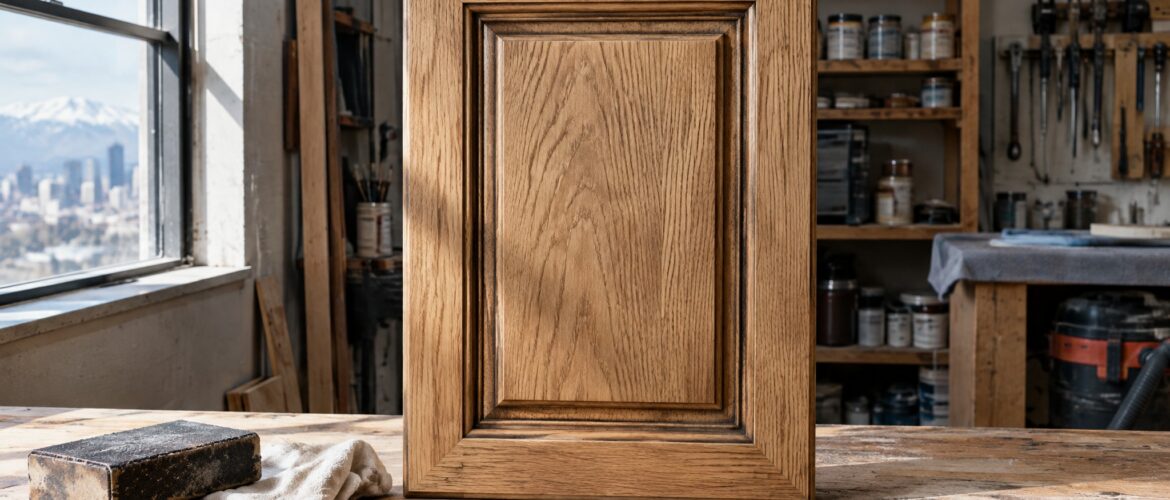
Kitchen cabinet glazing is a translucent, tinted coat worked into the profile and recesses of a base-coated door, so the detail reads as depth instead of one flat color. It beats flat paint on raised-profile, beaded and open-grain doors, because a single even coat hides the very detail that makes those doors worth keeping. We have sprayed factory-style finishes on Denver kitchens since 1979, and glazing sits alongside refinishing, painting and restoration in what we offer. Below, we run one job through our shop from first inspection to rehang, then cover what sets the price and how long it takes.
Kitchen Cabinet Glazing Process, Step by Step, on Raised-Panel Oak Doors
Picture a typical Denver kitchen: solid oak raised-panel doors in a honey stain that went out of style years ago. The owner wants warmth and depth, not a flat white. This is a representative job, not a specific client’s, and it is the one where glazing earns its keep.
Here is the sequence we follow, and what each step does to the look of the finished door.
- Inspect and repair. We go door by door and mark loose rails, dings, open panel joints and worn edges near the pulls. A glaze is translucent, so it highlights every flaw instead of covering it. Repairs come first, or they show up later as shadows.
- Strip or scuff-sand, then degrease. Years of cooking film sit on the doors nearest the range. We degrease so sanding does not push oil into the wood. Where the old finish is sound, we scuff-sand it. Where it is failing, we strip it.
- Decide on grain filling. This is the choice that sets the antique look. We can fill the oak pores for a smooth face, or leave the grain open so the glaze catches in it and reads as aged. If you want the deeper detail on that call, we cover grain filling on oak before glazing separately.
- Spray the precat primer. A precat primer has its hardener blended in at the factory, so it dries fast, bonds hard and sands flat. It gives the base color something solid to grip.
- Spray the base color by HVLP. HVLP stands for high-volume, low-pressure: a spray gun that breaks the finish into a fine, soft mist with little overspray. It lays an even film with no brush marks in the panel corners. The base color, say a warm cream, is the backdrop the glaze will read against.
- Work the glaze in by hand and wipe it back. We wait until the base is fully dry, then brush the tinted glaze over the door and wipe it off with a rag. It stays in the raised profile, the recesses and the open grain, and the high points clear. How hard we wipe decides the look: a light pass leaves a darker, more pronounced edge, and a heavy pass gives a soft, aged one.
- Seal with crosslinking urethane lacquer, then cure. This topcoat is also sprayed by HVLP. Crosslinking means its molecules bond to each other as it cures, which leaves a hard film that resists water, grease and scuffs. It locks the glaze under a clear layer so wiping the door down does not wipe the glaze away. The doors cure fully before they are rehung.
Most homeowners picture brushed or rolled paint when they think of a cabinet job. The difference shows up on a door like this one. A brush leaves ridges in the panel corners, and the film stays softer, so a glaze laid over it has no hard shell protecting it. Our glaze sits inside a sprayed system, from primer to topcoat. If you want to see how the spray method works in more depth, read about how HVLP spraying and urethane topcoats work.
Glazing is slower hand work than flat paint, and it has a real limit. Touch-ups are harder to blend than on a solid color, because the glaze depth varies door to door. If a door gets chipped later, the repair plan belongs with us, not with a paint pen from the hardware store.
Cabinet Glazing vs Painting: When an Antique Glaze Fits Denver Kitchens
Go back to the same oak doors and spray them flat white instead. The result is clean, but the raised panel loses its shadow lines and the grain disappears under one even color. That is the trade, and it is the right one for some kitchens.
Glaze fits raised-profile, beaded and open-grain doors. It also suits traditional, Old World and farmhouse looks, where the point is a finish that looks lived with. Antique glaze kitchen cabinets in Denver homes tend to work best when the doors already carry a profile for the glaze to settle into.
Flat paint is the stronger call for slab doors, clean contemporary lines, and an owner who wants one uniform color above all else.
If your doors are slab, you would pay for glaze steps that you could barely see, and we will tell you so. We quote both finishes, so the choice is yours to make with real numbers in front of you.
Cabinet Glazing Cost in Denver: What Sets the Quote
We price per door and per drawer front, after an on-site look. Three things set the labor: the condition of your existing finish, the profile on each door, and how many color steps the finish needs. A flat door in good shape costs less to finish than a beaded door with a failing stain.
A glazed finish prices above a one-color paint job on the same doors. It adds a base coat, the glaze and wipe-back, and a sealed topcoat, and every one of those steps takes hand time and cure time.
Refinishing still costs far less than replacement, because you keep the boxes and the layout. That is where most of the gap comes from, provided your boxes are sound. If they are sagging or water-damaged, we will say so before you spend anything. For the full comparison, see refinishing versus replacement.
For current numbers, use per-door pricing for Denver kitchens and the Denver pricing guide. Those pages carry the figures, so we do not repeat them here.
When you compare quotes, ask each painter for these four things:
- The number of coats, counted separately for primer, base, glaze and topcoat
- How the glaze is applied and wiped back, by hand or otherwise
- The topcoat, named by product type
- Repairs priced on their own line
A quote that says “paint and glaze” with one number tells you nothing about what goes on the door.
How Long a Glazed Cabinet Finish Takes in Denver
The finish sets the schedule, not the crew. Each coat has to cure before the next goes on, and a glaze adds a base, a glaze and a wipe-back ahead of the topcoat. A glazed job therefore runs longer than a flat paint job on the same doors. Our turnaround runs 2-5 days, and we set the exact count for your kitchen in the quote, based on your door count and the steps your look needs.
Denver’s dry air makes the last step matter more. Low humidity pulls moisture in and out of oak across the seasons, and a topcoat that has not fully cured is the one that marks or checks first. A glazed finish holds up here when the topcoat is fully cured before the doors go back on. We hold the doors until that point, and our 3 year warranty covers the finished work. We are licensed and insured, and we have been doing this since 1979.
The price gap is the reason to move now. Refinishing typically saves about 70% against a replacement job of $25,000 or more, and you keep the boxes you already own.
Your next step is simple. Send door photos for a glazing quote through the Contact Us page, with the door and drawer count and the look you want. We can also quote flat painting on the same doors, so you can set the two prices side by side.
Frequently asked questions
Will glazed kitchen cabinets hold up in Denver’s dry climate?
Yes, as long as the topcoat has fully cured before the doors are rehung. We seal the glaze under a sprayed crosslinking urethane lacquer, which forms a hard film over it. Our 3 year warranty covers the finished work.
Is cabinet glazing more expensive than painting?
Yes. A glazed finish costs more than a one-color paint job on the same doors because it adds a base coat, the glaze and wipe-back, and a sealed topcoat. The final quote moves with door and drawer count, profile complexity, existing finish condition and repairs.
Can you glaze slab or modern cabinet doors?
We can, but it is rarely the best use of your money. Glaze collects in profiles, beads and open grain, and a flat slab door has none of those. For slab doors and clean contemporary lines, flat paint is usually the stronger choice.
Can a glazed finish be touched up later?
It can, but it is harder than on a solid color. The glaze depth varies from door to door, so a patch is hard to blend by hand. If a door gets chipped, bring the repair to us rather than patching it yourself.
How do I get a glazing quote?
Send photos of your doors, the door and drawer count, and the look you want through the Contact Us page. We can quote glazing and flat painting on the same doors so you can compare the two prices.