Choosing between HVLP spray cabinet painting and brush paint comes down to chemical engineering versus manual application. You’re not just picking a color or sheen. You’re deciding whether your kitchen surfaces get protected by a bonded, catalyzed coating or merely covered by a layer of decorative enamel.
In Denver metro, indoor humidity often drops below 30% during winter. That single fact decides whether your cabinets survive seasonal thermal cycling or crack within a few years. A brush leaves texture and relies on mechanical adhesion. HVLP spray equipment atomizes industrial coatings into a uniform film that cures as one continuous shell.
We’ve been doing this since 1979, and we’ve refined our HVLP spray process around precat primer and crosslinking urethane lacquer specifically to handle Colorado’s dry climate and the wood movement that comes with it. Brushed finishes can’t get anywhere near the molecular density needed to hold up against our dry heat, no matter how carefully someone applies them. When you compare quotes for cabinet refinishing, don’t just look at the price per linear foot. Look at the application chemistry that will actually protect your investment against daily wear and the environment outside your window.
Why HVLP Spray Application Outperforms Brushed Cabinet Paint
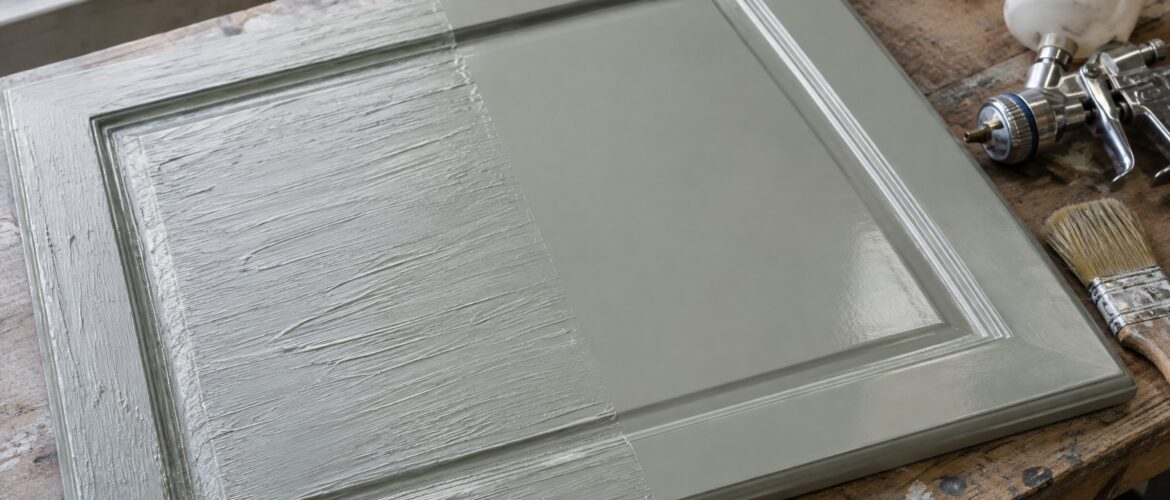
The difference between a factory finish and a painted surface comes down to how the coating reaches the wood. HVLP equipment uses high volumes of air at low pressure to break liquid coating into microscopic droplets, so it settles evenly across vertical and horizontal surfaces without the drag marks a bristle or foam brush leaves behind. That matters most on oak, where the open grain needs a coating that flows into the pores instead of bridging over them.
Oak cabinets sprayed with 2K poly show no grain telegraphing and no lap marks, because the atomized finish flows into the open pores before it cures. Brushed paint just bridges over them. For a deeper look at managing open-grain woods, our guide on grain filling and 2K poly smoothing techniques covers the prep steps before spraying starts.
Brushed cabinet paint doesn’t fail in Denver because of sloppy work. It fails because mechanical application can’t produce the film consistency needed to resist thermal cracking once humidity drops below 30%. When a painter drags a brush across a stile-and-rail joint, paint piles up in ridges and thins out on the edges. That uneven thickness expands and contracts at different rates as temperatures swing, and the stress concentrates right where wood movement is already worst. Two or three heating seasons in, you see hairline cracks along the joints or chipping around the hardware. Spray application avoids this by laying down a consistent mil thickness across every contour, so the coating moves with the wood instead of fighting it.
Crosslinking Urethane Lacquer vs Standard Enamel
Application method alone doesn’t guarantee durability. The coating chemistry has to match Colorado’s demands too. Precat primer and crosslinking urethane lacquer contain catalysts that trigger a chemical reaction as they cure, forming molecular bonds that produce a harder, more flexible surface than a standard enamel can reach through simple evaporation. This catalyzed finish stands up to the abrasive cleaners homeowners use every week, while staying flexible enough to move with seasonal wood shrinkage instead of going brittle. Standard brushed enamels dry by solvent evaporation and leave a thermoplastic film, one that softens in heat and hardens in cold, which keeps it perpetually exposed to the thermal cycling that defines Denver winters.
You want a finish that performs the same in January as it does in July. That takes chemistry built for arid climates, not a generic interior paint formulated for national distribution. “Factory finish cabinets” describes exactly this: a smooth, chemically resistant surface from controlled spray application of catalyzed coatings, not just the absence of visible brush strokes. Our 3-year warranty rests entirely on this combination of HVLP spray technology and crosslinking urethane lacquer, because neither piece on its own delivers the longevity we guarantee. As HVLP and urethane spray specialists, we’ve tracked decades of performance across Colorado conditions, and this is the only system that has consistently held up without early breakdown.
This approach doesn’t suit every job. We turn down projects where the existing cabinet boxes are structurally compromised or water-damaged beyond repair. Refinishing restores surfaces and protects cabinetry that still works; it can’t fix a fundamentally broken box. When the substrate is sound, though, spray-applied catalyzed coatings give you protection brushed alternatives just can’t match in this climate.
Durability Data for Denver’s Dry Climate
Brush-painted cabinets in metro Denver tend to fail on a predictable schedule, usually by the second or third winter. Hairline cracks show up first at the stile-and-rail joints, where wood movement concentrates the most stress. Chipping around drawer pulls and hinges follows, where daily hand contact meets an already brittle film. South-facing windows make it worse: UV exposure degrades the enamel binder, and sheen fades before the surface starts powdering on sun-exposed door faces. All of this happens because brushed coatings lack the film consistency and the chemical resistance to survive thermal stress, mechanical wear, and UV exposure at once, which is exactly what our altitude and dryness throw at a finish.
Conversion varnish and 2K poly applied with HVLP resist all three failure modes through better chemical crosslinking and a uniform film. The catalyzed structure keeps cleaning agents from penetrating or softening the surface, which is what lets brushed enamels get progressively easier to damage over time. Flexibility holds even after full cure, so the coating expands and contracts with seasonal humidity instead of micro-fracturing before it visibly cracks. In practice, sprayed catalyzed finishes routinely outlast brushed ones by three times or more under actual Denver conditions.
Durability comes from application method and coating formulation working together, not from either one alone. A premium 2K poly brushed on still fails early, because the brush reintroduces the exact inconsistencies the catalyzed chemistry is built to eliminate. HVLP spray equipment, for its part, can’t make up for a coating that lacks the crosslinking density needed to last in a dry climate. You need both. That’s why our process specs require HVLP application of precat primer and crosslinking urethane lacquer as the standard, not an upgrade.
Refinishing Economics: Spray Finish Value vs Replacement
Homeowners typically save about 70% compared to a $25,000+ full cabinet replacement, and they still get a factory-grade spray finish backed by a 3-year warranty. That gap exists because refinishing keeps your existing cabinet boxes and layout in place. No demolition, no structural changes, none of the months that custom fabrication and installation usually take. The value case comes down to getting equal or better surface quality for a fraction of replacement cost, as long as the refinisher is actually using industrial spray equipment and catalyzed coatings rather than residential painting methods.
For a detailed breakdown by kitchen size and configuration, our refinishing versus full replacement cost analysis covers typical project budgets across the Denver metro area.
Cost Comparison Without Sacrificing Finish Quality
Professional spray finishing runs 2 to 5 days, and that speed comes straight from HVLP efficiency paired with fast-cure chemistry that allows multiple coats within hours instead of days. Brushed projects need long drying intervals between coats to avoid lap marks and let solvent escape, which stretches the job to two weeks or more and keeps your kitchen out of commission that whole time. Spray application lays down thinner, more uniform coats that flash off fast, so same-day recoating is possible without giving up film integrity or chemical resistance. Faster work means lower labor cost and less time with your kitchen half-usable.
Think of HVLP spray refinishing as the middle option between cheap brush painting and full replacement. Brush painting costs less upfront but more over time, since the finish fails sooner and needs rework. Replacement gets you new cabinetry at a price that may not add that much value to your home. Spray refinishing sits in between: industrial-grade finish quality at a moderate price, with a lifespan that matches or beats the original factory finish. If you want to know whether your cabinets are a good fit, schedule a spray finish consultation and we’ll assess your actual substrate and layout instead of handing you a generic estimate.
Frequently Asked Questions
How long does a professionally sprayed cabinet finish last compared to brush-painted cabinets in Denver?
Sprayed catalyzed finishes typically last 10-15 years in Denver’s climate when properly maintained, while brush-painted cabinets often show joint cracking and edge chipping within 2-3 years due to inconsistent film thickness and inferior chemical resistance. The longevity difference stems from both application uniformity and crosslinking chemistry that brushed enamels cannot achieve.
Can existing oak cabinets be refinished to look smooth without visible grain texture?
Yes, but only through proper grain filling preparation followed by HVLP spray application of 2K poly or similar self-leveling coating. Brushed paint cannot fill open oak pores effectively and will telegraph grain texture regardless of coat count, whereas atomized spray finishes flow into pores before curing to create a genuinely smooth surface.
What makes crosslinking urethane lacquer better than regular cabinet paint for Colorado homes?
Crosslinking urethane lacquer contains catalysts that create molecular bonds during curing, producing a harder yet flexible surface resistant to cleaning chemicals and thermal expansion. Regular paints dry by evaporation alone, leaving thermoplastic films that soften with heat and become brittle in Denver’s dry winters, leading to premature cracking.
Why does spray finishing take only 2-5 days when brushed painting takes weeks?
HVLP spray equipment applies thinner, more uniform coats that flash off solvents rapidly, allowing multiple coats in a single day without lap marks or sagging. Brushed applications require thicker coats and extended drying intervals between layers to avoid visible brush strokes and ensure proper leveling, extending project timelines significantly.