

A well-targeted kitchen remodel typically raises your sale price, but how much you actually recoup depends on scope, local comparables, and whether you avoid the over-improvement trap. According to recent industry reports, a minor kitchen remodel can return more than the full cost invested nationally. Midrange and upscale projects return considerably less. Zillow confirms that while buyers consistently rank the kitchen as a top decision factor, a full gut renovation rarely pays back dollar-for-dollar. The practical takeaway: smaller, targeted updates often beat expensive overhauls on percentage recouped. Your neighborhood’s price ceiling and the condition of your current kitchen will determine whether you gain net financial value or primarily lifestyle value.
Table of Contents
- Why a kitchen remodel adds home value: the core drivers
- How remodel scope shapes your expected return
- Which specific updates return the most value
- Cabinet refinishing delivers outsized ROI compared to replacement
- Should you remodel before listing your home?
- How much should you spend on a kitchen remodel for resale?
- How to get the best resale value from your kitchen project
- Tax implications and incentives for kitchen remodeling
- Key Takeaways
- The part most homeowners get backwards
- Cabinetsrefinishing: factory-finish results without the replacement cost
- Useful sources
Why a kitchen remodel adds home value: the core drivers
Several variables move the ROI needle, and understanding them before you spend a dollar is the difference between a smart upgrade and an expensive mistake.
- Local market ceiling. Every neighborhood has a price cap buyers will pay regardless of finishes. Spending $80,000 on a kitchen in a street where homes top out at $350,000 rarely returns that investment.
- Current kitchen condition. A dated or visibly worn kitchen creates a buyer penalty. Removing that penalty through targeted updates often delivers more measurable value than adding luxury features to an already-functional space.
- Project scope. Cosmetic refreshes (paint, hardware, cabinet surfaces) carry lower cost and higher percent recouped. Structural changes (moving walls, relocating plumbing) add cost fast and rarely return proportionally.
- Layout changes. Opening a closed kitchen to adjacent living space can improve perceived square footage, but the plumbing and electrical work involved eats into returns quickly.
- Quality of finishes. Mid-grade finishes matched to the neighborhood outperform both bargain materials and ultra-luxury selections. Buyers in a $500,000 neighborhood expect quartz, not granite slabs at $200 per square foot.
- Buyer preferences. Neutral, timeless choices (white or gray cabinetry, subway tile, stainless appliances) appeal to the broadest buyer pool. Highly personalized choices narrow it.
The distinction between perceived value and appraised value matters here. An appraiser assigns value based on comparable sales, not on what you spent. A buyer, on the other hand, makes an emotional decision the moment they walk in. A kitchen that reads as clean, modern, and move-in ready commands stronger offers and faster closings, even when the appraised value doesn’t fully reflect the renovation cost. That gap is where smart, cosmetic-focused remodeling earns its keep.
Pro Tip: Before finalizing your budget, pull three to five recent sold comps within a half-mile of your home and note their kitchen descriptions. If the top-selling homes in your area feature granite countertops and updated cabinets, that’s your target. If they feature basic laminate, you’re already at the ceiling and a modest refresh is all you need.
How remodel scope shapes your expected return
The three tiers of kitchen remodeling produce very different financial outcomes. Here’s how they break down nationally, drawing on Remodeling Magazine’s Cost vs. Value framework and KitchenCabinetKings data on dollar value added:

| Remodel type | Typical national cost range | Typical % recouped | Dollar value added (approx.) | Primary benefit |
|---|---|---|---|---|
| Minor / refresh | $10,000–$25,000 | ~80% | $30,000–$35,000 | Highest % recouped; removes dated impression |
| Midrange | $30,000–$40,000 | ~50% | $35,000–$45,000 | Broad appeal; functional and cosmetic upgrade |
| Upscale / gut | $80,000–$150,000 | ~30–50% | $50,000 | Maximum lifestyle value; lower % recouped |
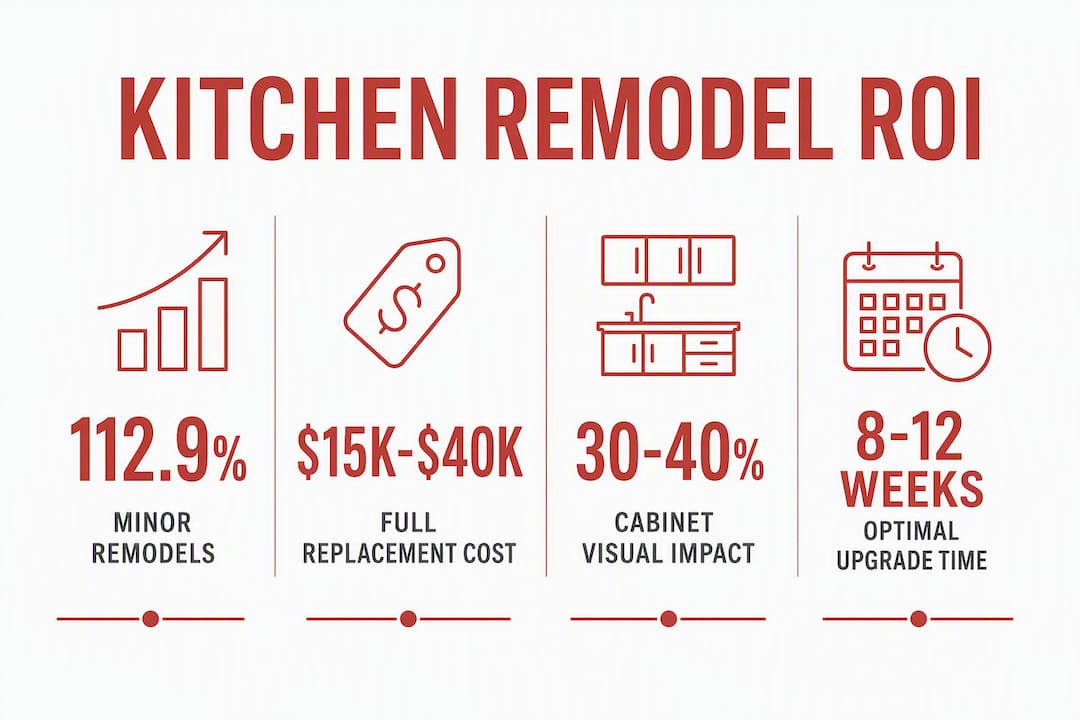
The minor remodel’s outsized percentage return comes from a simple dynamic: you’re spending a modest amount to eliminate the “needs work” signal that buyers penalize heavily. A midrange project adds genuine functional and aesthetic value but costs enough that full recoupment is unlikely. An upscale gut renovation often delivers a beautiful kitchen that the local market simply won’t pay a proportional premium for.
Regional variance is real. Denver, for example, sits in a competitive metro market where updated kitchens carry meaningful weight in buyer decisions. Coastal markets like San Francisco or New York can support higher absolute dollar returns, but the percentage recouped often follows the same pattern: minor beats upscale on ROI. Always adjust expectations to your specific market before committing to a scope.
Which specific updates return the most value
Not all kitchen upgrades are created equal. These are the updates that consistently move the needle on resale value, ranked roughly by impact per dollar spent:
- Cabinet surfaces and finish. Cabinets cover more visual square footage than any other element. Updating them, whether through refinishing, painting, or refacing, is the single highest-impact cosmetic change you can make. Cabinets are the kitchen’s focal point and the first thing buyers notice.
- Countertops. Replacing laminate with quartz or granite signals quality immediately. Mid-grade quartz ($50–$80 per square foot installed) hits the sweet spot for most markets.
- Lighting. Recessed LED lighting, under-cabinet strips, and a statement pendant over an island cost relatively little and dramatically change how a kitchen photographs and feels in person.
- Hardware. New pulls and knobs on existing cabinets cost $100–$400 total and deliver a disproportionate visual upgrade. Brushed nickel and matte black are the current safe bets for broad buyer appeal.
- Appliances. Matching stainless steel appliances at a mid-grade level (not luxury, not builder-grade) satisfy buyer expectations without overspending. A mismatched set reads as neglect.
- Flooring. Replacing cracked tile or worn vinyl with LVP (luxury vinyl plank) or tile runs $3–$8 per square foot installed and removes a common buyer objection.
- Paint and backsplash. Fresh neutral paint and a simple subway tile backsplash cost under $2,000 combined and make a kitchen feel new without touching a single cabinet or appliance.
Good Housekeeping’s guidance from real estate professionals reinforces that practical, functional updates, including soft-close hinges, drawer organizers, and quality lighting, frequently outrank ultra-luxury add-ons when buyers evaluate kitchens. Buyers want to imagine themselves cooking dinner, not admiring a showroom.
Cabinet refinishing delivers outsized ROI compared to replacement
Cabinets typically represent 30–40% of a kitchen’s total visual impact, which is why they concentrate buyer attention more than any other single element. The question most homeowners face isn’t whether to update them, but how.
Full cabinet replacement costs $15,000–$40,000 and takes weeks of lead time, installation, and disruption. Professional cabinet refinishing, using a factory-finish spray method, achieves a comparable visual result for $3,000–$8,000 and completes in 3–5 days. The process involves thorough degreasing, sanding, priming, and applying multiple coats of durable finish through professional spray equipment, producing a smooth, hard surface that brushed or rolled paint cannot replicate.
| Factor | Cabinet refinishing | Full cabinet replacement |
|---|---|---|
| Typical cost range | $3,000–$8,000 | $15,000–$40,000 |
| Timeline | 3–5 days | 3–8 weeks |
| Visual impact | High (factory-quality finish) | High (new boxes and doors) |
| Resale perception | Move-in ready, updated | New kitchen |
| Best for | Sound boxes, salvageable style | Damaged boxes, layout change needed |
| Disruption | Minimal | Significant |
Good Housekeeping and industry remodel guidance consistently recommend cabinet refinishing or painting to achieve a factory-quality look without replacement-level cost and lead time. The math is straightforward: if refinishing costs $5,000 and removes the dated-kitchen penalty that was suppressing your sale price by $15,000, the net gain is real and measurable.
Pro Tip: Refinishing is the right call when the cabinet boxes are structurally sound and the door style isn’t so dated that it reads as a design problem. If you have solid-wood or MDF boxes with good bones, a professional factory-finish refinish will look indistinguishable from new to most buyers. Check whether your cabinets need refinishing rather than replacing before committing to a full replacement budget.
Should you remodel before listing your home?
The answer depends on four variables. Work through this checklist before committing to any scope:
- Check your neighborhood comp ceiling. If the top-selling homes nearby already feature updated kitchens, you need to match them to compete. If they don’t, a modest refresh is enough.
- Assess your kitchen’s condition relative to comps. A kitchen that reads as “needs work” costs you in offers and time on market. One that reads as “dated but clean” may only need staging and minor touch-ups.
- Evaluate your timeline. A minor refresh (paint, hardware, cabinet refinishing) can be done in under two weeks. A midrange remodel takes 4–8 weeks. If you’re listing in 30 days, scope accordingly.
- Confirm contractor availability and financing. In competitive markets like Denver, good contractors book weeks out. Factor that into your listing timeline, not as an afterthought.
Two common scenarios play out differently:
Sell fast with minimal spend. If your timeline is tight, focus on staging, fresh paint, new hardware, and a professional cabinet refinishing. Total spend: $5,000–$10,000. You remove the “dated” objection without delaying the listing. Staged cabinet refinishing is specifically designed for this situation.
Maximize price with a targeted midrange upgrade. If you have 8–12 weeks before listing and your kitchen is genuinely below neighborhood standards, a targeted midrange project (new countertops, cabinet refinishing, lighting, appliances) can add $20,000–$40,000 to your sale price. The key is keeping scope tight and avoiding structural changes that blow the budget.
Kitchen upgrades also influence how quickly a home sells. Industry analysis from NAR and NARI consistently shows that updated kitchens help homes sell faster and generate stronger initial offers, which matters in any market where carrying costs add up.
How much should you spend on a kitchen remodel for resale?
The most reliable budget guardrail is the 5–10% rule: keep total kitchen renovation costs between 5% and 10% of your home’s market value to avoid over-investing relative to local comps.
Here’s the math on a hypothetical $450,000 home:
- 5% cap: $22,500. This funds a solid minor remodel, including cabinet refinishing, new hardware, countertops, and paint.
- 10% cap: $45,000. This funds a midrange project with new appliances, flooring, lighting, and countertops added.
- Above 10%: You’re likely over-improving for the neighborhood unless you’re in a high-appreciation market with strong buyer demand.
Over-improvement is the most common ROI pitfall. Spending beyond the neighborhood’s price ceiling typically delivers weak financial returns even when the finished kitchen looks beautiful. A $90,000 kitchen in a $400,000 neighborhood is a lifestyle investment, not a financial one.
Financing considerations that affect net ROI:
- Cash. No interest cost, so the full recouped value goes to you. Best for smaller projects under $25,000.
- Home equity line of credit (HELOC). Interest rates vary; factor the carrying cost into your ROI calculation. Works well for midrange projects when you plan to sell within 12–24 months.
- Personal or short-term loans. Higher interest rates eat into returns. Use only for minor projects with fast payback timelines.
- Cash-out refinance. Resets your mortgage rate, which may not make sense in a higher-rate environment. Run the full numbers before committing.
How to get the best resale value from your kitchen project
Execution matters as much as scope. These steps protect your ROI from the most common budget and timeline traps:
- Start with cosmetic resurfacing. Cabinet refinishing, paint, and hardware deliver the highest visible impact per dollar. Do these before deciding whether you need anything else.
- Choose neutral, timeless materials. White or light gray cabinetry, quartz countertops, and subway tile have broad buyer appeal and won’t date the kitchen in three years. Trendy choices narrow your buyer pool.
- Match appliance level to the neighborhood. Mid-grade stainless steel is the target for most markets. Luxury appliances in a mid-market home rarely return their cost.
- Invest in lighting. Recessed lighting and under-cabinet LEDs are inexpensive to install and dramatically improve how a kitchen photographs, which matters enormously in an era when buyers preview homes online before visiting.
- Get three bids for any contracted work. The spread between bids on the same scope is often 20–30%. The lowest bid isn’t always right, but the highest rarely is either.
- Lock scope before signing. Change orders are where kitchen budgets collapse. Define materials, finishes, and quantities in the contract before work starts.
- Pull permits where required. Unpermitted electrical or plumbing work can surface during buyer inspections and kill deals. The permit cost is always cheaper than a renegotiated sale price.
Pro Tip: For kitchen decor updates that pair well with cabinet refinishing, high-impact, low-cost upgrades like new lighting fixtures, a tile backsplash, and updated hardware can be completed in a weekend and cost under $1,500 total. These are the changes that make buyers say “this kitchen is move-in ready” without a single structural change.
For broader context on renovation prioritization and budgeting, the principle holds across markets: spend where buyers look first, and stop before you outpace your neighborhood.
Tax implications and incentives for kitchen remodeling
Kitchen remodels are generally not tax-deductible in the year you pay for them, but they carry a meaningful tax benefit when you sell. The IRS allows homeowners to add the cost of capital improvements to their home’s cost basis. A higher cost basis reduces your taxable capital gain when you sell.
For example: if you bought your home for $300,000, spent $30,000 on a kitchen remodel, and sold for $500,000, your taxable gain is $170,000 rather than $200,000. At the current long-term capital gains rate, that difference is real money.
The primary exclusion to know: the IRS allows single filers to exclude up to $250,000 in capital gains on a primary residence sale, and married couples filing jointly can exclude up to $500,000, provided you’ve lived in the home for at least two of the five years before the sale. Many homeowners fall under this threshold and owe no capital gains tax at all, but tracking improvement costs is still worth doing for the cases where gains exceed the exclusion.
What doesn’t qualify: repairs and maintenance (fixing a leaky faucet, repainting a wall) are not capital improvements and cannot be added to your basis. A full kitchen remodel, new countertops, or cabinet replacement qualifies. Routine touch-ups do not.
Some energy-efficient appliance upgrades may qualify for federal tax credits under the Inflation Reduction Act’s energy efficiency provisions, though kitchen appliances specifically have limited eligibility compared to HVAC and insulation upgrades. Check IRS Publication 523 and consult a tax professional for your specific situation.
This is general information, not tax or legal advice. Confirm current IRS rules and your eligibility with a qualified tax professional before filing.
Key Takeaways
A minor kitchen remodel nationally returns roughly 112.9% of its cost, making targeted, cosmetic-focused updates the most financially reliable approach for homeowners who want to increase resale value without over-improving.
| Point | Details |
|---|---|
| Minor remodels lead on ROI | The 2025 Zonda Cost vs. Value Report shows ~112.9% recouped nationally for minor kitchen remodels. |
| Budget to the 5–10% rule | Keep total kitchen spend between 5% and 10% of your home’s market value to avoid outpacing local comps. |
| Cabinets drive buyer perception | Cabinets cover the most visual square footage; refinishing them for $3,000–$8,000 removes the dated-kitchen penalty buyers penalize. |
| Scope control beats luxury finishes | Eliminating “needs work” signals with a modest budget outperforms upscale gut renovations on percent recouped. |
| Cabinetsrefinishing for Denver homeowners | Cabinetsrefinishing delivers factory-finish cabinet refinishing in 3–5 days, a high-ROI alternative to full replacement for Denver area sellers. |
The part most homeowners get backwards
The conventional wisdom says “update your kitchen before you sell.” That’s not wrong, but it’s incomplete in a way that costs people money.
Most homeowners who call a contractor start by asking “what should we replace?” The better question is “what are buyers in my neighborhood actually penalizing us for?” Those are not the same question, and the answer to the second one is almost always cheaper to fix.
A kitchen that reads as dated because of dark oak cabinets and old hardware doesn’t need new cabinets. It needs refinished cabinets in a lighter color, new hardware, and better lighting. That’s a $6,000–$9,000 project, not a $35,000 one. The buyer standing in that kitchen doesn’t know or care whether the boxes are new. They care whether the kitchen looks clean, modern, and move-in ready.
The upscale gut renovation is almost always a lifestyle decision dressed up as a financial one. There’s nothing wrong with that, but be honest about it. If you’re planning to live in the home for five more years and you want a kitchen you love, spend what makes sense for your life. If you’re selling in 12 months, the math points clearly toward targeted cosmetic updates, with cabinet refinishing at the top of the list.
What actually persuades buyers is the absence of obvious problems. A kitchen that looks like it was recently cared for, with consistent finishes, good light, and clean surfaces, closes faster and at stronger prices than a kitchen with one spectacular feature surrounded by dated everything else.
Cabinetsrefinishing: factory-finish results without the replacement cost
For Denver homeowners who want the visual impact of a new kitchen without a six-week renovation, Cabinetsrefinishing offers a direct alternative. The factory-finish spray process delivers a hard, durable surface that brushed or rolled paint can’t match, completed in 3–5 days with minimal household disruption. Projects typically run $3,000–$8,000, compared to the $15,000–$40,000 that full cabinet replacement requires.

Cabinetsrefinishing serves the Denver metro area and handles the full scope: surface preparation, minor repairs, custom color matching, and multiple protective topcoats. The result reads as new to buyers, which is exactly the goal for homeowners preparing to list. For a quick kitchen cabinet update before your listing date, or a full cabinet refinishing service in Denver, contact Cabinetsrefinishing to request a no-obligation estimate. Call or text 720-219-9716 to get started.
Useful sources
The figures and guidance in this article draw on the following authoritative sources. National ROI ranges come from the Remodeling Magazine Cost vs. Value framework and the 2025 Zonda Cost vs. Value Report. Consumer preference data and buyer behavior insights come from Zillow and Good Housekeeping. Practical cost ranges and contractor timeline estimates are sourced from industry remodeling analysis.
- Kitchen Remodel Return on Investment | Zillow
- Realtors Reveal Kitchen Upgrades That Add Value | Good Housekeeping
- Top improvements that increase home value | Opendoor
- Kitchen Makeover on a Budget: Professional Cabinet Refinishing in Denver | Cabinetsrefinishing
Recommended
- High ROI Kitchen Upgrades Denver 2026: A Homeowner’s Guide to Maximum Value
- How Much Value Does Painting Cabinets Add to Your Home in 2026?
- Does Painting Cabinets Devalue a Home? Denver Real Estate & Refinishing Guide (2026) – Cabinet Refinishing and Cabinet Painting Denver 720-219-9716
- Updating Cabinets Before Selling a House: The High-ROI Secret for Denver Homeowners