
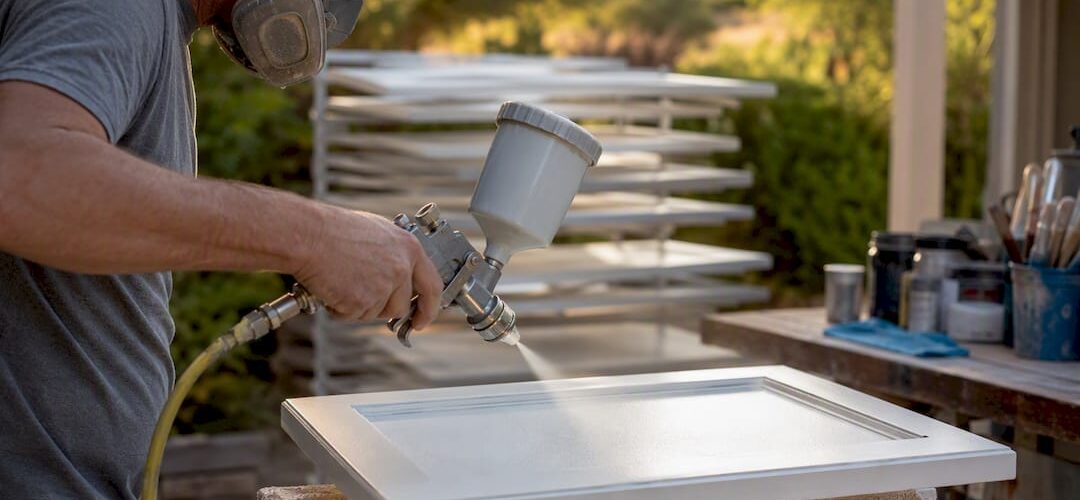
Professionals use commercial HVLP spray systems, shop spray booths or door-drying racks, catalyzed 2K polyurethane coatings, and HEPA dust extraction with sealed containment to produce a durable, factory-quality cabinet finish. That combination is what separates a sprayed finish that looks store-bought from one that shows brush marks or chips within a year. Consumer sprayers and brush-and-roll methods simply can’t match the atomization control, film build, and cure chemistry that commercial-grade tools deliver.
Here’s the core toolkit a legitimate professional cabinet refinisher relies on:
- HVLP turbine or compressor-driven spray guns for controlled, even atomization on doors and frames
- A shop spray booth or dedicated drying rack system for consistent coating and curing away from job-site dust
- A 2K (two-component) catalyzed polyurethane topcoat, applied in multiple coats with sanding between each
The sections below walk through each piece of equipment, the coatings behind it, and the questions worth asking before you sign a contract.
Key Takeaways
A factory-quality cabinet finish depends on commercial HVLP spraying, catalyzed 2K polyurethane, HEPA-controlled prep, and a shop-cured drying process working together, not any single tool.
| Point | Details |
|---|---|
| Equipment matters, but process matters more | HVLP guns and spray booths only produce factory results when paired with HEPA prep and intercoat sanding. |
| 2K coatings outperform 1K paints | Catalyzed polyurethane cross-links as it cures, giving cabinets more hardness and chemical resistance. |
| Shop-sprayed doors cure better | Controlled shop temperature and airflow produce a more even finish than any job-site environment can. |
| Ask for proof before hiring | Request a product TDS, sample door, and written warranty to confirm a contractor’s claims. |
| Cabinetsrefinishing runs the full protocol | Shop door spraying, HEPA prep, and 2K topcoats typically complete in 3 to 5 days for $3,000 to $8,000. |
Table of Contents
- What Spray Equipment Do Professional Cabinet Refinishers Use?
- What Coatings Do Pros Actually Spray on Cabinets?
- How Do Pros Control Dust Before Spraying Cabinets?
- Why Do Pros Spray Doors in the Shop but Finish Frames On-Site?
- What Does the Full Spray Process Look Like Step by Step?
- What Should You Ask a Cabinet Sprayer Before Hiring Them?
- Why Equipment Alone Doesn’t Guarantee a Factory Finish
- Get a Factory Finish Without the Replacement Price Tag
- Frequently Asked Questions
- Sources
What Spray Equipment Do Professional Cabinet Refinishers Use?
Professional HVLP (high volume, low pressure) spray guns are the backbone of commercial cabinet finishing. Unlike the handheld sprayers sold at home improvement stores, professional HVLP rigs let a technician dial in fluid needle size, air pressure, and fan pattern to match the coating’s viscosity, producing a finer, more even mist with less overspray. That control is what keeps a cabinet door free of orange peel texture or drips along the edges.
Many refinishing shops also use a dedicated spray booth: a pressurized, filtered space that balances incoming and outgoing airflow so dust and fumes don’t settle into wet finish. Booths typically run dual-stage filtration, trapping overspray before it recirculates and keeping the coating consistent from the first door to the last.
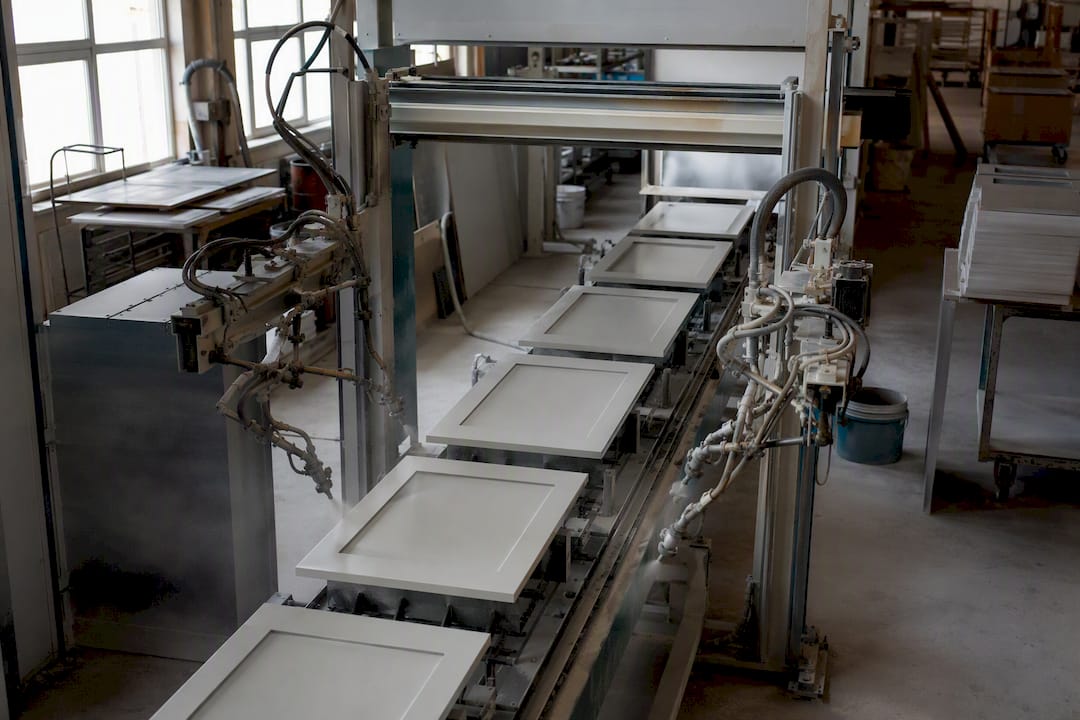
Shops that process a high volume of doors sometimes step up to automated equipment. Twin-arm reciprocating spray lines and hybrid flat-line machines move flat cabinet parts through a pressurized, multi-stage-filtered cabin on a conveyor, applying uniform coverage without a human operator adjusting the gun on every pass. That’s not standard for every contractor, but it’s common among larger finishing operations built around throughput.
Pro Tip: Ask whether your contractor’s booth or spray area uses replaceable intake and exhaust filters. Clogged filters change airflow balance, and that alone can cause uneven sheen across a batch of doors.
What Coatings Do Pros Actually Spray on Cabinets?
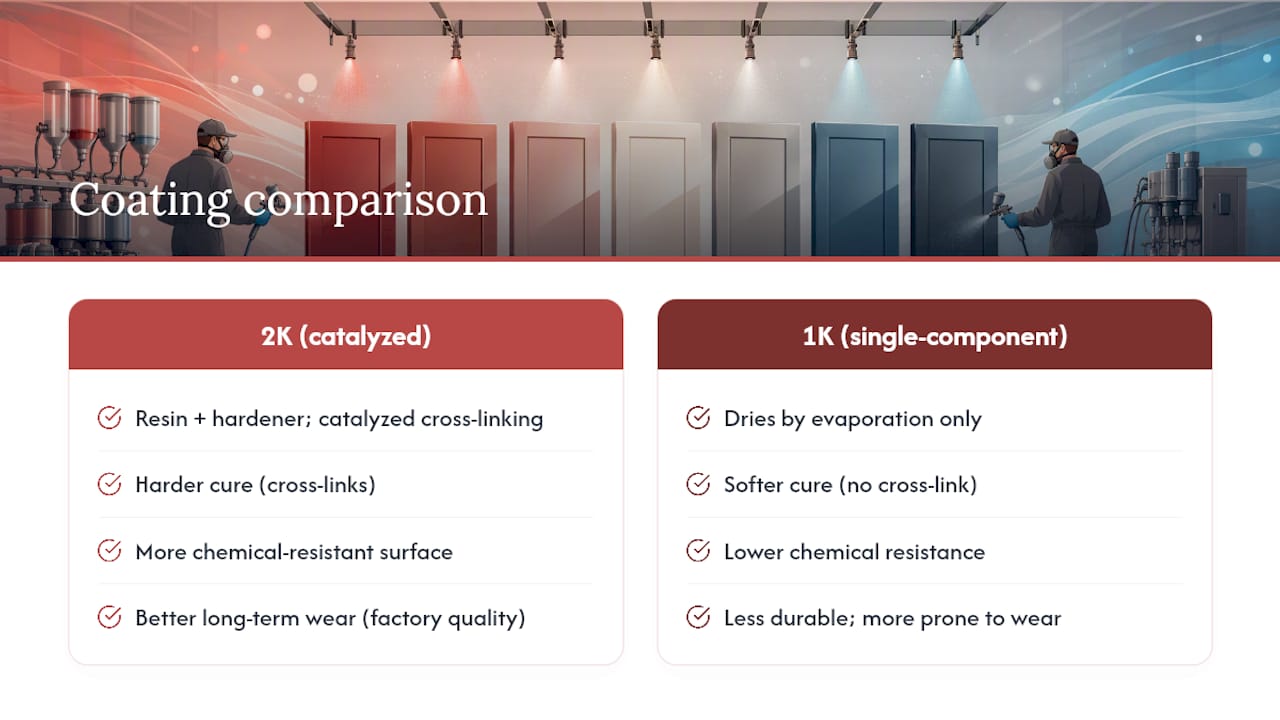
Most factory-quality results come down to one material choice: a catalyzed two-component system. Professionals commonly spray Italian-style 2K catalyzed polyurethane, mixing a resin with a hardener right before application. That chemical reaction cross-links the finish as it cures, producing a harder, more chemical-resistant surface than a single-component (1K) paint that only dries by evaporation.
A bonding primer typically goes down first, sometimes with a grain filler on open-pore woods like oak, so the topcoat doesn’t telegraph the wood’s texture. Shop-grade protocols call for calibrated HVLP tuning and wet-film thickness checks at each stage to keep coverage inside the coating manufacturer’s specification.
Most kitchens land on a satin or semi-gloss sheen, since matte finishes show fingerprints and grease faster near stove and sink areas, while high gloss magnifies any surface imperfection.
Before you hire anyone, request the exact product name and its technical data sheet. A legitimate 2K contractor should be able to hand that document over without hesitation, and it will confirm cure time, recommended film thickness, and safety handling. You can compare notes against what professional cabinet painters actually use to see if the quoted product lines up with factory-finish standards, and a partner guide to refinishing durability breaks down how coating choice affects long-term wear.
How Do Pros Control Dust Before Spraying Cabinets?
Surface prep decides whether a coating bonds for years or peels within months, and dust control is half of that battle. Professional shops connect their sanders to HEPA-rated vacuum extraction, pulling old finish, sawdust, and deglossing residue away from the surface instead of letting it settle back into the wood grain.
A typical sanding progression looks like this:
- Coarse pass (roughly 220 grit) to strip old finish and scuff the substrate
- Medium pass (roughly 320 grit) between primer coats to knock down raised grain and dust nibs
- Fine pass (roughly 400 grit) before the final topcoat for a glass-smooth surface
For work done inside an occupied home, contractors set up sealed, negative-pressure containment, essentially isolating the kitchen from the rest of the house so sanding dust and spray mist stay contained. That protects the client’s furniture and air quality while the crew works. Certain substrates, like knotty pine or older wood with tannin bleed, also need a stain-blocking primer coat to keep discoloration from bleeding through the new finish. If you’re curious about the mechanics behind grit selection, this sanding guide walks through why each pass matters.
Why Do Pros Spray Doors in the Shop but Finish Frames On-Site?
Most professional refinishing jobs split the work between two locations, and that split is deliberate. Doors and drawer fronts come off the cabinet, get labeled by location, and travel to the shop where they hang on dedicated drying racks and modular spray stands. That setup lets a technician coat both faces and all four edges without touching a wet surface, and the shop’s controlled temperature and airflow produce a more even cure than any job site can offer.
Cabinet frames, by contrast, stay bolted to the wall. Crews finish those on-site using portable HVLP rigs inside sealed containment, which limits some flexibility on cure timing since the room can’t be climate-controlled the way a shop can.
Running both tracks in parallel is what keeps the schedule tight:
- Doors cure in the shop while frames get prepped and primed at the house
- Both come together for the final coat and reinstall
- A well-run job typically wraps in a few days, not the weeks a full cabinet replacement demands
What Does the Full Spray Process Look Like Step by Step?
A factory-quality sprayed finish follows a predictable sequence, and skipping a step is usually where quality problems start.
- Removal and labeling. Doors, drawer fronts, and hardware come off and get tagged for reinstall.
- Prep and repair. Crews fill dents, degrease surfaces, and HEPA-sand everything to bare, sound substrate.
- Primer coats. Two coats of bonding primer typically go down, with a sanding pass between them.
- Topcoats. Two to three coats of 2K catalyzed polyurethane follow, sanded lightly between coats for adhesion and smoothness.
- Controlled cure. Doors rest on shop racks in a stable environment, since catalyzed systems cure more reliably without temperature swings or humidity spikes.
- Reinstall and alignment. Hardware and doors go back on, adjusted for even gaps and smooth operation.
What Should You Ask a Cabinet Sprayer Before Hiring Them?
A short set of direct questions during your estimate will tell you fast whether a contractor actually works this way or is describing a brush-and-roll job with better marketing.
Ask them directly: Do you spray a catalyzed 2K system, and can I see the product’s TDS? Do you use HEPA extraction and sealed containment while sanding? Are doors sprayed in a shop or in my kitchen? Will you provide a written warranty and a sample door to check the sheen and color before the full job starts?
Request proof, not just answers:
- Photos of their shop, spray booth, or drying racks in actual use
- A finished sample door you can inspect in person
- Proof of insurance, licensing, and a written scope of work
Pro Tip: If a contractor gets vague about what coating they use or can’t produce a TDS on request, that’s usually a sign they’re relying on hardware-store paint rather than a true catalyzed system.
Watch for red flags: a contractor who claims “factory finish” but only owns a brush and a handheld sprayer, no written warranty offered, or reluctance to remove doors for shop spraying when the project clearly calls for it. You can review common spraying techniques pros use to sharpen your sense of what a real answer sounds like.
Why Equipment Alone Doesn’t Guarantee a Factory Finish
Owning an HVLP gun and a bucket of 2K polyurethane doesn’t make someone a professional cabinet sprayer. It’s the discipline behind the equipment, the HEPA-sanded prep, the shop-controlled cure, the sanding between every single coat, that turns commercial-grade tools into a finish that survives a decade of kitchen use. Cabinetsrefinishing built its process around exactly that discipline: doors sprayed in a controlled shop environment, frames finished under sealed containment on-site, and a multi-coat catalyzed system applied with the same equipment described throughout this article. Projects typically run several days from removal to reinstall, with costs generally landing within a range that is a fraction of the cost of a full cabinet replacement. That gap between equipment ownership and actual craftsmanship is exactly what a homeowner needs to probe before signing anything.
Get a Factory Finish Without the Replacement Price Tag
You now know what separates a real professional cabinet spray job from a weekend paint project: commercial HVLP equipment, catalyzed 2K coatings, HEPA-controlled prep, and a shop/field workflow that keeps the cure environment consistent. Cabinetsrefinishing runs that exact process on every Denver-area job, spraying doors in a controlled shop setting while crews finish frames on-site under sealed containment, and most projects wrap in 3 to 5 days at a fraction of full cabinet replacement cost.
If your cabinets are structurally sound but look tired, refinishing is usually the smarter move over ripping everything out. Request an on-site estimate for cabinet refinishing in Denver and get a firm price and timeline based on the same equipment and coatings covered above.
Frequently Asked Questions
What is the difference between HVLP and airless spraying for cabinets?
HVLP atomizes finish with a high volume of low-pressure air, giving finer control and less overspray, which is why most cabinet professionals prefer it over airless rigs built for large flat walls.
Do professionals always spray cabinets in a shop?
Not always. Doors and drawer fronts commonly go to the shop for spraying and curing on drying racks, while frames usually stay on-site and get finished inside sealed containment.
Why do pros use 2K polyurethane instead of regular paint?
A catalyzed 2K system cross-links chemically as it cures, producing a harder and more chemical-resistant surface than a one-component paint that only air-dries.
How long does a professionally sprayed cabinet job take?
Most jobs using shop and field workflows together finish in 3 to 5 days, since doors cure in the shop while frames get prepped and primed at the house in parallel.
What should I ask a contractor to prove they use professional equipment?
Request the coating’s technical data sheet, ask whether they use HEPA extraction and sealed containment, and ask to see a finished sample door before committing to the full project.
Sources
- What Is 2K Polyurethane Cabinet Finish? | Italian Two-Component Catalyzed Coating
- The PaintLine | #1 Cabinet Door Painting & Drying Racks
- Hybrid flat line spray machine for kitchen cabinet finishing automation
Recommended
- What Paint Do Professional Cabinet Painters Use for a Factory Finish?
- Types of Cabinet Spraying Techniques for a Pro Finish – Cabinet Refinishing and Cabinet Painting Denver 720-219-9716
- Professional Cabinet Spray Painting in Colorado Springs: Factory-Like Finishes for 2026
- On-Site Cabinet Spray Painting Denver: The Professional Guide to a Factory Finish [2026]