Denver kitchens get more daylight than most, and that light is unforgiving. It shows every dull stain, every worn edge and every cheap paint job. It also makes a good two-color scheme look expensive.
We’ve sprayed cabinets in this city since 1979, so we know which pairings hold up in that light and which ones look flat by noon. Here is one kitchen worked through from first color sample to final coat, then what it costs against a replacement quote.
Two-Tone Kitchen Cabinets for a Denver Home, Start to Finish
Here is a typical case we see often, not a specific past client. The house is older, and the kitchen has solid oak doors with a honey stain worn pale around the handles and dark near the stove. The owners like their layout and the quality of the boxes. They just want lighter uppers, with a deeper color on the base cabinets and island.
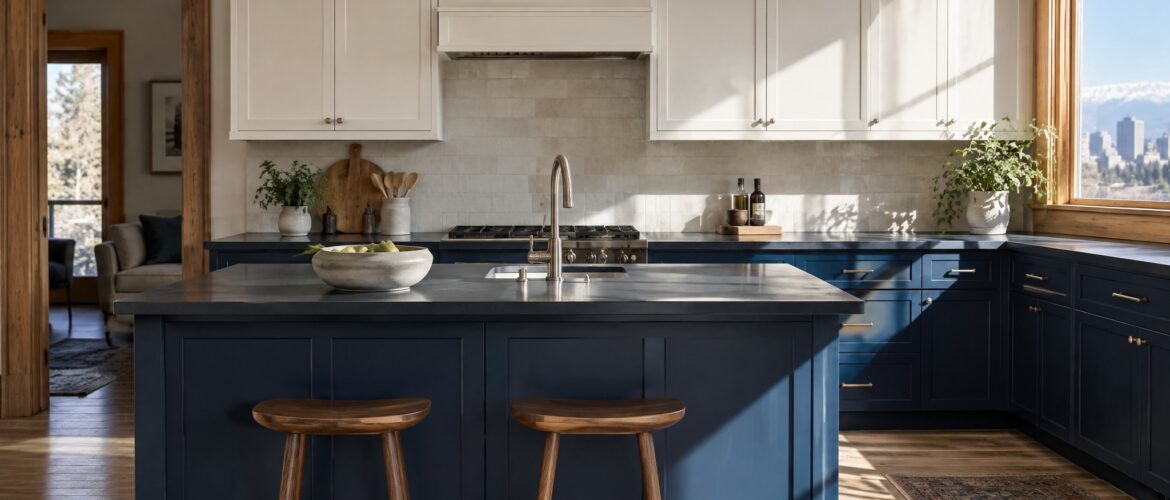
Our default for that kitchen is warm white uppers over deep navy base cabinets and island.
Colorado’s high-altitude daylight is strong and clear, with less haze than at sea level. That works in favor of both colors. Navy reads as a rich, saturated blue instead of sliding to black, and a warm white stays soft instead of turning stark and clinical. The white bounces light around the room, while the navy anchors the island and gives the eye somewhere to land.
Don’t pick either color from a chip or a screen. Have us spray both as painted samples on the actual doors, then look at them in the morning and again in the evening. East-facing windows throw cool, bright light early, and the same navy can look warmer once the sun drops. Oak also takes color differently than a flat sample card does, so you want to judge the real surface.
How we build two colors on existing cabinets
Two colors on one set of cabinets take more steps than one, and the order matters. This is the sequence we follow on a kitchen like this:
- Prep and repair. We remove doors and hardware, degrease everything, fix dings and old hinge holes, and scuff the surfaces so the primer has something to grip.
- Grain-fill the oak. Oak has open pores that telegraph through paint as a rough, ridged texture. We work a grain filler, a paste that packs those pores level, into every oak surface, then sand it smooth. Our page on oak cabinet refinishing and grain filling covers this step in more depth.
- Precat primer on every door. Precat is short for pre-catalyzed: the hardener is already mixed in, so the primer bonds hard to the wood and sands to a smooth, even base.
- Spray the uppers first. We use HVLP equipment, which stands for high volume, low pressure. It atomizes the finish with a lot of air at gentle pressure, so it lays down evenly with little overspray and no brush or roller texture.
- Mask the finished uppers at the color break. Once the warm white is cured enough to handle, we tape and paper it off along the line where the two colors meet.
- Spray the base cabinets and island in navy. Same equipment, same technique, now on the darker color.
- Finish each color in crosslinking urethane lacquer. As it cures, its molecules link together into a hard, tight film. That film is what stands up to pots, cleaners and years of door slams.
The color break is where a cheaper job gives itself away. A brushed or rolled edge leaves ridges and tiny bleed marks along the line, and you see them every time you stand at the sink. Masked spray gives a crisp, flat edge because there’s no tool dragging along the boundary. If you want the longer argument, we wrote up HVLP spray versus brushed paint separately.
Spray refinishing changes color and finish, not construction. It won’t fix a sagging box or move a wall, so if your cabinets are structurally failing, replacement is the honest answer. For a sound kitchen with a tired finish, two-tone cabinet painting in Denver gets you the high-end look without tearing anything out.
Two-Tone Cabinet Painting Cost Versus New Cabinets
A two-tone job costs more than a single-color job on the same cabinets, and the reasons are simple. Two colors mean two separate color passes, masking between them, and extra drying time so the first color is hard enough to tape against. That is real shop labor, not a markup for a trendy look.
Ask for the two-tone as its own line on the quote. That way you can see what the second color adds, and you can compare quotes from other shops honestly.
What moves the price is mostly counting. The number of doors and drawer fronts in each color matters, because each one gets sprayed, dried and finished. How the island is handled matters too: a single deep color across the whole island is simpler than a color on the base and a different one on the end panels. Our 2026 per-door refinishing rates give you the arithmetic, so you can work your own door count by color before anyone visits.
Now the comparison that brings most people to us. Replacing a kitchen like this one with new cabinets typically runs $25,000 or more. On a typical job, we save homeowners about 70% against that. That is our own figure from the work we do, described as typical, not a guarantee. Your number depends on your door count, the condition of the boxes and the colors you choose.
For the full side-by-side, read refinishing versus full replacement.
Two-Tone Cabinet Ideas: Popular Color Combinations for 2026
Among popular cabinet color combinations for 2026, most of the interest in Denver sits with a light upper and a deeper base, and that fits the modern and transitional looks many local remodels are aiming for. Navy and warm white is one answer, not the only one. These are the other two-tone cabinet colors we’d put in front of you.
Cream or soft white uppers over muted sage lowers. Sage is gentle against cream, so the contrast stays low. That suits a bright room with big windows, where a heavy contrast would feel busy.
Crisp white uppers over charcoal base cabinets and island. This reads the most contemporary of the three. It also shows surface flaws under strong light, because a bright white next to a near-black exposes every ripple and dust nib. If you pick this one, spray quality matters more than it does anywhere else, and it’s where a brushed finish fails first.
Darker uppers over light lowers. This reverse is less common. Dark color at eye level can feel heavy and close in a room, especially a small one, so test it on a few doors before you commit.
Whichever you choose, let the split follow your room’s light and layout more than the trend. A color that photographs well in a showroom can still sit wrong in your kitchen if the window wall faces the wrong way.
Will a Refinished Two-Tone Kitchen Hold Up in Denver’s Dry Air?
Yes, when the finish system is right. Dry air pulls moisture out of wood and finishes alike, so a cheap coat of brushed paint can crack or peel at the edges. Our system is built against that. The hardness comes from the crosslinking urethane lacquer, and the bond comes from the precat primer underneath it. We also back the work with a 3-year warranty.
No finish never wears. Handles, the area around the sink and the edges of the drawers you use most will age first, in any kitchen, whoever sprayed it. What you’re buying is a finish that wears slowly and evenly, instead of one that fails in patches.
If you’re deciding now, two facts should help. Our turnaround is 2-5 days, so your kitchen isn’t torn apart for weeks while you wait on a crew or a custom order. And we’re licensed and insured, which matters when someone is working in your home and spraying inside it.
Your next step is quick. Gather photos of your current doors and drawer fronts, the two colors you’re weighing, and a rough count of cabinets in each color. Then request a two-tone quote through our contact page and send it all over.
Frequently asked questions
Why does two-tone cost more than painting all the cabinets one color?
A second color means a second spray pass, masking between the colors, and extra drying time before we can tape against the first one. The price follows the number of doors and drawer fronts in each color and how the island is handled. Ask for the two-tone as its own line on the quote so you can see exactly what it adds.
Which cabinets usually get the second color?
Most often the uppers go light and the base cabinets and island go deep, such as warm white over navy. A reverse split with darker uppers is possible, but it can feel heavy at eye level, so test it on a few doors first. The split should follow your room’s light and layout more than the trend.
Is the 70% saving guaranteed?
No. About 70% against a replacement job of $25,000 or more is our own typical figure, not a promise on any one kitchen. Your result depends on your door count, the condition of the boxes and the colors you pick.
Can you do two-tone over oak cabinets with a visible grain?
Yes. We grain-fill the oak first so the pores don’t show through the finish, then prime with precat primer and spray each color. Grain filling matters most under a light upper color, where texture would otherwise stand out.
How long is my kitchen out of use?
Our turnaround is 2-5 days. Two colors take more drying time than one, so the quote and schedule should account for that. Send photos and your cabinet counts through the contact page and we’ll go over timing with you.