
A door that sags, rubs its neighbor, or sits a quarter inch proud of the frame looks worse once you put a fresh finish on it. New lacquer makes the flaw easier to see. That is why cabinet door repair and adjustment in Denver is built into how we scope every refinishing job, not sold as a separate visit.
We have sprayed kitchen cabinets since 1979. We use HVLP (high-volume, low-pressure) spray equipment, a precat primer, and a crosslinking urethane lacquer, which is a factory-style finish that cures chemically into a hard film. We do not brush or roll. The doors come off the boxes for that process anyway, so this is the cheapest moment to fix how they hang.
Cabinet Door Repair and Adjustment Before the Finish Goes On
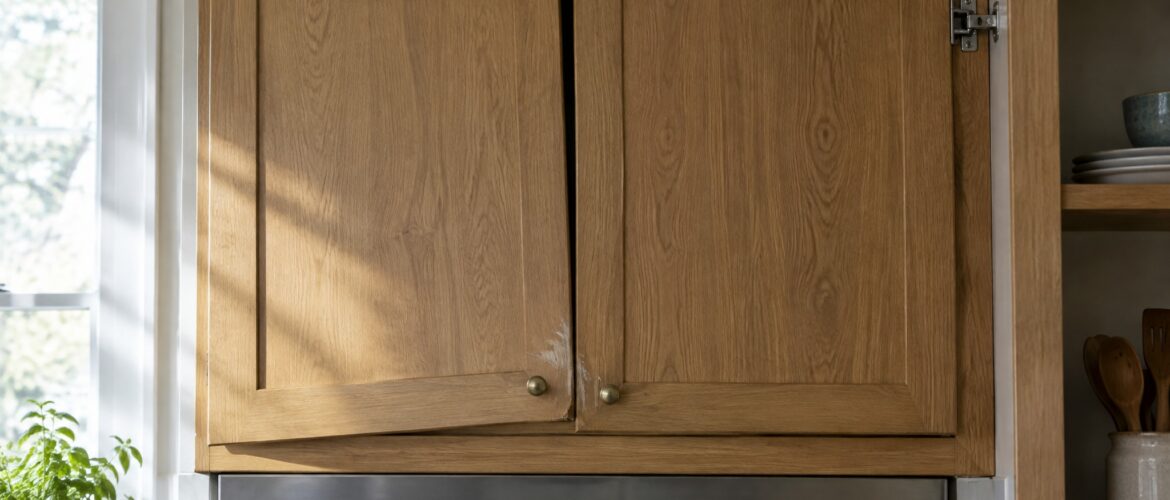
Take a double-door upper over the range in a typical Denver kitchen. The left door has dropped, so its free bottom corner touches the right door and scuffs the paint at the same spot every time it closes. The gaps between the doors and the frame, called reveals, run wide at the top and tight at the bottom. Sight along the edge of the solid-wood right door and you see a slight bow.
If you recognize your own kitchen in that picture, here is the point to hold onto. A new finish cannot move a door. Spray over a door that rubs and the rub comes back at the same point, now cutting through fresh lacquer instead of old paint.
Sagging Cabinet Door Fix Starts With Hinge Adjustment
On a door like that left one, we look at the hinge before anything else, and there are three likely causes.
The first, and a frequent one, is a failed fastening. Screws spin in the hole or pull out of particleboard, or the hinge plate has worked loose in the box side. Tightening a screw that has no grip does nothing for long. We fill the hole or re-drill it, then re-seat the hinge so the screw bites solid material.
The second is a hinge that is set too low or leaning. Most concealed hinges (the kind hidden inside the box when the door is shut) have adjustment screws for exactly this. A cabinet hinge adjustment often resolves a sag without replacing the door or the hinge, which is the cheapest outcome and the one we look for first.
The third is a box that is racked or has pulled away from its wall mounting. Hinge work will not hold on a box that is moving. We tell you when that is the case instead of hiding it under paint, because a refinished door on a loose box will sag again.
Here is the order we work in on that range-side upper:
- We take both doors off and label them by position, so each one goes back where it came from.
- We check every fastening and screw hole, and repair the ones that have lost their grip.
- We sight the bowed door and decide whether the bow is small enough to live with after hinge work or needs a rebuild or replacement.
- We prep the doors and prime them with precat primer, a primer with its catalyst already mixed in so it cures harder than a basic latex primer.
- We spray the crosslinking urethane lacquer through HVLP equipment. If you want to see why that matters, here is how HVLP spray versus brush paint compare on the door itself.
- We reinstall and set each hinge on three axes: side-to-side, in-and-out, and up-and-down.
We keep adjusting until the gaps match on both doors, top to bottom.
That last step is why fit work belongs inside the refinishing job. The doors are already off, so the hinges, screws, and gaps are in plain sight and easy to correct before a drop of primer goes on. At reinstall we fine-tune against the finished surface, since lacquer adds a small film thickness and the final reveals are set against the real door, not the bare one.
Bundling does not add a second trip. A separate repair visit means someone comes out, adjusts hinges on doors that are about to be sprayed, and then a paint crew takes the doors off again and puts them back. Doing both in one pass means fit problems are fixed once, inside the job.
Colorado’s dry air gives you another reason to check fit during the job. It pulls moisture out of wood, so joints and hinge fastenings can loosen over time. A sealed finish slows that movement, but it cannot stop it.
Warped Cabinet Door Repair: What Adjustment Can and Cannot Correct
Sag and misalignment come from how a door hangs, and hinge work corrects them. A warp is different, because the board itself bows or cups. Adjustment can improve how a warped door sits, but it cannot flatten it.
Colorado’s dry air is a common cause. Solid wood gives up moisture here, and a wide panel that loses it unevenly will bow.
You can run a quick test at home. Sight down the edge of the door, rehang it, and adjust the hinges so the door is as square as it will go. Then check whether the gap evens out.
If the gap evens out, fit work is enough, and the door goes back to work after refinishing. If the door still binds at the same spot, the board is the problem, and it likely needs a rebuild or replacement.
We say which one it is on the estimate, before any work starts. We also do not promise that a finish will flatten a warp, because lacquer follows the shape underneath it. This is not a way to straighten a badly cupped door, and a door in that condition is better replaced than sprayed.
Cabinet Alignment Service in Denver: What a Bundled Quote Covers
One estimate covers the door fit and hinge work, the spray finish, and the reinstall. You get a single scope and a single price, not a repair visit followed by a separate paint job. The difference is sequence and scope: the fit is fixed before the spray, so the finish goes onto doors that already close the way they should.
The numbers we see on typical jobs look like this:
- Savings of about 70% against a $25,000+ full replacement job.
- A 2-5 day turnaround.
- A licensed and insured shop, with a 3-year warranty backing the work.
Those are our typical figures, not guarantees for every kitchen, and your doors, boxes, and hinges set the actual scope. If you are weighing the replacement quote in your hand, our breakdown of refinishing versus replacement shows the full comparison. To price only the doors that need work, see per-door refinishing pricing in Denver.
You can also check us the way you would check anyone. Here is how to vet a Denver refinishing contractor, including what a warranty should actually cover.
Tell us which doors sag, rub, or look warped, and request a quote on your doors. We will scope the fit work and the finish together, flag any door that needs a rebuild or replacement up front, and put the 3-year warranty and 2-5 day turnaround in writing against your actual kitchen.
Frequently asked questions
Can a sagging cabinet door be fixed without replacing it?
Usually, yes. Most sags trace back to loose or stripped screws or a hinge that is set low, and a repaired screw hole or a hinge adjustment often fixes them. The exception is a box that has pulled away from the wall or racked out of square, which needs attention before the door will hold.
Will refinishing hide a door that rubs or hangs crooked?
No. A new finish cannot move or reposition a door, so a rub shows up again at the same point on the new coat. We correct the fit before priming and spraying, then fine-tune the hinges at reinstall.
Can you straighten a warped cabinet door?
Fit work can improve how a bowed door sits, but hinge adjustment cannot fully flatten the board. If the door still binds at the same spot after rehanging, it likely needs a rebuild or replacement. The estimate says which before work starts.
Does Colorado’s dry air loosen cabinet hinges?
It can. Dry air draws moisture out of wood, so joints and hinge fastenings may loosen over time. A sealed finish slows that movement but cannot stop it, which is why we check fit during the job.
How long does the work take and what does it save?
Our typical turnaround is 2-5 days, and homeowners typically save about 70% against a $25,000+ replacement job. The shop is licensed and insured, and the work carries a 3-year warranty.