
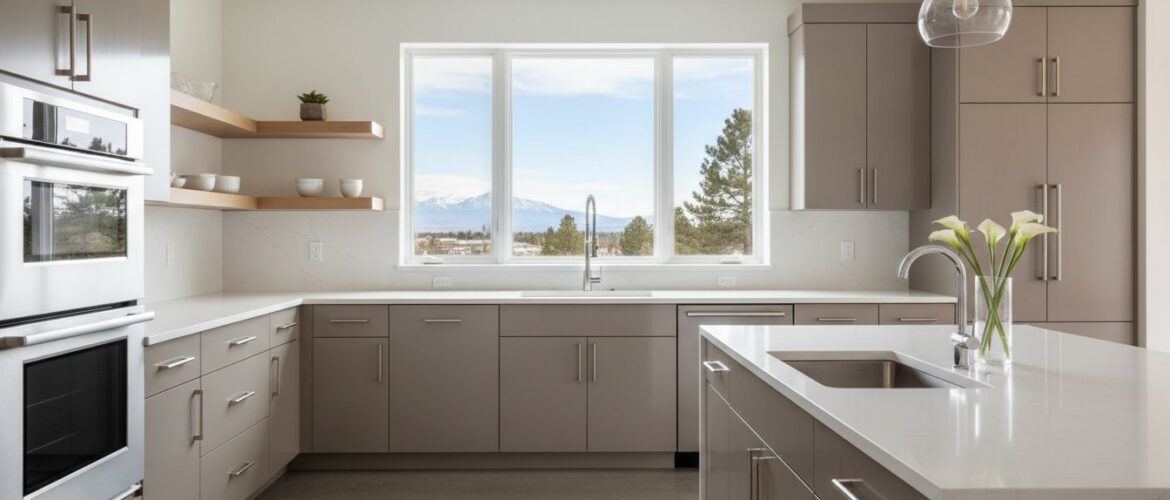
There’s nothing more frustrating than investing your time and effort into painting your kitchen cabinets, only to step back and see a surface plagued by streaks, drips, and amateur brush marks. That flawed finish can make even the most expensive cabinets look cheap and ruin the entire project. Many homeowners fear this exact outcome, but achieving a professional result is not out of reach. The secret to that glass-smooth, durable surface you want lies in mastering the correct techniques for avoiding brush marks when painting cabinets-a skill that separates the pros from the novices.
Cabinet Refinishing Service Areas in Denver & Surrounding Cities
Professional Cabinet Painting Throughout the Denver Metro Area & Northern Colorado
Cabinet Painting in Denver County, CO
We proudly offer cabinet painting and refinishing in Denver, including
Downtown Denver, Cherry Creek, Washington Park,
Capitol Hill, Highlands, Sloan’s Lake,
Lowry, and Central Park (Stapleton).
Cabinet Painting in Jefferson County, CO
Serving Lakewood, CO, Littleton, CO, Golden, CO,
Arvada, CO, Wheat Ridge, CO, Evergreen, CO,
and Morrison, CO.
Cabinet Painting in Arapahoe County, CO
Including Centennial, CO, Greenwood Village, CO,
Cherry Hills Village, CO, Englewood, CO,
and Aurora, CO.
Cabinet Painting in Adams County & Broomfield, CO
Serving Thornton, CO, Westminster, CO,
Northglenn, CO, Commerce City, CO,
Brighton, CO, and Broomfield, CO.
Cabinet Painting in Boulder County & Northern Colorado
Including Superior, CO, Louisville, CO,
Lafayette, CO, Erie, CO, Firestone, CO,
Frederick, CO, Longmont, CO, Loveland, CO,
and surrounding Northern Colorado communities.
We also service cabinet painting and refinishing projects throughout the entire state of Colorado.
In this definitive guide, we’ll show you exactly how to get that flawless, factory-like finish. We are sharing the vital prep work, professional-grade tools, and proven application methods that guarantee a beautiful, long-lasting result. Forget the stress and uncertainty. By following these expert steps, you will gain the confidence to transform your kitchen, save thousands of dollars, and achieve a stunning finish you’ll be proud to show off for years to come.
Key Takeaways
- Proper prep is your first defense; controlling your paint’s viscosity and the room’s environment is the foundation for a smooth finish.
- Your choice of materials is non-negotiable. Learn why professional-grade cabinet enamel is essential for a self-leveling, durable result that house paint cannot match.
- The secret to avoiding brush marks when painting cabinets lies in a methodical application technique used by pros to maintain a wet edge.
- A flawless finish can be ruined without proper patience. Understand the critical difference between "dry to the touch" and "fully cured" to ensure long-term durability.
The Foundation: Why Brush Marks Happen and How to Prep for a Flawless Finish
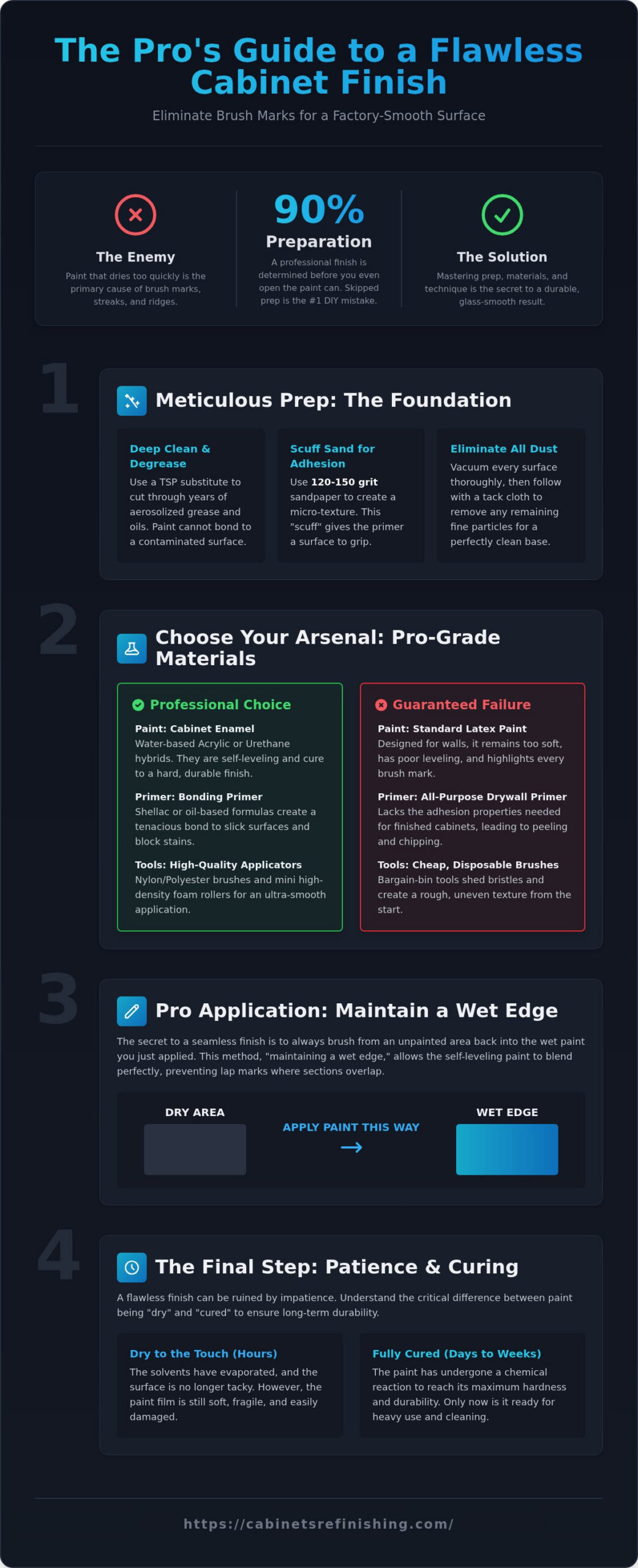
The difference between a professional, factory-like finish and an amateur paint job comes down to one thing: brush marks. These frustrating ridges are not a sign of poor brushing technique, but of paint drying too quickly before it has time to settle and level out. Factors like high temperatures, low humidity, and even a slight breeze can ruin your work. At Cabinet refinishing Denver, we know that achieving a flawless finish is 90% preparation. Skipping these vital prep steps is the single most common and costly mistake in any DIY project, and it’s the primary obstacle to successfully avoiding brush marks when painting cabinets.
To see these foundational principles in action, watch this short video from a fellow craftsman:
Understanding the Science of Paint Leveling
Professional-grade cabinet paints are designed to be self-leveling. This means the paint has a longer "open time," allowing it to flow and smooth out naturally, eliminating brush strokes. We often use industrial-strength conditioners or extenders to reduce viscosity and slow the drying process even further. Understanding the science behind various paint application techniques is key. A cool, slightly humid environment helps this process, while heat and wind are the enemies of a smooth finish.
Step 1: Meticulous Cleaning and Degreasing
Your kitchen cabinets are coated in years of aerosolized grease, cooking oils, and cleaning residues. Paint simply cannot adhere to a greasy or contaminated surface. This is a non-negotiable first step. We use an industrial-strength TSP (Trisodium Phosphate) substitute to cut through the grime and ensure the surface is perfectly clean. Without this deep cleaning, your new paint job is guaranteed to fail, leading to peeling and chipping down the road.
Step 2: Sanding for Adhesion, Not Removal
The goal of sanding is not to strip the old finish, but to "scuff" it. This process, known as scuff sanding, uses 120-150 grit sandpaper to create a microscopic texture on the surface. This texture gives the new primer something to bite into, creating a powerful mechanical bond. After sanding, it is absolutely vital to remove every particle of dust with a vacuum, followed by a wipe-down with a tack cloth for a perfectly clean base.
Choosing Your Arsenal: The Best Paint, Primers, and Tools for Cabinets
Your technique can be perfect, but without the right materials, you will never achieve a factory-like finish. The secret to avoiding brush marks when painting cabinets starts with selecting professional-grade products. This is not the place to cut corners. Cheap house paint and bargain-bin tools are a guarantee for a failed project, resulting in a soft, tacky finish that shows every single stroke and imperfection. Investing in the right arsenal is a vital factor for durability and a flawless, glass-smooth surface.
Selecting the Right Paint: Cabinet Enamels vs. Latex Paint
Standard latex wall paint is designed for drywall, not high-traffic surfaces like cabinets. It remains too soft, cures slowly, and has poor leveling qualities, making brush marks more prominent. For a durable, hard-wearing finish, you must use a cabinet enamel. We recommend high-quality water-based acrylic or urethane-alkyd hybrid enamels. Products like Benjamin Moore ADVANCE or Sherwin-Williams Emerald Urethane Trim Enamel are engineered to self-level, which smooths out brush strokes as the paint dries, and cure to a hard, furniture-grade finish that resists chipping and wear.
The Unsung Hero: High-Adhesion Bonding Primer
Primer is the non-negotiable foundation for your paint job. Its purpose is twofold: it blocks stains from bleeding through your new paint, and more importantly, it creates a tenacious bond to slick, previously finished cabinet surfaces. Trusted guides on how to paint kitchen cabinets always emphasize this step for a reason. For maximum adhesion, use a shellac-based or oil-based bonding primer. After the primer is fully dry, lightly sand it with 220-grit sandpaper to knock down any texture, creating an ultra-smooth base for your topcoat.
Brushes and Rollers Designed for a Glass-Like Finish
The right applicators are critical for avoiding brush marks when painting cabinets. Using the correct combination of tools allows you to work efficiently while minimizing texture. Your toolkit should include:
- A High-Quality Brush: Use a 2- to 2.5-inch angled brush with soft, fine nylon/polyester bristles. This is for cutting in corners and painting detailed areas where a roller can’t reach.
- A High-Density Mini Roller: For all flat surfaces like door panels and cabinet frames, use a 4- or 6-inch high-density foam or mohair mini roller. This applies a thin, even coat of paint with virtually no texture, which is impossible to achieve with a brush alone.
Professional Application Techniques for a Brush-Free Finish
Proper preparation and high-quality materials set the stage, but your application technique is what delivers a flawless, factory-like finish. The difference between an amateur and a professional result lies in the physical act of painting. These are the methodical, results-oriented techniques our experts use for avoiding brush marks when painting cabinets and guaranteeing a smooth, durable surface that transforms your kitchen.
Mastering the ‘Wet Edge’ to Avoid Lap Marks
A ‘wet edge’ is the foundation of a seamless paint job. It simply means keeping the edge of the area you are painting wet, so you can blend the next section into it without creating visible seams or lap marks. Always work from an unpainted area into your fresh, wet paint. To maintain control, paint in small, manageable sections, such as one rail or one stile at a time, completing each section before moving on. This prevents the paint from drying too quickly and ensures a uniform appearance.
The ‘Roll and Tip’ Combination Method
For cabinet doors and frames, the ‘roll and tip’ method is a vital technique that mimics a spray finish without the need for expensive equipment. It’s a two-step process that combines the speed of a roller with the smoothness of a brush. The process is direct and effective:
- Step 1: Roll. Use a high-density foam mini-roller to apply a thin, even coat of paint to a section of the cabinet. The roller distributes the paint quickly and uniformly.
- Step 2: Tip. Immediately, take a high-quality brush (like a soft nylon/polyester blend) and, holding it at a low angle, use extremely light pressure to gently drag the tip of the bristles across the rolled surface in a single, smooth stroke. This ‘tipping off’ action levels the roller texture, leaving a beautiful, flat surface.
Applying Thin Coats and Sanding In Between
Thick coats of paint are a primary cause of sags, drips, and visible texture. Professionals know that the key to durability and a smooth finish is applying 2-3 thin coats rather than one heavy one. Thin coats allow the paint’s self-leveling properties to work effectively. After each coat is fully cured (check the manufacturer’s instructions), lightly sand the entire surface with 220-grit sandpaper. This scuffs the surface just enough to remove minor imperfections and create a better bond for the next coat. While these methods are effective, achieving a true factory finish requires years of experience. For a guaranteed flawless result, contact the professionals at Painting Kitchen Cabinets Denver.
The Final Step: Curing, Patience, and When to Hire a Pro
You’ve done the hard work of prepping, priming, and painting. But the final, most overlooked stage is where many DIY projects fail: the curing process. Rushing this step can ruin your finish, reintroducing the very imperfections you worked so hard to prevent. Understanding the difference between a dry surface and a durable, fully cured finish is the key to a long-lasting result.
Creating the Ideal Drying Environment
Paint may feel dry to the touch in a few hours, but it is far from cured. Full curing is a chemical process where the paint hardens into a durable, scratch-resistant shell, and this takes time-often 2 to 4 weeks. To ensure a smooth finish, let your cabinet doors and drawers cure in a controlled space:
- Temperature: 60-75°F (15-24°C)
- Humidity: Low, ideally below 50%
- Environment: Dust-free and well-ventilated
Resist the urge to re-install them early. Handling, bumping, or stacking uncured doors is a guaranteed way to cause dents, chips, and smudges, forcing you to start over. Patience is a vital factor in a successful project.
The Professional Alternative: A True Factory Finish
Even with perfect technique and patience, a hand-brushed or rolled finish will never achieve the 100% flawless surface of a factory finish. The ultimate secret to avoiding brush marks when painting cabinets is to eliminate the brush entirely. Professionals use High Volume, Low Pressure (HVLP) sprayers in a controlled, dust-free spray booth. This equipment atomizes industrial-strength coatings, applying a perfectly even, self-leveling layer that is impossible to replicate by hand.
This method isn’t just about creating a smooth surface; it’s about creating a durable, glass-smooth finish that looks and feels brand new. For a guaranteed, durable result that transforms your kitchen without compromise, the professional alternative is the most reliable choice. For a guaranteed factory finish in Denver, request your free quote today.
Achieve a Flawless, Factory Finish on Your Cabinets
Achieving a professional, smooth finish on your cabinets comes down to a few vital factors. As we’ve covered, meticulous prep work is the foundation for success, followed by choosing industrial-strength paint and the right application tools. Mastering the proper techniques is the final piece of the puzzle for avoiding brush marks when painting cabinets and getting that sought-after, durable result.
The prep work and precision required can be demanding. If you want to guarantee a durable, factory-like finish without the hassle, trust the experts. With over 38 years of experience serving Denver, Boulder, Colorado Springs, and beyond, our team delivers flawless results every time. Tired of the prep work? Get a flawless, factory-like finish from our Denver experts. Request a free quote!
Whether you choose to DIY or hire our pros, you are now equipped with the knowledge to completely transform your kitchen.
Frequently Asked Questions About Painting Cabinets
Is it better to use a brush or a roller for painting cabinets?
For a true factory finish, a professional-grade sprayer is always the superior choice. However, if you are choosing between a brush and a roller, a combination is best. Use a high-quality angled brush for detailed areas like trim and corners. For flat surfaces like door panels and cabinet sides, use a high-density foam or microfiber roller. This method provides a much smoother result than using only a brush for the entire project.
What is the best paint to use on kitchen cabinets to avoid brush marks?
The best paint for a flawless finish is a self-leveling enamel. Products like Benjamin Moore ADVANCE or Sherwin-Williams Emerald Urethane Trim Enamel are specifically formulated to smooth out as they dry, which is the most vital factor for avoiding brush marks when painting cabinets. These industrial-strength coatings cure to a hard, durable finish that resists chipping and is easy to clean, ensuring your work lasts for years.
Do I really need to use a paint conditioner like Floetrol?
While not always necessary with high-end self-leveling paints, a conditioner like Floetrol is an excellent tool for DIY painters. It extends the paint’s "open time," giving it more time to level out before it begins to set. This simple step can dramatically reduce the appearance of brush strokes and roller marks, especially in warmer or less humid conditions. It is a cost-effective way to improve the quality of your final finish.
How many coats of paint should I put on kitchen cabinets?
A professional, long-lasting finish requires a systematic approach. You should always apply one full coat of a high-quality bonding primer to ensure proper adhesion. After the primer is fully cured, apply two thin, even coats of your topcoat paint. This process guarantees complete coverage, true color depth, and a durable surface that can withstand daily use. Skipping any of these essential steps will compromise the final result and its longevity.
Why do my cabinets feel sticky or tacky even after drying?
A tacky finish indicates that the paint has not fully cured. While paint may be dry to the touch in a few hours, the curing process-where it hardens to its maximum durability-can take up to 30 days. High humidity or applying coats too thickly can prolong this time. Using a low-quality latex paint can also cause persistent stickiness, as it may never cure to a hard, resilient finish required for cabinetry.
Can I paint over stained cabinets without sanding?
We do not recommend painting over stained cabinets without proper prep work. Sanding is a vital factor for a durable finish. The original varnish on stained cabinets creates a slick surface that prevents new paint from adhering properly. A light scuff-sanding deglosses the finish and creates a "tooth" for the primer to grip. Skipping this step is the fastest way to ensure your new paint job will peel, chip, and fail prematurely.