
Transforming your kitchen with freshly painted cabinets is one of the most impactful home upgrades you can make. But the difference between a durable, factory-like finish and a streaky, peeling nightmare that ruins your expensive cabinets comes down to the process. The fear of a DIY project taking over your home for weeks, only to end in regret, is a valid concern. That is precisely why we are sharing our industry experience to help you understand the most critical DIY cabinet painting mistakes to avoid. This guide will provide the clarity you need to make a confident decision for your home.
Cabinet Painting in Denver County, CO
We proudly offer cabinet painting and refinishing in Denver, including
Downtown Denver, Cherry Creek, Washington Park,
Capitol Hill, Highlands, Sloan’s Lake,
Lowry, and Central Park (Stapleton).
Cabinet Painting in Jefferson County, CO
Serving Lakewood, CO, Littleton, CO, Golden, CO,
Arvada, CO, Wheat Ridge, CO, Evergreen, CO,
and Morrison, CO.
Cabinet Painting in Arapahoe County, CO
Including Centennial, CO, Greenwood Village, CO,
Cherry Hills Village, CO, Englewood, CO,
and Aurora, CO.
Cabinet Painting in Adams County & Broomfield, CO
Serving Thornton, CO, Westminster, CO,
Northglenn, CO, Commerce City, CO,
Brighton, CO, and Broomfield, CO.
Cabinet Painting in Boulder County & Northern Colorado
Including Superior, CO, Louisville, CO,
Lafayette, CO, Erie, CO, Firestone, CO,
Frederick, CO, Longmont, CO, Loveland, CO,
and surrounding Northern Colorado communities.
We will break down the ten most common pitfalls, from improper prep work to choosing the wrong products for a lasting finish. By understanding these errors, you’ll be equipped with the knowledge to achieve a smooth, flawless result that increases your home’s value-not your frustration. Learn what separates an amateur job from a professional one and how to get the results you want without the headaches you fear.
Key Takeaways
- Discover why meticulous surface preparation is the single most critical factor in preventing paint from peeling and chipping on your kitchen cabinets.
- Learn the difference between hardware store paint and the industrial-strength coatings professionals use for a durable, factory-like finish.
- Understand the common application errors and unrealistic timelines that are the biggest DIY cabinet painting mistakes to avoid.
- Recognize when hiring a professional is the best investment to guarantee a flawless, long-lasting result for your high-use kitchen.
Mistake #1: Skipping or Rushing Critical Surface Preparation
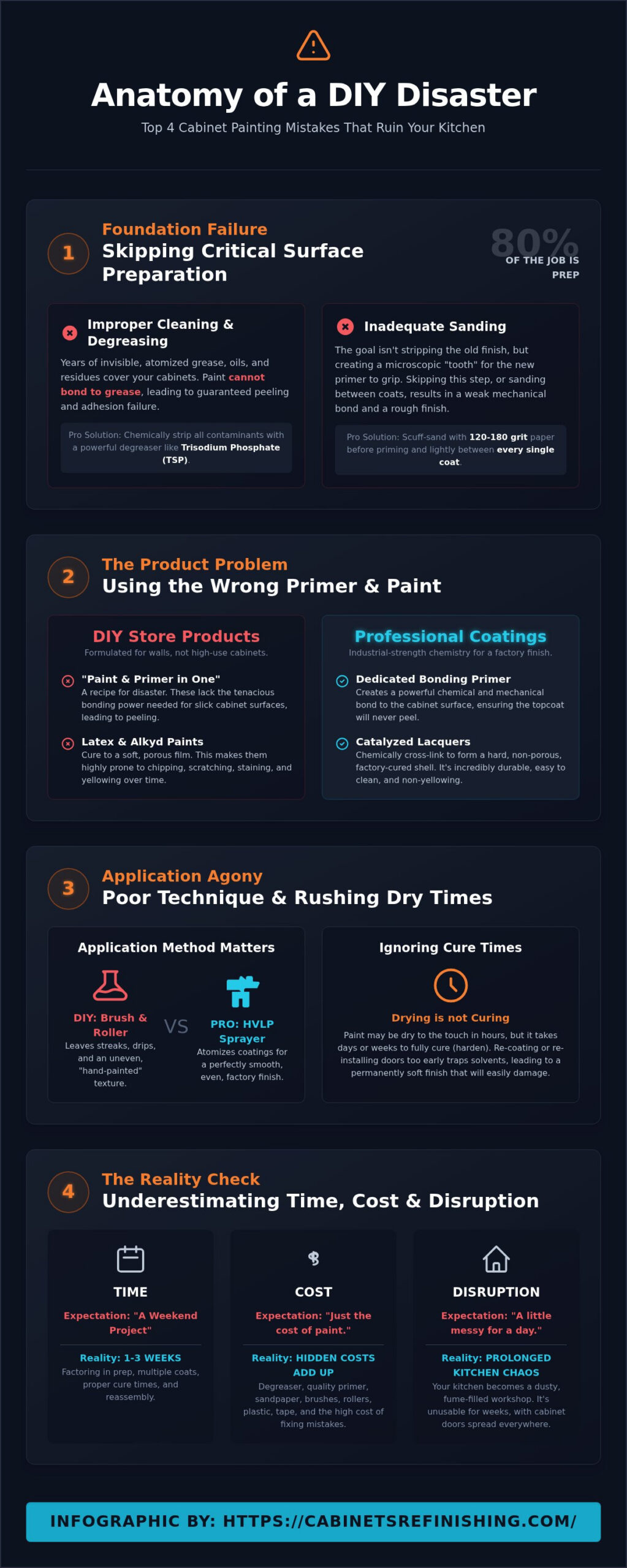
In our 38 years of experience, the most common of all DIY cabinet painting mistakes to avoid is rushing the prep work. Homeowners often believe a quick wipe-down is enough, but professionals know that meticulous surface preparation is 80% of the job. This single step is the vital factor that determines whether your new finish lasts for one year or for ten or more. Your kitchen cabinets may look clean, but they are covered in years of invisible, atomized grease, oils, and cleaning residues that will cause your new paint to peel and fail.
To see why this step is so critical, watch this short video demonstration:
Improper Cleaning and Degreasing
Paint cannot bond to grease, period. A simple wash with dish soap and water will not cut through years of baked-on kitchen grime. For a finish with industrial-strength durability, you must use a powerful degreaser like Trisodium Phosphate (TSP) to chemically strip away all contaminants. The professional process always begins with removing all hardware-doors, drawers, hinges, and pulls-to ensure every square inch is meticulously cleaned. Skipping this guarantees paint adhesion failure.
Inadequate Sanding
The goal of sanding is not to strip the old finish, but to create a "tooth" for the new primer to mechanically grip the surface. This is called scuff-sanding. Using a medium-grit sandpaper (120-180 grit) is ideal; using a grit that is too coarse will create deep scratches that show through the final coat. For a truly flawless, factory finish, a light sanding between every single coat of primer and paint is non-negotiable. This critical step removes any imperfections and is fundamental to understanding paint types and how they must layer for maximum durability. It’s this meticulous process that separates a professional result from a DIY look.
Mistake #2: Choosing the Wrong Primer and Paint
The single biggest difference between an amateur paint job and a professional, factory-grade finish comes down to the product. The paint available at a big-box hardware store is formulated for walls, not for the high-touch, high-abuse surfaces of kitchen cabinets. This isn’t about brand names; it’s about chemistry. Standard latex paint simply cures by air-drying, leaving a soft film. In contrast, professional coatings are catalyzed, creating a chemical reaction that results in an industrial-strength, durable shell. This choice is a vital factor that directly impacts the durability, cleanability, and final look of your project.
Using All-in-One ‘Paint and Primer’ Products
One of the most common DIY cabinet painting mistakes to avoid is falling for the convenience of ‘paint and primer in one’ products. These are a recipe for disaster on cabinets. A cabinet door is a slick, non-porous surface that paint struggles to grip. The job of a primer isn’t just to cover the old color; it’s to create a tenacious bond. A dedicated, high-adhesion bonding primer is the only way to solve adhesion problems before they start, guaranteeing your topcoat won’t peel or chip. Professionals always use a multi-step system because it delivers guaranteed, long-lasting results.
The Limits of Latex and Alkyd Paints
Even when using a separate primer, the type of topcoat you choose is critical. Standard latex and acrylic paints never fully harden, remaining soft and porous. This makes them extremely prone to chipping, scratching, and absorbing stains from grease or food. Alkyd (oil-based) paints offer better durability but come with significant drawbacks. They yellow considerably over time, have very high VOCs (Volatile Organic Compounds), and require careful handling. It is crucial to follow EPA guidelines to properly dispose of leftover paint and solvents.
This is why professionals rely on industrial-strength coatings like pre-catalyzed lacquers. These products create a hard, non-porous, factory-cured shell that is chemically resistant and incredibly easy to clean. You get a finish that looks and performs like it came straight from a high-end cabinet manufacturer-a result that typical house paints can never replicate.
Mistake #3: Poor Application Technique and Rushing Dry Times
Even with perfect preparation, the entire project can fail at the application stage. This is where the difference between an amateur job and a professional, factory finish becomes obvious. Technique mistakes are immediately visible, difficult to fix, and often require you to strip the paint and start over. More than any other step, this is where patience pays off. Rushing the process is one of the most common DIY cabinet painting mistakes to avoid, leading directly to drips, smudges, and a weak finish that won’t last.
Visible Brush Strokes and Roller Marks
Achieving a glass-smooth finish with a brush and roller is nearly impossible on cabinets. Even the best brushes will leave subtle strokes in thick cabinet paint. Foam rollers are notorious for creating a stippled, "orange peel" texture that looks cheap. Professionals use High-Volume, Low-Pressure (HVLP) sprayers that atomize the coating, laying down a perfectly even, thin layer that self-levels into a flawless surface. This is how a true factory finish is achieved-no marks, no texture, just a pristine surface.
Applying Coats Too Thickly
The desire to finish a project quickly leads many DIY painters to apply heavy coats of paint. This is a classic amateur mistake that guarantees a poor result. A thick coat of paint is too heavy to level out properly, leading to unsightly drips and sags. More importantly, it will not cure correctly; the surface may feel dry, but the paint underneath remains soft and weak. The professional standard is to apply multiple thin, even coats, allowing each to dry properly before the next. This builds a stronger, more durable, and perfectly smooth finish.
Not Respecting Cure Time vs. Dry Time
This is one of the most critical DIY cabinet painting mistakes to avoid. There is a vital difference between dry time and cure time.
- Dry Time: The paint feels dry to the touch. This can happen in a few hours, but the paint is still soft and fragile.
- Cure Time: The paint has fully hardened and achieved maximum chemical resistance and durability. For most latex paints, this can take 30 days or more depending on temperature and humidity.
Re-installing your cabinet doors and drawers before the paint is fully cured will cause damage. You will see imprints, chips, and sticking when doors are closed. Professional, industrial-strength coatings often use chemical catalysts to cure much faster and harder, a significant advantage over store-bought paints.
Mistake #4: Underestimating the True Time, Cost, and Disruption
Of all the DIY cabinet painting mistakes to avoid, underestimating the sheer scale of the project is the most common. Weekend warriors watch a 10-minute video and believe they can transform their kitchen in two days. The reality is a project that consumes your time, your money, and your living space for far longer than anticipated.
A proper, durable finish requires a meticulous process. This means your kitchen-the heart of your home-will be in a state of chaos and largely unusable for at least a full week, often longer. Cabinet doors will be spread out in your garage or another room, the kitchen will be full of supplies, and your daily routine will be completely disrupted.
The Realistic Timeline for a DIY Project
A professional timeline is compressed by experience, specialized equipment, and industrial-strength products. A DIY timeline, however, is dictated by standard materials and a learning curve. A realistic schedule looks like this:
- Day 1-2: The "dirty work." This includes carefully labeling every door and hinge, removing all hardware, thoroughly degreasing every surface, filling imperfections, and the first round of sanding.
- Day 3-6: The painting phase. This involves at least one coat of high-adhesion primer and a minimum of two top coats. Crucially, you must account for proper drying time between each and every coat, which can vary based on humidity and temperature.
- Day 7+: The waiting game. Even after the final coat is dry to the touch, the paint needs days-sometimes weeks-to fully cure. Reassembling your cabinets too soon will cause nicks, scrapes, and smudges, ruining your hard work.
The Hidden Costs of ‘Saving Money’
The initial appeal of DIY is saving on labor, but material and tool costs add up fast. To achieve a finish that even comes close to professional quality, you cannot cut corners. Your shopping list will include more than just a can of paint:
- Tools: An orbital sander, high-quality angled brushes, foam rollers for a smooth finish, paint trays, and tack cloths.
- Materials: A powerful degreaser, wood filler, painter’s tape, masking paper, a bonding primer, and premium cabinet-grade enamel paint.
When you factor in the potential cost of having to fix mistakes or even hire a professional to salvage a failed attempt, the "savings" can disappear. Before you commit, see what a guaranteed, factory finish truly costs. Get a free, all-inclusive quote from Cabinet refinishing Denver and understand the real value we provide.
When to Skip the DIY and Hire a Professional Cabinet Painter
Taking on a DIY project can be incredibly rewarding, but kitchen cabinets are a high-stakes, high-use area of your home. They are the centerpiece of your kitchen, and a flawed finish is not something you can easily hide. After learning about all the potential DIY cabinet painting mistakes to avoid, it becomes clear that for a guaranteed, durable, and truly flawless result, hiring a professional is the most practical choice.
A professional cabinet painter’s entire process is built to eliminate the risks and variables that lead to DIY failures. Your time is valuable, and a professional service gives you a completely transformed kitchen without the weeks of disruption, stress, and uncertainty. You are not just paying for paint; you are investing in a proven system that delivers a factory-like finish.
What a Professional Process Looks Like
Our method is designed for perfection and durability, moving the most critical work off-site to our controlled spray shop to protect your home and achieve a superior finish. The process includes:
- Step 1: Consultation & Removal. We start with an in-home consultation, then carefully remove all cabinet doors and drawer fronts to transport them to our professional facility.
- Step 2: Meticulous Off-Site Prep. In our shop, every surface is chemically stripped, cleaned, and sanded. This vital prep work ensures the new coating will adhere perfectly.
- Step 3: Industrial Spray Application. We apply catalyzed primers and industrial-strength lacquer coatings using professional spray equipment for an even, glass-smooth, and incredibly durable finish.
- Step 4: Careful Reinstallation. Once the coatings are fully cured, we return to your home and meticulously reinstall everything, transforming your kitchen with minimal disruption.
The Value of a Professional Guarantee
When you hire Painting Kitchen Cabinets Denver, you get more than just a paint job-you get peace of mind. Our finish is guaranteed to be durable, washable, and beautiful for years to come. With over 38 years of experience, we have perfected a system that avoids the common pitfalls and ensures your project is completed on a clear timeline. You eliminate the risk of a failed DIY project that could lower your home’s value. For a truly professional transformation, trust the experts to deliver the quality your home deserves.
Skip the Mistakes and Get a Guaranteed Flawless Finish
Painting your kitchen cabinets is a high-impact project where the final result is everything. Success hinges on two critical factors we’ve covered: meticulous surface preparation and using the correct, high-quality paint and primer. Underestimating the true time, effort, and skill required are the most common DIY cabinet painting mistakes to avoid, often leading to a finish that chips, peels, and disappoints.
While a successful DIY project is rewarding, a flawed finish can devalue your kitchen. For a result that is guaranteed to be durable, beautiful, and flawless, the smartest move is to trust the experts. With over 38 years of experience in Denver, we use industrial-strength lacquers, not house paint, to deliver a guaranteed durable, factory-like finish that you simply can’t get from a can. We make the process simple and the results outstanding.
Tired of the DIY headache? Get a fast, free quote for a professional factory finish!
Your dream kitchen transformation is closer than you think.
Frequently Asked Questions
Can you paint kitchen cabinets without sanding them first?
No, skipping the sanding process is a critical mistake that guarantees a poor result. Sanding is not about removing the old finish entirely; it’s about scuffing the surface to create a microscopic texture. This "tooth" is essential for the new primer and paint to mechanically bond to the cabinet. Without proper sanding, your new finish will inevitably chip, peel, and fail, forcing you to redo the entire project.
What is the most durable type of paint for kitchen cabinets?
The most durable finishes are not standard latex paints. For a true, long-lasting factory finish, professionals use industrial strength coatings like pre-catalyzed lacquers or two-component polyurethane enamels. These products cure to a much harder, non-porous shell than house paint. This industrial-grade hardness provides superior resistance to chipping, moisture, grease, and daily wear and tear, ensuring your investment lasts for years.
How long does a professionally painted cabinet finish last?
A high-quality, professionally painted cabinet finish should last between 8 and 15 years, and often longer with proper care. The longevity is a direct result of meticulous prep work and the use of industrial-grade coatings. Unlike a typical house painter’s job that may fail in 1-2 years, a specialist’s multi-step process-including deep cleaning, sanding, and specialized primers-ensures the finish is built for the high-traffic demands of a kitchen.
Is it cheaper to paint cabinets or replace them?
Painting your kitchen cabinets is significantly more affordable than replacing them. Professional cabinet refinishing typically costs 60-75% less than installing brand new cabinets of similar quality. This makes it an extremely cost-effective way to achieve a dramatic kitchen transformation without the expense and disruption of a full remodel. Hiring an expert also ensures you bypass common and costly DIY cabinet painting mistakes to avoid that could damage your existing cabinets.
How much does it cost to have kitchen cabinets professionally painted in Denver?
In the Denver metro area, the cost for professional kitchen cabinet painting generally ranges from $4,000 to $9,000 for an average-sized kitchen. The final price is based on factors like the total number of doors and drawers, the overall size and layout of the kitchen, and the current condition of the cabinets. For an accurate price immediately, you can text us pictures of your kitchen for a detailed quote.
Can you paint laminate or thermofoil cabinets?
Yes, you can paint laminate and thermofoil cabinets, but the prep work is absolutely critical for success. These slick, non-porous surfaces require a specialized high-adhesion or bonding primer. Using standard primer is one of the biggest DIY cabinet painting mistakes to avoid, as it will not stick properly and will peel off easily. With the right shellac-based or bonding primer, the topcoat can form a durable, lasting bond for a flawless finish.