
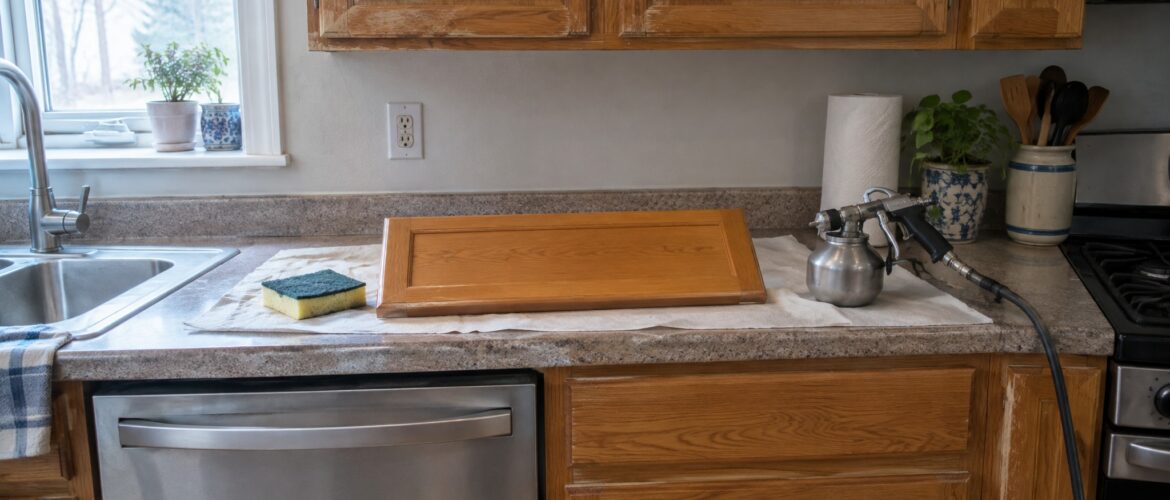
If you own a house in Lakewood or near the Denver Tech Center, odds are your kitchen cabinets are solid wood that has simply worn out its finish. The boxes are fine. The surface is not.
We’ve sprayed kitchens across the Denver metro since 1979, and the question we hear most is whether refinishing is a real alternative to ripping everything out or just a paint job with a nicer name. The answer comes down to process. Below, I walk through one kitchen from the first walkthrough to the last hinge adjustment, so you can see exactly what a factory finish involves and judge any quote you get against it.
Cabinet Refinishing in Denver, Lakewood and DTC: A Kitchen Worked Through Start to Finish
Picture a typical call. A Lakewood homeowner has a kitchen of honey oak from the 1990s. The finish is dull overall and tacky around the sink and dishwasher, where steam and splashed cleaner have softened it. The door edges, where hands grab every day, have worn through to bare wood. She is holding a replacement quote north of $25,000 and is not sure the cabinets are bad enough to justify it.
They aren’t. Here is what we do with that kitchen, in order.
- Assess, tag and remove. We walk the kitchen, count every door and drawer front, and check hinges and boxes. Each piece gets a tag that records its exact position, so everything goes back where it came from. Then we pull doors, drawer fronts and hardware and take them to be sprayed.
- Degrease and deep clean. Kitchen grease is the main reason finishes fail, and it builds up in places you never see, like the stile beside the range and the top rail over the stove. Primer will not bond to an oily surface, however good the primer is. A paint crew that skips this step is the reason you’ve seen peeling after one winter.
- Repair. We fill dings, scratches and any peeling spots, and we deal with those worn edges. A finish only looks as flat as what’s underneath it.
- Sand and grain fill. We sand the whole surface to give the primer something to grip. Oak adds one more job: it has deep, open grain that will show through the final coat as a texture like a washboard if you ignore it. We fill the grain first so the finished door reads smooth. The details are in our piece on grain filling and 2K poly on oak cabinets.
- Spray the primer. We lay down precat primer with HVLP equipment. HVLP atomizes the material finely at low pressure, which puts a thin, even coat on the surface without runs or brush lines.
- Spray the topcoat. The finish is a crosslinking urethane lacquer, the same class of durability you’d expect from 2K poly or conversion varnish. We apply it in controlled coats and sand between them, so each layer is level before the next goes on.
- Cure, reinstall, adjust. The finish cures before the doors go back on. We rehang every door, set the hinges so the reveals are even, and check that each drawer closes cleanly.
That is the whole job. No shortcuts, no magic product.
Why this is not paint
Brushed or rolled paint dries in a soft film that carries the marks of the tool. You can see the strokes, and you can feel them under your thumb. Spraying removes those marks completely.
The bigger difference shows up in two years, not on day one. Crosslinking urethane cures chemically into a hard film. It resists chipping at the door edges and shrugs off the moisture and cleaners that wreck latex around a sink. Brushed enamel stays softer, so it scratches, dents and slowly picks up grime you can never fully wash off. If you want the side-by-side, we’ve laid out HVLP spray versus brush paint in detail, and our page on factory finish cabinet refinishing in Denver and Lakewood covers the finish itself.
A factory finish has limits too. Refinishing changes the surface, not the layout, and it won’t rescue boxes that have swollen from long-term water damage. If your cabinets are structurally failing, or you want a different floor plan, replacement is the right call and we’ll tell you so.
Add-ons, time and what you save
You can add cabinet glazing or a two-tone scheme, such as painted uppers over a darker base, in the same job. The sprayed process is the same, so it doesn’t add a second visit.
The kitchen above takes 2-5 days, door to door, and you keep your kitchen. There is no demolition, no new countertops to template and no weeks without a sink. Homeowners typically save about 70% against a $25,000+ replacement, and the work carries a 3-year warranty. We’re licensed and insured, which you should expect from anyone who works in your house, and which you should ask to see before you sign with anyone. For a longer look at the money, read refinishing versus replacement.
Why the Finish Has to Handle Colorado’s Dry Climate
Colorado air is dry, and it swings. A kitchen can sit at very low humidity through a January cold snap and then take on steam from a pot of pasta water a few hours later. Wood responds to all of it. Doors swell and shrink across the grain, and the joints where rails meet stiles move a little with every change.
A finish has to move with that wood. A brittle film cracks at the door-frame joints first, because that’s where the movement concentrates, and once it cracks, it lifts and peels from there. Poorly bonded paint goes the same way, since a coat that is only sitting on a slick surface has nothing to hold it when the wood shifts.
This is where precat primer and crosslinking urethane earn their place. The primer bonds to the sanded, cleaned wood, and the urethane bonds to the primer, so you get a system of layers locked together instead of one thick coat of paint. The cured film is hard enough to resist wear but not so rigid that it cracks at the first joint movement. Brushed latex or enamel stays softer and tends to hold on less firmly, so it scuffs from the outside and fails at the joints from the inside.
Your cabinets will still move, because wood always does, so don’t expect a finish to stop that. What the finish can do is move with them, and that is why we spray the same system on every kitchen.
Getting a Refinishing Quote in Denver, Lakewood and the DTC
We serve the Denver metro, including Lakewood and the DTC corridor, so there is no travel surprise in the estimate. What slows a quote is missing information. Before you call, gather four things:
- Count. The number of doors and drawer fronts. This is how pricing works, so a rough count moves things along fast.
- Wood. Oak, maple or something else. Oak needs the grain-fill step, and we plan for it.
- Condition. Where the finish is worn, sticky or peeling, and whether any boxes are damaged.
- Photos. A few wide shots of the kitchen and close-ups of the worst spots, especially around the sink and dishwasher.
With that, we can give you a clear number rather than a range of guesses. For a sense of where pricing lands before you call, see our breakdown of cost per door in 2026.
Now the comparison that matters. A replacement quote of $25,000 or more buys you new boxes, new doors and weeks of disruption. Refinishing typically costs about 70% less and is finished in 2-5 days, with the same warranty behind it: 3 years.
Get the numbers side by side while the replacement quote is still in your hand. When you’re ready, request a free quote and send the photos along with it.
Frequently asked questions
How long does cabinet refinishing take?
A typical kitchen takes 2-5 days. That covers removal, cleaning, repair, grain filling where needed, priming, spraying the topcoat, curing and reinstalling the doors. You keep using the rest of your house the whole time.
How much do I save by refinishing instead of replacing my cabinets?
Homeowners typically save about 70% compared with a $25,000+ replacement job. The saving comes from keeping your existing boxes and replacing only the surface. If your boxes are structurally damaged, replacement may still be the better choice.
What warranty and credentials should I expect from a refinishing contractor?
Expect proof of a license and insurance before any work begins, and a written warranty on the finish. Ours is a 3-year warranty, and we’re licensed and insured. A contractor who can’t show you those should not be working in your kitchen.
Will a sprayed finish hold up better than brushed paint?
Yes. Precat primer topped with crosslinking urethane lacquer cures into a harder film than brushed latex or enamel. It resists chipping at the door edges and holds up better to moisture and cleaners around the sink.
Can you refinish oak cabinets without the grain showing through?
Yes, but only if the grain is filled before priming. We sand, fill the open grain, and then prime and spray, so the finished doors come out smooth. Skipping that step leaves a visible texture in the final coat.