
Picture a Centennial kitchen with 20-year-old oak cabinets. The boxes are solid and the doors still close square, but the finish has yellowed, the edges around the pulls are worn to bare wood, and the whole room looks dated. The homeowner has two quotes on the counter: one for $25,000+ to replace everything, and one from a painter who plans to brush and roll the doors on site. This is where cabinet painting Denver comes into play, offering an affordable and stylish alternative to a full renovation. With cabinet painting Denver, you can achieve a fresh look without the expense of complete replacement.
Key takeaways
Considering cabinet painting Denver can transform your kitchen without the hefty price tag of replacement.
Choosing cabinet painting Denver is a smart way to enhance your kitchen aesthetics while saving money.
- Painting directly over old cabinets fails: degreasing, scuffing and priming have to come first, and skipped prep is the most common cause of peeling.
- A sprayed factory finish uses HVLP-applied precat primer and a crosslinking urethane lacquer, which cures into a hard film instead of staying soft like wall paint.
- Refinishing typically saves about 70% compared with a $25,000+ cabinet replacement.
- Doors and drawer fronts are sprayed and cured in the shop, with a 2-5 day turnaround and a 3 year warranty.
- Refinishing changes the finish, not the structure, so it suits sound boxes and not water-damaged ones or a new layout.
We’ve been in this business since 1979, and our answer to that homeowner is almost always the same. Neither quote is the right one.
Cabinet Painting in Denver: Why a Sprayed Factory Finish Beats a Brushed Paint Job
Understanding the benefits of cabinet painting Denver can help you make the right choice for your home.
The replacement quote assumes your cabinets are the problem. They usually aren’t. The wood and the construction are fine, and the failure is in the finish, which is the one part we can rebuild properly without tearing out your kitchen.
The brush-and-roll quote makes the opposite mistake. It treats the finish as a color change, so it spends almost nothing on the steps that decide whether the paint is still there in three years.
What happens to each cabinet in our shop
Here is the sequence we follow on a typical job, in order:
- We remove the doors, drawer fronts and hardware and take them to the shop, where the work happens in controlled conditions rather than around your cooktop.
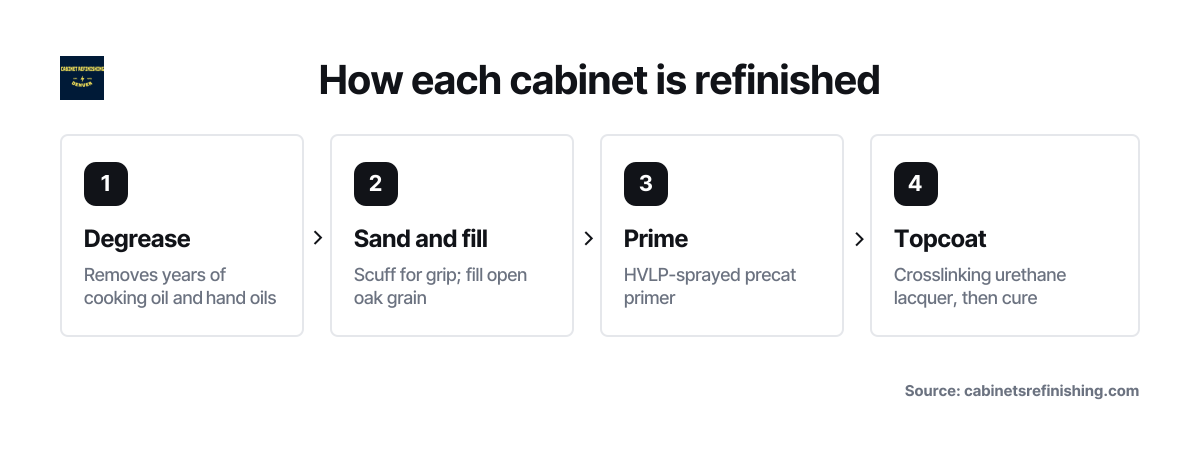
- We degrease every surface. Twenty years of cooking oil, hand oils and steam leave a film you can’t see, and paint bonds to that film instead of the wood.
- We sand to give the surface a mechanical grip. On oak we also fill the open grain, so the pattern doesn’t show through the new finish as ridges.
- We spray precat primer with HVLP equipment, which lays the coat down evenly with no brush drag.
- We spray the crosslinking urethane lacquer topcoat in the same way, then let the pieces cure before anything goes back on your boxes.
Nothing in that list is exotic. Every step is also one that a brush-and-roll job shortens or skips, because each one costs labor.
Why we call it a factory finish
A new cabinet from a manufacturer isn’t painted with a brush. It’s sprayed with a catalyzed finish that cures hard, and that is what we mean by a factory finish. If you want the longer version, we’ve written up what a factory finish on kitchen cabinets really means.
The durable end of that family includes 2K poly and conversion varnish. Our crosslinking urethane lacquer belongs to the same technical class: the film cures by chemical crosslinking into a hard surface, instead of simply drying and staying soft.
That difference shows up in your hands. Household wall-style paint stays relatively soft, so it dents under a fingernail, chips along door edges and wears through around handles, which are the places a kitchen gets touched hundreds of times a week. A hard film resists hands, steam and grease. Because it’s sprayed, it’s also smooth, with no brush marks and no roller stipple catching the light. The full comparison is in our piece on HVLP spray versus brushed paint.
Back to the oak kitchen. Oak has deep, open grain, and brushed paint settles into it unevenly, so the doors end up with visible grain lines and ridges at every brush stroke. Grain filler, precat primer and a sprayed urethane topcoat give you a flat, glass-smooth surface instead.
Will it hold up in Colorado’s dry air?
Colorado air is dry, and wood responds to it. Panels and rails give up moisture, shrink a little and move at the joints, and a soft, thin paint film cracks along those lines first. A hard, well-bonded film on properly prepped wood moves with less damage, and that is why we put so much weight on prep and film quality. We cover this in more detail in our guide to finishes that hold up in Colorado’s dry climate.
We back the work with a 3 year warranty. We’re licensed and insured, and we’ve been spraying cabinets here long enough to have seen how our own jobs age.
My Review of Graco FFLP Tips for Spraying Cabinets
Can you paint straight over the old finish?
No. Painting directly over existing cabinets is the single most common reason paint peels. You have to degrease first, scuff or sand the old finish, and prime with the right primer before any topcoat goes on.
From the shop floor, failed paint jobs nearly always trace back to two things: skipped degreasing and sanding, and soft household paint on high-touch surfaces. Skipped prep lets the coating peel in sheets, while soft paint wears and chips at the edges. The mistakes tend to come in a familiar set:
- Skipping the degreaser. Paint sticks to kitchen grease, not to the wood under it, so it lifts at the first scrape. Cabinets near the range suffer most.
- Using the wrong primer. A primer that doesn’t suit the old finish or the wood leaves a weak layer under the topcoat. On oak, a primer without grain filling also leaves the grain showing.
- Brushing or rolling. You get brush marks, a soft film and an uneven build at the edges.
- Rehanging too early. A film that looks dry can still be soft underneath. Hinges and hands leave marks, and doors stick to the frame.
You’ll notice that none of these are about the brand of paint. They’re about process.
How long it takes and what to expect
The turnaround is 2-5 days. Because the doors and drawer fronts are sprayed and cured in our shop, the dust and overspray stay out of your house, and you aren’t living for weeks in a kitchen with open cabinet boxes and a tarp over the stove.
One limit you should know about. Refinishing changes the finish, not the structure. It can’t repair boxes that are swollen from water damage, and it doesn’t change your layout. If you want a different configuration, replacement is the right call, and we’ll say so.
What Cabinet Painting Costs in Denver Versus Replacing Everything with cabinet painting Denver
Refinishing is priced by the number of doors and drawer fronts and the scope of the work, so a small kitchen costs less than a large one with an island. Replacement runs $25,000+, and homeowners typically save about 70% by refinishing instead. We’ve compared the two in detail under refinishing versus replacement.
Think about what that gap buys you. Most of a replacement bill pays for new boxes, tear-out and installation of cabinets that were already sound. Refinishing puts your money into the part that wore out.
A cheap cabinet painting quote usually means brushed or rolled latex and very little prep. That is how a quote comes in low, and it’s also how a job ends up peeling around your handles within a couple of years. When you compare two numbers, compare what each one includes: degreasing, sanding, primer, spray equipment and cure time.
When you explore cabinet painting Denver, you’ll notice the emphasis on quality and durability.
We don’t publish a single flat rate, because the scope on each kitchen is different. Our 2026 Denver pricing guide explains how the price is built, and a free estimate gives you the actual figure for your kitchen.
Choosing a Cabinet Painter in the Denver Metro Area
Any contractor can say “factory finish” on a quote. Ask these questions, and listen for specific answers:
- Do you spray or brush? If it’s brush and roll, you know what you’re getting.
- How does cabinet painting Denver compare to traditional methods? Cabinet painting Denver offers a more efficient and effective way to achieve stunning results.
- What primer and topcoat do you use? A real answer names a primer and a catalyzed or crosslinking topcoat, not just “two coats of paint.”
- Where is the work done? Doors sprayed in a controlled shop cure better than doors sprayed in a garage or a kitchen.
- What does the warranty cover, and for how long? Ours is 3 years. Get the terms in writing.
- Are you licensed and insured? Ask for proof before anyone removes a door.
If you want more on weighing the answers, here is how to choose a refinishing contractor. We work across Denver, Aurora, Parker, Highlands Ranch, Centennial, Littleton, Greenwood Village, Arvada and Wheat Ridge.
If your cabinet boxes are sound and the finish is what’s tired, see our cabinet painting service in Denver and get a free estimate. Bring the replacement quote and the painter’s quote with you, and we’ll show you where each one differs from ours.
Frequently asked questions
What do painters charge to paint kitchen cabinets in Denver?
Refinishing is priced by the number of doors and drawer fronts and the scope of the work, so the figure depends on your kitchen. Replacement runs $25,000+, and our customers typically save about 70% by refinishing instead. A free estimate gives you a firm number for your cabinets.
Why does cabinet paint peel or chip?
The right contractor for cabinet painting Denver will ensure that the finish lasts and looks professional.
Most peeling starts with skipped degreasing and sanding, because paint then bonds to kitchen grease instead of the wood. Chipping at edges and around handles usually comes from soft household paint on surfaces that get touched constantly. A hard, crosslinked sprayed film on properly prepped wood avoids both.
With cabinet painting Denver, your kitchen can have a completely updated look without the hassle of full replacement.
Will a sprayed finish hold up in Colorado’s dry climate?
Wood moves as it gives up moisture in dry air, and a soft thin film cracks at the joints first. Careful prep and a hard, well-bonded urethane film cope with that movement better. We stand behind the work with a 3 year warranty.
Do you spray cabinets in my house or in your shop for cabinet painting Denver?
We remove the doors and drawer fronts and spray them in the shop, where the finish cures in controlled conditions. That keeps overspray and dust out of your home. The whole job runs 2-5 days.
We specialize in cabinet painting Denver, ensuring that every step is done with precision.