
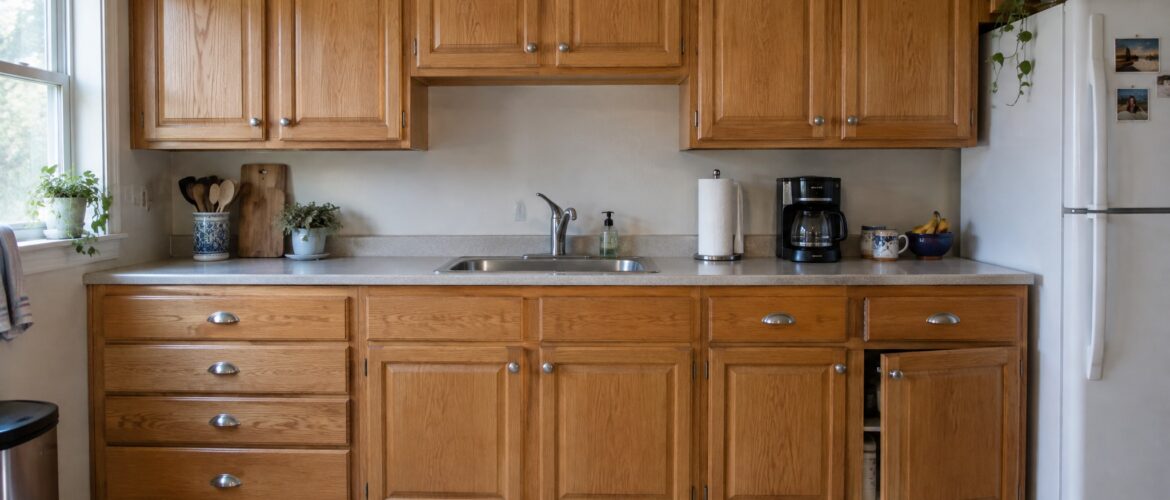
Refinishing changes the finish on the cabinets you already own. Refacing swaps the visible doors and drawer fronts for new ones and veneers the frames. If your boxes are sound and you like your layout, spray refinishing is the lower-cost way to a factory-style finish, and the rest of this piece shows why.
Key takeaways
- Refinishing keeps your existing doors, drawer fronts and frames and changes only the finish, while refacing replaces the doors and drawer fronts and veneers the frames.
- Painting is one method of refinishing, so refacing against painting is the same decision, and the real quality split is brush-and-roll against HVLP spray with a crosslinking urethane topcoat.
- Spray refinishing typically runs about 70% below a $25,000+ replacement, and refacing usually lands between refinishing and replacement.
- Refinished surfaces fail where prep was skipped, and refaced veneer tends to lift at edges and seams near heat and moisture.
- A fair quote comparison matches door and drawer-front counts, prep scope, hardware decisions, and warranty and turnaround terms.
Cabinet Refinishing and Refacing Touch Different Parts of the Same Kitchen
Picture a typical Denver kitchen. The doors are solid oak, the plywood boxes are square and solid, and the honey-toned finish has worn through around the pulls and the sink. A replacement quote of $25,000 or more is sitting on the counter. This isn’t a past job of ours. It’s a common starting point, and it lets us pin each term to the same cabinets.
Refinishing vs refacing on the same kitchen
| Refinishing | Refacing | |
|---|---|---|
| What changes | Finish on existing doors | New doors, veneered frames |
| Cost | Prep and spray labor | Higher than refinishing |
| Wait | 2-5 days | New door fronts to make |
| Typical failure | Skipped prep | Veneer lifting at edges |
What each route actually changes
Refinishing changes the finish on the doors, drawer fronts and frames that are already there. Nothing gets replaced. Refacing replaces the visible doors and drawer fronts with new ones, then veneers the frames and box ends so everything matches.
Then there’s “resurfacing.” People use it as a synonym for refacing, and others use it for the veneer step alone. Ask any contractor which one they mean before you compare numbers.
So the difference between refacing and refinishing comes down to one thing. Refinishing keeps your doors and refreshes the surface. Refacing buys new doors and covers the frames.
How we refinish that oak kitchen
Here is how we’d handle it in the shop, start to finish:
- The boxes stay in place. We mask the walls, counters and appliances.
- The doors and drawer fronts come off, and we label them so each returns to its opening.
- We degrease every surface, because years of kitchen grease will defeat any coating laid over it. Then we scuff sand for adhesion.
- Oak is open-grain, so we fill the grain. Skip that and the pores telegraph through the finish as tiny pits.
- We spray a precat primer, then HVLP-spray a crosslinking urethane lacquer topcoat.
- The doors go back up, and we adjust hinges and reveals so they hang square.
Finishers generally agree that prep decides adhesion more than the topcoat does. Degreasing, sanding and the primer under the lacquer determine whether a finish holds. That’s why we put our hours there.
Where the money goes
Refinishing keeps the doors and boxes you already have, so its cost sits in prep and spray labor. We’ve done this since 1979, and a job like this typically runs about 70% below a $25,000+ replacement. If you want the wider picture, we’ve laid out refinishing versus a full replacement separately.
Refacing adds a line item refinishing doesn’t have: new faces. Those doors have to be made, shipped and fitted, so refacing usually lands between refinishing and a full replacement. That answers the question of whether refacing is cheaper than refinishing. On the same kitchen, it isn’t.
Painting is refinishing, so the real split is the application
Cabinet refacing vs painting sounds like a separate decision. It isn’t. Painting is one method of refinishing, so refacing against painting is the same choice as refacing against refinishing.
The quality split that matters is brush-and-roll against HVLP spray. A brushed or rolled coat leaves marks and sits softer on the surface, while HVLP atomizes the material into an even film, and a crosslinking urethane lacquer cures into a harder, more chemical-resistant topcoat than ordinary wall-style paint. If you want the process detail behind that claim, see how HVLP spray differs from brush-on paint.
A cheaper painter who brushes will quote lower than we do. You’ll see that difference in the finish within a year or two.
Which one holds up in Denver’s dry air
Denver’s dry air pulls moisture out of solid wood and moves it through the seasons. Your oak doors will swell a little in a humid spell and shrink in a dry one. The fair test of any finish here is how it handles that movement without cracking at the joints.
Each route fails in its own place. A refinished surface fails where prep was skipped: grease left on the door, no scuff sanding, a missing bonding primer. Refaced veneer tends to fail at edges and seams, where it can lift near heat and moisture, such as beside the range or around the dishwasher.
Neither is bulletproof. Refinishing doesn’t fix a door that’s already warped or split, and no finish will hold on bad prep. For more on coatings that suit this climate, read about finishes that hold up in dry Denver air.
The verdict for this kitchen
Sound boxes and a layout you like point to spray refinishing. You keep the oak you’ve got and get a factory-style finish without paying for new doors. We’re licensed and insured, and we stand behind the work with a 3 year warranty.
Where Refinishing Stops and Refacing Makes Sense
Refinishing has limits, and you should know them before you book anything. It keeps the existing door shape, so if you want a different profile, say flat-panel slab doors in place of raised-panel oak, a new finish won’t get you there.
Refacing fits better in three cases:
- You want a different door profile.
- The doors are too warped, split or worn to take a new finish.
- The look you’re after depends on new door faces.
Refacing has downsides, and they’re worth stating plainly. It costs more than refinishing, and you wait while the new door fronts are made. Veneer edges can also lift near heat and moisture, as above.
Structural box damage is a separate matter. Water-swollen sink bases or broken frames need repair before either route makes sense, because a new finish or new faces over a failing box only hides the problem.
Refacing is the other route you may have been quoted. It’s a legitimate option when the doors are the problem rather than the finish.
How Denver Refinishing and Refacing Quotes Compare
Quotes only compare when they cover the same work, and many don’t. Before you set a refinishing quote beside a refacing quote, check that both match on these points:
- The same count of doors and drawer fronts.
- The same prep scope: degreasing, sanding, grain filling.
- The same hardware decisions, whether you’re reusing pulls and hinges or replacing them.
- The same warranty and turnaround terms.
Door and drawer-front counts drive the number on both sides. Our per-door refinishing pricing shows how that works. Refacing cost in Denver follows the same counts plus the price of new faces, so a refacing quote will normally come in above the refinishing figure for the same kitchen.
Warranty terms deserve a close read, since two quotes can promise very different coverage. Here’s what a refinishing warranty actually covers, so you can hold any quote up against it.
You don’t have to guess from a photo. Request a free estimate on the doors and drawer fronts you already have, and bring any replacement or refacing quote you’re holding so we can check the two like for like. Our turnaround is 2-5 days.
If you’d rather talk first, talk to the shop about your doors.
Frequently asked questions
Is it better to refinish or reface kitchen cabinets?
If your boxes are sound and you like your layout and door shape, refinishing is the better value. You keep the doors you have and pay for prep and spray labor, not new faces. Refacing is better when you want a different door profile or the doors are too warped or split to take a new finish.
What is the downside of cabinet refacing?
It costs more than refinishing, and you wait while new door fronts are made. The veneer on frames and box ends can also lift at edges and seams near heat and moisture, such as beside a range or dishwasher.
What is the average cost to have kitchen cabinets refinished in Denver?
The price follows your count of doors and drawer fronts and the prep each one needs. Spray refinishing typically runs about 70% below a $25,000+ replacement job. For an exact figure on your kitchen, ask for a free estimate.
What should I know before painting my cabinets?
Prep decides whether the finish holds: degrease, scuff sand and use a bonding primer. Open-grain wood like oak also needs grain filling. A brushed or rolled coat won’t match a sprayed crosslinking urethane lacquer, so ask any painter how they apply it.