
Denver kitchens are moving on from the all-gray era. Paint manufacturers have been steering homeowners toward warmer, earthier directions for 2026, and the four names that come up most often in local estimates sit squarely inside that shift: White Shaker, greige, Accessible Beige, and Evergreen Fog. Two of them are dependable neutrals, one is a warmer beige that flatters older kitchens, and one is the soft green that has become the most requested color in the metro. What follows is how each color behaves in a real Denver kitchen, plus what to settle before anyone starts spraying doors.
Why 2026 Feels Warmer Than 2025
Sherwin-Williams and Benjamin Moore both named warm, earth-toned Colors of the Year for 2026, which tells you where the industry’s attention is pointed. Trend roundups for the year describe soft greens like sage, olive, and moss leading the way, alongside deep blues, moody hues, and statement accents in terracotta and mustard. Designers have also flagged creamy white cabinets as surprisingly current for 2026 rather than dated.
Denver has its own version of this story. A local painting company argued in a 2026 press release that the city’s gray era is ending, pointing to warm Color of the Year picks as the proof. That tracks with what homeowners see in their own neighborhoods: a lot of gray walls, gray exteriors, and black accents that now read as a few years old. The fix is rarely a dramatic color. It is usually a warmer neutral or a green with enough gray in it to stay calm.
White Shaker: Still the Safest Bet in the Metro
White Shaker survives every trend cycle because the door profile does the work. A five-piece Shaker door with a clean white finish reads as bright, tidy, and easy to sell, which is why listing prep jobs lean on it so heavily.
The decision that matters is temperature, not whether to go white at all. A crisp bright white looks sharp against cool counters and dark floors, but it can feel clinical in a north-facing kitchen with limited afternoon light. A creamy white softens the same room and pairs more easily with warm wood floors, brass hardware, and the beige tones running through 2026 palettes. Creamy white is also the version designers have been calling on trend this year, which makes it the lower-risk choice for anyone planning to sell within a few years.
Greige: The Bridge Between Two Eras
Greige is gray with enough warmth in it to stop feeling cold. That makes it useful in Denver homes where the cabinets are the last gray thing left in a room that has already moved toward warmer walls and wood tones.
The catch with greige is that it has no fixed identity. Some greige reads almost taupe in the can and turns distinctly gray on a cabinet door. Others look beige in the sample and go muddy in a kitchen without much natural light. This is why spray-applied samples on an actual door beat a paper chip every time. If you are refinishing rather than replacing, the door you already own is the only honest test surface, because the sheen and the surrounding light are the ones that will matter after the job is finished.
Accessible Beige: Warmth That Hides More
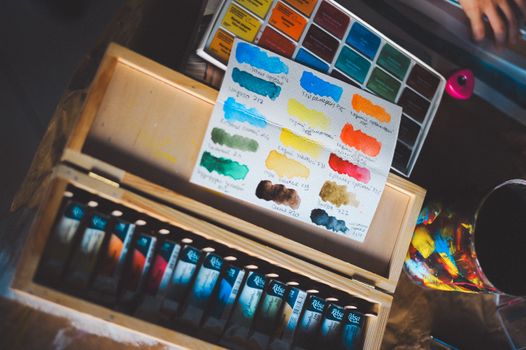
Accessible Beige has become a default answer for homeowners who want warmth without committing to a color. It sits in the cream and earthy khaki family that shows up in 2026 trend palettes, and it holds up well in kitchens that get strong afternoon sun, where a cooler white can start to look harsh.
It is also forgiving. Beige finishes show less dust and fewer fingerprints than bright white, which helps in households with kids, dogs, or a kitchen that doubles as the main entrance. The risk is undertone drift. A beige with a green or yellow lean can clash with cool quartz or gray tile, so it needs to be judged next to the countertop and backsplash rather than on its own. Pair it with white walls and warm wood accents and it reads intentional instead of sleepy.
Evergreen Fog: The Green With Staying Power
Soft greens are the headline color story for 2026, and Evergreen Fog is the one most homeowners can name. It is a muted green with gray in it, so it behaves like a neutral in a way that brighter sage and olive greens do not. In a Denver kitchen it works on full cabinet runs, on an island only, or on a lower cabinet with white uppers above.
Two combinations do most of the heavy lifting. Paired with warm wood tones and brass or aged metal hardware, the green reads soft and natural. Paired with black accents and a moody island, it leans toward the deeper, more dramatic direction also gaining ground this year. The color holds up in rooms with less light because it has enough gray to avoid going bright. It does reward a warm white on the walls and trim, since a cool white next to it can make the green look heavier than intended.
Comparing the Four at a Glance
Color | Character | Pairs Well With | Watch Out For |
|---|---|---|---|
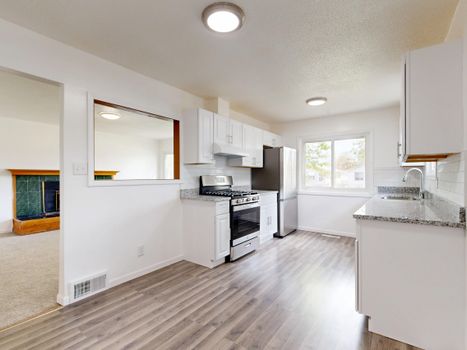
White Shaker | Bright, clean, classic profile | Dark floors, cool counters, brass hardware | Stark white in low-light, north-facing rooms |
Greige | Soft gray warmed with beige | Warm walls, wood tones, mixed metals | Undertones flipping gray or muddy once sprayed |
Accessible Beige | Warm neutral, low contrast | White walls, warm wood, stone counters | Clashing with cool quartz or gray tile |
Evergreen Fog | Muted green with gray depth | Warm white trim, brass, black accents, wood | Cool white walls making it look heavy |
How Denver Light Changes Every One of These Colors
Colorado’s sunlight is intense and the air is dry, and both change how a paint color reads. East and south-facing kitchens tend to wash colors out during the morning, while north-facing rooms push them cooler and flatter all day. A greige that looks perfect in a bright showroom can lose its warmth in a basement-adjacent kitchen, and a creamy white can look almost yellow against snow glare coming through a big window.
The practical answer is to sample in the room, on the cabinet, under the light you actually cook in. Look at the sample in the morning, at midday, and at night with the kitchen lights on. Cheap samples cost less than a repaint and settle arguments faster than a design board.
Why the Finish Matters as Much as the Color
Any of these four colors can look expensive or cheap depending on how it is applied. A brush-and-roll job leaves texture, lap marks, and visible edges on a Shaker door, and those flaws show up far more on white, beige, and muted green than they do on a dark stain.
A spray-only process gives a smooth, even film with no brush marks, which is the difference between a factory finish and a repaint. It also lets the color be matched precisely to the Sherwin-Williams and Benjamin Moore shades homeowners have already picked out, rather than settling for a close-enough stock color. Low-VOC and low-odor materials keep the process manageable in an occupied home. Cabinet refinishing also keeps the existing boxes and doors out of a landfill, which matters to a lot of Denver homeowners weighing a refresh against a full renovation.

A Simple Way to Choose
Start with the fixed elements: floor, countertop, backsplash, and any tile you are not changing.
Decide whether the kitchen needs more warmth or more brightness. Warm kitchens move toward beige and green. Cool kitchens move toward white and greige.
Sample two colors, not six. One safe option, one bolder option.
Look at the samples on a door panel in daylight and again at night.
Confirm the hardware finish before the cabinets are sprayed, since brass, black, and brushed nickel each pull the same paint color in a different direction.
Frequently Asked Questions
Are green cabinets hard to sell in Denver?
A muted green like Evergreen Fog is far easier to sell than a saturated one because it behaves like a neutral next to wood and white. Soft greens are among the leading directions for 2026, so buyers are seeing them in listings already. If resale is imminent, an island in green with white perimeter cabinets is the lower-risk version of the idea.
Is white Shaker still in style for 2026?
Yes, though the shade has shifted. Designers have pointed to creamy white cabinets as a current choice for 2026 rather than a dated one. The Shaker door profile stays popular because it works with nearly every hardware finish and countertop material. Choosing cream over bright white keeps it warmer and more up to date.
What is the difference between greige and Accessible Beige?
Greige is a gray that has been warmed with beige, so it usually reads as a soft gray with depth. Accessible Beige is warmer and closer to cream, with less gray in the mix. In a bright Denver kitchen, greige can look almost gray, while beige holds its warmth. Sample both if you are torn between the two families.
Can refinishing match a specific paint color?
Yes. Refinishing allows color matching to Sherwin-Williams and Benjamin Moore shades, so you are not limited to a preset lineup. The important step is testing the match on a door panel in your own kitchen light before the full set is sprayed, since the same color can read differently across rooms and times of day.
Choosing a cabinet color for a 2026 Denver kitchen is less about chasing the trend list and more about matching the palette to the light and the fixed materials already in the room. White Shaker, greige, Accessible Beige, and Evergreen Fog each solve a different problem, and any of them can look current for years when the finish is smooth, the undertone is right, and the hardware was chosen before the first coat went on.