

The true durability of a kitchen transformation isn’t measured by the paint in the can; it’s determined by the hours of mechanical prep, meticulous containment, and industrial spray application required to build a permanent bond. If you’re researching how much to paint cabinets in the Denver metropolitan area, you’ve likely noticed that estimates across local neighborhoods swing wildly from one bid to the next.
That pricing spread causes understandable frustration, especially when you dread paying for a rushed job that chips within months or facing the chaos of full cabinet demolition. You deserve transparent answers before inviting a crew into your home. Drawing on 45+ years of specialized craftsmanship, Cabinet refinishing Denver has built this comprehensive guide to reveal how professional project estimates are calculated, what preparation standards guarantee factory-grade results, and how to modernize your kitchen at a fraction of replacement costs.
Key Takeaways
- Understand how much to paint cabinets Colorado Springs specialists quote by learning how door counts, drawer fronts, and architectural details shape your project investment.
- Discover why aggressive mechanical prep, degreasing, and full-containment masking systems are required to prevent peeling and secure a permanent bond.
- Learn the key functional differences between cabinet painting and cabinet refinishing, and why both options deliver dramatic savings over full demolition.
- Find out how to properly vet Front Range contractors by confirming dedicated off-site spray facilities instead of hiring general house painters.
- See how leveraging 45+ years of specialized finishing experience and rapid digital photo estimates streamlines your kitchen update from start to finish.
What Determines the Cost to Paint Kitchen Cabinets in Colorado Springs?
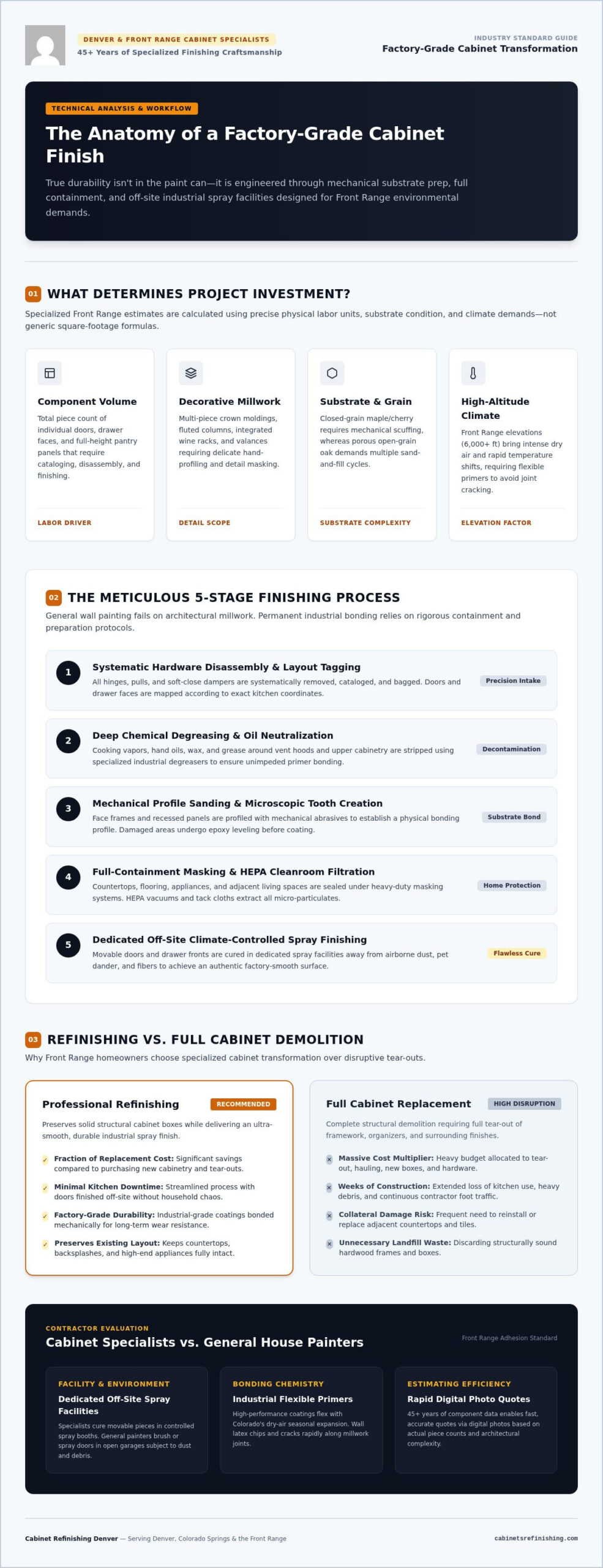
National home-improvement lead aggregators often publish flat formulas based on kitchen square footage. In reality, evaluating how much to paint cabinets Colorado Springs homeowners have in their properties comes down to specific physical labor units rather than floor space. A small, densely packed galley kitchen can demand significantly more prep hours than an expansive open-concept layout with simple shaker profiles. Specialized Front Range refinishers calculate estimates based on detailed labor steps, architectural detailing, and substrate challenges rather than broad square-foot metrics.
Regional environmental factors along the Front Range play a critical role as well. Colorado Springs homes sit at an elevation exceeding 6,000 feet, where intense dry air and rapid seasonal temperature shifts cause natural wood to expand and contract continually. Ensuring industrial coatings adhere without cracking at the joints demands flexible primers, dedicated climate-controlled spraying facilities, and thorough surface remediation.
To see how professional finishing teams evaluate these project requirements, watch this detailed walkthrough:
Cabinet Layout and Component Volume
Labor time correlates directly with the total piece count. Every door, drawer face, and full-height pantry panel must be uninstalled, tagged, transported, prepped, sprayed, and rehung. Architectural details increase containment and detail-sanding labor on fixed framework:
- Piece Counts: Estimators tally individual doors and drawer faces across upper, lower, and island installations.
- Decorative Millwork: Multi-piece crown molding, fluted columns, integrated wine racks, and valances require delicate hand-prep and precision masking.
- Coating Scope: Most standard projects focus on outer face frames and exterior door profiles, whereas coating interior boxes or individual pull-out organizers expands production time and material volume.
Wood Condition, Grain Profiles, and Substrate Prep
The baseline composition of existing kitchen cabinets dictates the intensity of the preparatory steps. Dense closed-grain hardwoods like maple or cherry accept coatings smoothly after standard mechanical scuffing. Open-grain species like red oak require specialized paste wood fillers and multiple sand-and-fill cycles to eliminate deep wood pores before primer application.
Cooking residue, heavy grease on upper cabinets around vent hoods, and failing factory clear coats also dictate project effort. Any prior wax or failing polyurethane must be stripped mechanically, and areas subject to sink splash or dishwasher steam require deep epoxy leveling before application to guarantee lasting adhesion.
The Meticulous Process Behind a Factory-Grade Cabinet Finish
General wall painting approaches fail rapidly on cabinetry because architectural millwork endures continuous physical contact, steam, and mechanical wear. When assessing how much to paint cabinets Colorado Springs homeowners should expect to invest, the true value lies within an exacting preparation system. A flawless outcome requires extensive containment, mechanical bonding protocols, and dedicated spray finishing rather than quick brushwork.
Every quality project begins with total hardware disassembly. Technicians systematically remove, catalog, and bag all hinges, pulls, and soft-close dampers. Doors and drawer fronts are tagged according to a precise map of the kitchen layout and transported off-site to a specialized spray facility. Transporting these movable components protects them from household dust, pet hair, and airborne fibers while they dry.
Deep Surface Cleaning and Mechanical Sanding
Cooking vapors and hand oils prevent primers from bonding if not completely neutralized. Specialized industrial degreasers strip away oils, food splatters, and wax residues. Once clean, technicians profile-sand all face frames and recessed panels with mechanical abrasives to build microscopic tooth for maximum adhesion. Crews then run HEPA filtration vacuums followed by tack-cloth wiping to pull away every speck of stray grit.
Full Kitchen Masking and Site Containment
In-place cabinet frames demand rigorous protection for the rest of your home. Professional crews mask countertops, backsplashes, flooring, and appliances with heavy-gauge poly plastic and edge-lock tape. Sealed plastic airlock walls separate the kitchen from adjacent living areas, and exhaust air scrubbers maintain negative pressure. Applying principles highlighted in research on Painting Safety in the Arts, proper continuous ventilation safely manages airborne particles and fumes throughout application.
Controlled Spray Application vs. Brush-and-Roll
Brushes and standard rollers leave visible lap marks, roller stipple, and irregular coating depths that chip prematurely. High-volume, low-pressure (HVLP) and air-assisted airless sprayers atomize specialized architectural coatings into an ultra-fine mist. This equipment produces the smooth, non-porous glass finish found on new factory millwork.
- Targeted Primer Coats: High-adhesion stain-blocking primers seal the wood fibers and lock out tannin bleed-through.
- Multi-Stage Sanding: Delicate intermediate scuff-sanding between topcoats levels any micro-imperfections.
- Off-Site Curing: Doors dry in dust-free, climate-managed drying racks for uncompromised chemical cure hardness.
Investing in seasoned craftsmanship backed by 45+ years of trade expertise ensures your kitchen receives these proven industrial methods. Homeowners seeking lasting durability can explore cabinet painting and refinishing services designed to outlast ordinary house-paint applications.
Cabinet Painting vs. Cabinet Refinishing vs. Full Replacement
Homeowners exploring how much to paint cabinets Colorado Springs contractors quote often hear the terms “painting” and “refinishing” used interchangeably. They represent two fundamentally different trade techniques. Understanding the mechanical differences between these restoration methods, as well as how they contrast with total kitchen replacement, helps you protect your remodeling budget and select the ideal process for your home.
Painting vs. Staining and Lacquering
Each restoration pathway alters the underlying wood in a distinct way:
- Cabinet Painting: Applies high-durability, opaque industrial coatings directly over prepped wood surfaces. This process hides natural grain variations and transforms outdated wood into modern designer shades like soft white, greige, navy, or sage green.
- Cabinet Refinishing: Involves stripping old clear finishes down to the bare timber. Specialists then apply penetrating wood stains and protective clear lacquers to enrich the natural grain rather than masking it.
- Cabinet Restoration and Glazing: Addresses worn clear coats or adds hand-applied accent glazes to highlight profile edges and ornamental trim details.
Both methods revitalize your space without structural demolition, keeping overall project costs far below full cabinetry replacement.
Preserving Quality Cabinet Boxes While Slashing Remodel Waste
Complete cabinet tear-outs often create massive hidden expenses. Cabinets represent 30% to 40% of a full kitchen remodel budget. Demolishing existing casework inevitably destroys adjacent drywall, damages expensive tile backsplashes, and frequently cracks premium quartz or granite countertops during removal. Replacement also triggers plumbing disconnections and weeks of unusable cooking space.
Established neighborhoods across Colorado Springs, from Broadmoor to Briargate, often feature vintage solid-wood cabinet boxes. These older installations provide structural durability superior to modern manufactured particleboard units. Updating the exterior surfaces through industrial spray finishing preserves those sound hardwood frames while delivering an updated aesthetic. The on-site phase wraps up in days rather than dragging out over months of noisy construction. Following the Federal Trade Commission’s guide to hiring contractors, obtaining detailed written scopes will clearly illustrate how retaining your existing boxes avoids structural change orders.
Knowing how much to paint cabinets Colorado Springs projects require allows you to invest where it counts: premium surface bonding and meticulous mechanical preparation, avoiding the chaos and landfill waste of unneeded demolition.
How to Choose a Qualified Cabinet Painter in Colorado Springs
When evaluating how much to paint cabinets Colorado Springs specialists quote, you will quickly notice that bids reflect drastically different levels of trade expertise. Cheap bids often come from general house painters who primarily paint drywall and exterior siding. Cabinetry is fine woodworking furniture; it requires specialized industrial coatings, high-grade HVLP spray gear, and a climate-controlled shop environment. General wall painters simply do not carry the equipment or training needed to deliver factory-level results.
Always verify basic credentials before moving forward. In Colorado Springs, contractor licensing is regulated locally through the Pikes Peak Regional Building Department (PPRBD), which requires licensed contractors to maintain at least $300,000 in liability insurance. Ensuring your contractor holds proper liability coverage safeguards your home, countertops, and appliances throughout the containment and spraying process.
Critical Questions to Ask Before Signing an Estimate
Ask these direct technical questions to separate true cabinet refinishing craftsmen from general painters:
- Application Method: Do you spray all components using fine-finish equipment, or do you use manual brushes and rollers on fixed frames?
- Preparation Protocols: What specific industrial degreasers and mechanical sanding grits do you use before applying bonding primer?
- Air Filtration: How do you isolate the kitchen containment zone and exhaust fumes safely out of the living area?
- Curing Facilities: Where are doors and drawer fronts prepped, sprayed, and cured? High-end finishes require a dedicated off-site spray facility.
Spotting Red Flags in Lowball Quotes
Extremely cheap estimates inevitably lead to peeling, chipping surfaces that require complete stripping later. Watch out for these warning signs:
- Painting Hanging Doors: Never allow a contractor to paint doors while they are still attached to cabinet boxes. Hinges will stick, edges will drip, and hardware will fail.
- One-Day Turnaround Promises: Proper chemical degreasing, mechanical scuff-sanding, bonding primer drying, and multi-coat curing cannot happen in twenty-four hours.
- Standard Wall Latex: General painters often apply retail wall paints. These soft architectural latexes soften and peel when exposed to household hand oils and moisture.
- Vague Scopes: Avoid hand-written bids that fail to detail cleaning, sanding, and specific coating systems.
Protect your investment by working with seasoned trade authorities who bring 45+ years of dedicated refinishing expertise to the Front Range. Request your cabinet painting and refinishing estimate today to review proven preparation systems and secure a durable, factory-grade finish for your home.
Invest in Lasting Craftsmanship: Schedule Your Front Range Consultation
Renovating your kitchen cabinetry doesn’t require high-pressure sales reps or endless waiting periods for simple project figures. When determining how much to paint cabinets Colorado Springs homeowners need to allocate, transparency and proven capability matter most. Investing in specialized cabinet painting preserves your existing framework while delivering a tailored, high-end aesthetic that enhances your entire home.
The Cabinet refinishing Denver Quality Advantage
With 45+ years of dedicated trade experience serving Denver, Colorado Springs, and Front Range communities, Cabinet refinishing Denver provides an uncompromising alternative to standard contracting models. Millwork in Colorado faces high elevation, arid winters, and sudden humidity swings. Our finishing methods utilize industrial-grade coatings engineered to flex with natural wood movement rather than checking or delaminating.
- Complete Site Protection: Heavy-duty poly masking and negative-air filtration isolate your living areas completely.
- Mechanical Adhesion Standards: Systematic HEPA extraction, profile sanding, and degreasing prevent premature peeling.
- Dedicated Shop Facilities: Doors and drawer fronts cure in climate-controlled spray booths to achieve a flawless, factory-grade finish.
Fast, Hassle-Free Project Evaluation
Securing an accurate, detailed project scope shouldn’t involve taking half a day off work for an invasive walk-through. We simplify the quoting process through streamlined digital messaging. Simply snap and send clear photos of your kitchen layout, showing the total run of upper cabinets, lower bases, and full-height pantry walls. Our estimators evaluate your piece counts and layout complexity to return prompt, straightforward feedback.
During the consultation phase, our specialists help coordinate every detail:
- Curated Palettes: Select modern architectural tones, including soft whites, warm greiges, deep navies, or sage greens.
- Durable Sheens: Choose optimal sheen profiles ranging from refined low-luster satins to sleek semi-gloss surfaces.
- Hardware Updates: Coordinate new soft-close hinges or fill previous drill holes for seamless new hardware configurations.
Transform your kitchen with lasting, factory-grade durability without the disruption of total demolition. Request your expert cabinet painting consultation today to discover how much to paint cabinets Colorado Springs specialists quote for your specific layout.
Transform Your Colorado Springs Kitchen With Factory-Grade Craftsmanship
Understanding how much to paint cabinets Colorado Springs homes require reveals that true value comes down to technical prep, dedicated spray facilities, and preserving solid casework instead of financing messy tear-outs. A proper coating system protects your architectural millwork from the Front Range’s dry climate while avoiding the immense disruption of full kitchen demolition.
With 45+ years of specialized cabinet painting and refinishing experience, our team combines industrial-grade coatings, meticulous HEPA-filtered sanding, and airtight room containment to deliver factory-smooth durability. You don’t have to settle for brush marks or risk premature peeling from general wall painters. Get your free Front Range cabinet painting consultation today, and take the first confident step toward modernizing your kitchen with lasting craftsmanship.
Frequently Asked Questions
How long does a professional cabinet painting project take from start to finish?
Most standard kitchen cabinet painting projects wrap up within three to five business days. The on-site masking and spraying of fixed boxes typically take just two days, while movable doors and drawer fronts undergo multi-step cleaning, mechanical sanding, and fine spray finishing in a dedicated shop. This timeline allows proper cure times between coats without turning your home into an active construction zone for weeks.
Can oak cabinets be painted smooth without visible wood grain patterns showing through?
Yes, oak cabinets can achieve a smooth finish through dedicated grain-filling procedures. Red oak features deep open grain pores that standard paints cannot bridge alone. Professional crews apply specialized paste wood fillers, sand the surface flush, and apply high-build primers before spraying final coats. This detailed labor alters how much to paint cabinets Colorado Springs homeowners invest, but it completely eliminates heavy grain texture.
What is the durability of spray-painted cabinets compared to factory finishes?
When applied using industrial-grade coatings and high-adhesion primers, professional spray painting matches the durability of factory-manufactured cabinetry. Unlike soft household wall paints, specialized architectural cabinet coatings cure into a hard, washable shell that resists kitchen grease, moisture, and daily handling. With 45+ years of specialized finishing experience, we ensure that mechanical prep and chemical curing provide long-term resistance against chipping, peeling, and cracking.
Is cabinet painting messy or disruptive to the rest of the household?
Disruption is kept minimal because movable parts are finished off-site and kitchen containment is airtight. Technicians seal off entryways with heavy-duty plastic walls and install negative-air exhaust units to route airborne odors and dust outside. Countertops, backsplashes, and floors remain completely masked throughout the on-site process. You retain full access to the rest of your home, and on-site masking comes down in just a couple of days.
Can I change my cabinet hardware and hinges during the painting process?
Yes, updating hardware during the painting phase is an ideal, cost-effective upgrade. If your new pulls or handles don’t match existing screw spacing, technicians fill old drill holes with two-part wood filler and sand them smooth before priming. Upgrading to hidden, soft-close hinges is also common. We re-drill and mount all new hardware precisely during final reassembly, giving your kitchen an entirely customized, modern feel.
Why should I choose professional spray painting over painting cabinets myself?
Professional spray finishing avoids the visible roller stipple, brush marks, and poor adhesion common in amateur attempts. Cabinetry requires heavy degreasing, mechanical profiling, and commercial spray equipment that atomizes coatings into a flawless finish. When evaluating how much to paint cabinets Colorado Springs projects involve, paying for professional shop spraying protects your investment and ensures your cabinets won’t peel or blister under daily moisture and heat exposure.
Does painting kitchen cabinets add resale value to a Colorado Springs home?
Painting kitchen cabinets delivers one of the highest returns on investment for interior home remodeling. Minor kitchen updates centered on keeping existing cabinet boxes while updating finishes can return over 100% of their cost at resale. Buyers prioritize bright, updated kitchens with modern colors like soft whites and greiges. Refreshing your existing casework elevates property value immediately at a fraction of the cost of structural demolition.