
Search for what cabinet refinishing costs and you’ll get ranges so wide they’re useless. One site implies a weekend project, another quotes a price that sounds like a small remodel. Neither tells you what’s in the number.
We’ve been refinishing kitchen cabinets in Denver since 1979, so we’ll do what a published average can’t. We’ll price one real kitchen, line by line, the way we build a quote at the shop. Then you can hold any bid you receive up against it.
How Much Cabinet Refinishing Costs: Pricing a Real 30-Door Kitchen
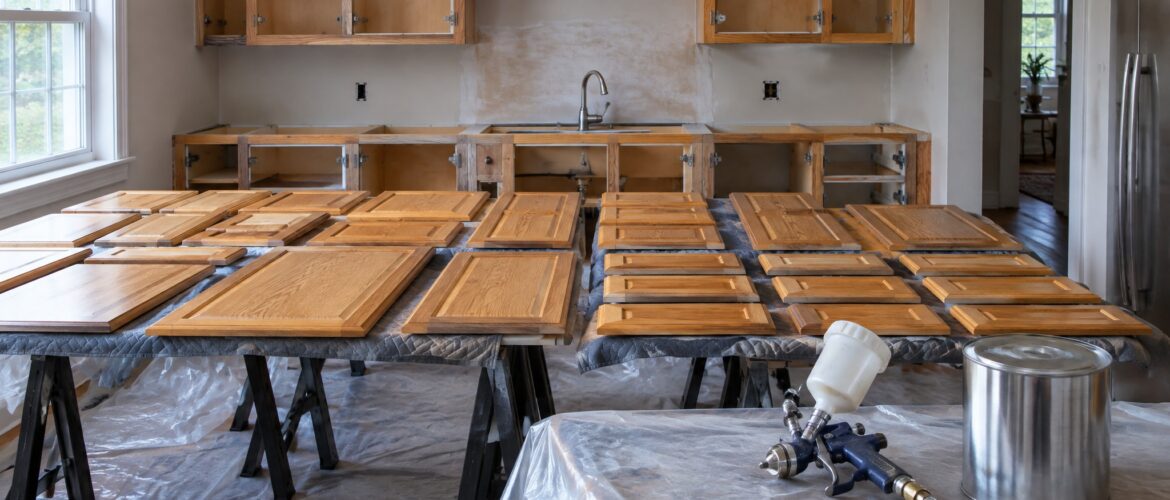
Take a kitchen we see constantly in Aurora, Centennial and Highlands Ranch. It has roughly 30 doors and drawer fronts. The finish is either 1990s honey oak or a painted coat that has worn through at the handles and around the sink. The homeowner wants a clean, factory-looking color, and we’ll do it with a spray-applied finish: HVLP application, precat primer, and a crosslinking urethane lacquer (the family of finishes people call 2K poly or conversion varnish).
How the quote is built
A proper quote has these lines, and you should be able to see each one:
- Doors and drawer fronts, priced per piece. This is the biggest line. Every piece is sprayed on both faces and the edges, so each one is handled, flipped, dried and sprayed again.
- Face frames and cabinet boxes. These are usually priced by the linear foot, because they stay on the wall. We mask the kitchen and spray them in place.
- Prep. Degreasing comes first, since cooking residue is the main reason finishes fail. Then comes sanding, grain filling on oak, and repair of peeling or scratched spots.
- Primer. Precat primer goes on with HVLP equipment and is sanded smooth before any color.
- Color coats. Thin, even coats are sprayed, not brushed or rolled.
- Clear topcoat. The crosslinking urethane lacquer is what gives the cabinets their hard, wipeable surface.
- Hardware and adjustment. We remove hinges and pulls, reinstall them, and adjust the doors so they hang and close square.
Refinishing is priced per door and per linear foot, not per kitchen. A kitchen is a count of pieces plus the condition of each one. That’s why published averages swing so widely: a 12-door galley and a 40-piece kitchen with an island are different jobs, and a per-kitchen figure hides the difference. When you want real rates to apply to this example, start with our per-door refinishing rates in Denver and our 2026 Denver pricing guide.
The job runs two to five days, depending on the kitchen, and it carries our 3 year warranty.
Refinishing is not refacing
Search results blend these two, and it distorts every price comparison. Refacing replaces the door and drawer fronts and often applies veneer to the face frames. You’re buying new parts. Refinishing keeps your existing doors and boxes and rebuilds the surface on them.
Different work means different money. If a bid says “new doors” or “veneer,” it isn’t a refinishing quote, and putting it next to ours tells you nothing.
What a cheap quote leaves out
The low bid in a stack of three is usually a brushed or rolled paint job. Here is what that bid skips:
| Brushed or rolled paint quote | Spray-applied factory finish quote | |
|---|---|---|
| Application | Brush and roller, with visible strokes | HVLP spray, smooth and even |
| Primer | Often a single brushed coat, or none | Precat primer, sprayed and sanded |
| Topcoat | Softer paint that chips at edges | Crosslinking urethane lacquer, hard film |
| Oak grain | Shows through the paint | Filled before priming |
| Doors | Often painted on the hinges | Hardware removed, doors sprayed off the frame |
A brushed job is cheaper because it skips labor and uses a softer coating. You pay the difference later, in chips around the pulls and a surface that scrubs off. We cover that gap in detail in HVLP spray versus brushed paint.
What moves the number up or down
Six things drive most of the price on our 30-door kitchen.
Condition of the existing finish. A sound, clean finish needs a scuff and a degrease. A finish that’s peeling, gouged or soaked with years of grease needs more labor before anything is sprayed.
Wood species and grain. Oak has open grain, and it telegraphs through the finish if you skip the filler step. Grain filling on oak cabinets adds time, but it’s what separates a smooth, furniture-grade surface from painted oak that looks like painted oak. Maple and other tight-grain woods skip that step.
Color change. Going from honey oak to white takes more coverage than refreshing a tone you already have.
Glazing or two-tone. Glazing adds cost and depth because it’s another hand-finished step. A two-tone kitchen means two color runs and more masking.
Number of doors. More pieces means more spraying, drying and handling, so price scales with the count.
Repairs. Chips, dents and failed edges get fixed before priming, and each repair is labor.
One limit worth stating. Refinishing rebuilds the surface, but it won’t rescue doors that have swollen from water damage or boxes that are structurally failing, and it won’t change your layout. If the cabinets themselves are shot, replacement may be the honest answer.
Why Refinishing Costs a Fraction of Replacement
Most homeowners who call us are holding a replacement quote north of $25,000. Our work typically saves about 70% against that number, and the savings come from what you don’t pay for: demolition, new cabinet boxes, countertop disruption and the weeks of a torn-up kitchen.
Your kitchen stays usable while we work. Nothing comes off the wall except doors and hardware, so there’s no dust-filled demo, and the whole job takes two to five days. Compare that with the weeks-long lead time on most new cabinet orders.
The question you’ll want answered next is whether a sprayed finish holds up here. Colorado’s dry air pulls moisture out of wood, and softer paint films crack along joints and wear through at edges as the wood moves. A crosslinking urethane lacquer cures into a hard, chemically bonded film that’s built to take that movement, and we stand behind it with a 3 year warranty.
For a deeper look at the numbers, read our comparison of refinishing versus replacement.
Getting a Quote You Can Compare
A quote is only comparable if every bidder prices the same work, so make each one answer the same questions in writing. Ask for per-door pricing with face frames and boxes broken out as separate lines. Then ask what spray system is used, and whether the answer is HVLP or a brush and roller.
Next, ask what primer goes on and what the topcoat is. “Paint” isn’t an answer. You want to hear a precat primer and a crosslinking urethane lacquer, or a clear description of whatever the shop uses instead. Ask how oak grain is handled, and whether doors are sprayed off the frame with hardware removed.
Then ask about the paperwork. How long is the warranty, in writing? Is the contractor licensed and insured? A bid that can’t answer those is the one to be careful about, however low the number.
We work throughout the Denver metro area, including Aurora, Parker, Highlands Ranch, Centennial and Littleton. If you’re comparing a paint-only bid against a replacement quote, we’ll walk your kitchen, count the pieces and write up each line item. You can request an on-site estimate and see exactly where the money goes before you decide.
Frequently asked questions
How much does it cost to get kitchen cabinets refinished?
It depends on the number of doors and drawer fronts, the linear feet of face frame, and the condition and wood species of what you have now. Shops price by the piece and by the linear foot, not by the kitchen. Refinishing typically saves about 70% compared with a $25,000+ replacement, and an on-site estimate gives you the exact line items.
What do professional painters use to paint kitchen cabinets?
We spray with HVLP equipment, starting with a precat primer and finishing with a crosslinking urethane lacquer, often called 2K poly or conversion varnish. That produces a hard, smooth factory-style finish. Brushed or rolled paint is softer and shows strokes.
What cabinet color is outdated?
Orange-toned honey oak and heavy brown stains are the finishes homeowners most often want gone. Refinishing changes the color completely, so dated oak doesn’t mean replacing the cabinets. On oak, we fill the grain first so the new color looks smooth.
What is the most expensive part of redoing a kitchen?
Cabinets are usually one of the largest line items, especially when you tear out and replace them. That’s why homeowners facing a $25,000+ replacement quote look at refinishing. Keeping your existing boxes and rebuilding the surface cuts about 70% from that cost.