
What if your kitchen’s “new” look didn’t start peeling near the dishwasher after only eighteen months? Many homeowners ask how long does professional cabinet painting last before they commit to a renovation, fearing that a fresh coat of paint is just a temporary fix. You’re right to be skeptical of standard house painting techniques. In the high-moisture environment of a Denver kitchen, a basic DIY job or a cheap service will fail quickly. We understand the anxiety of potentially wasting money on a finish that won’t survive daily use.
This 2026 durability guide promises to show you exactly how a professional refinishing process achieves a factory-like finish that lasts for a decade or more. You’ll discover the specific value of choosing high-performance industrial coatings over cabinet replacement. We will preview the meticulous cleaning, sanding, and professional spray application used in Cabinet Painting Denver and Cabinet Refinishing Denver projects to ensure your cabinets remain durable for years to come. Our 45 years of experience proves that the right system creates a permanent bond that withstands the test of time.
Key Takeaways
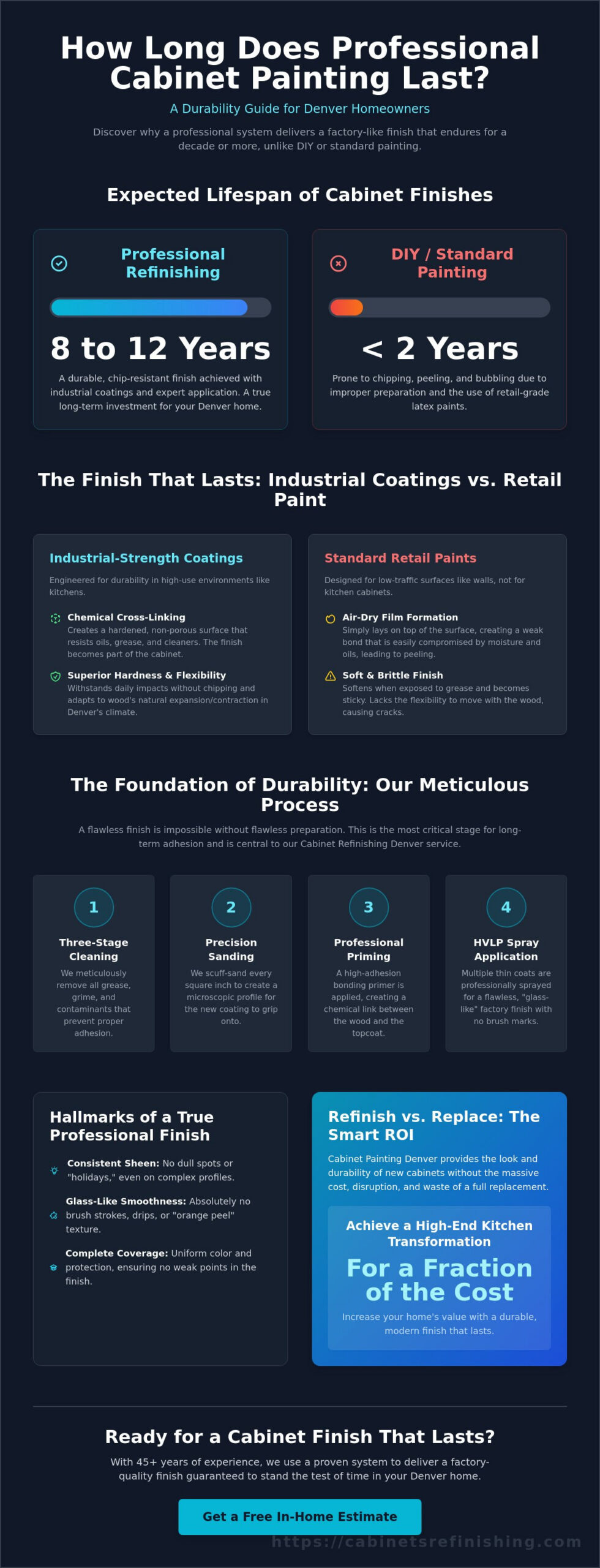
- Understand why professional results typically endure for 8 to 12 years and discover the factors that determine how long does professional cabinet painting last in a busy kitchen.
- Learn the difference between industrial-strength coatings and retail paints, and why professional spray application is essential for a factory-smooth, chip-resistant finish.
- See why meticulous preparation, including three-stage cleaning and precision sanding, is the most critical step for long-term adhesion in Denver’s unique climate.
- Identify the proper maintenance techniques and cleaning agents that extend the life of your refinished cabinets while avoiding common mistakes that damage the bond.
- Evaluate the significant cost savings and high return on investment achieved by choosing professional cabinet refinishing over full kitchen replacement.
The Lifespan of Professionally Painted Cabinets: What to Expect
Homeowners in the Denver metro area frequently ask how long does professional cabinet painting last before they decide to refresh their kitchens. A professionally executed project typically maintains its integrity for 8 to 12 years. This is not a simple coat of paint; it is a sophisticated technical application. Unlike DIY attempts that often fail within 24 months, professional Cabinet refinishing Denver involves industrial-grade coatings that bond chemically to the wood. This bond ensures the surface remains intact through thousands of door openings and closings.
It is vital to distinguish between cosmetic wear and structural failure. Structural failure includes peeling, chipping, or bubbling. These issues usually stem from poor adhesion during the wood finishing process. While cosmetic fading might occur after a decade of heavy UV exposure from Colorado’s intense sun, the finish itself should remain firmly attached. The quality of your original cabinet boxes also plays a major role. Solid maple, oak, or cherry boxes provide a stable foundation that allows the new finish to last significantly longer than cheap particle board alternatives.
To better understand the longevity of these finishes and why they don’t peel, watch this helpful video:
The 10-Year Benchmark: Why Quality Matters
Achieving a 10-year lifespan requires a factory-like finish that stays bonded longer than standard latex paints. We use a proven system that leverages 45+ years of experience to ensure the coating survives the unique climate of the Front Range. Denver homeowners see a higher ROI from Cabinet Painting Denver because the results rival the durability of new custom cabinets. Our process accounts for the way wood expands and contracts in low humidity, preventing the premature cracking often seen in amateur work.
Signs of a High-Quality Professional Application
A premium application is immediately recognizable by its “glass-like” smoothness. When you run your hand over the surface, there should be no grit or “orange peel” texture. A high-quality Cabinet refinishing Denver project will also feature:
- Consistent sheen: The light reflects evenly across all surfaces, including difficult edges and corners.
- Chemical resistance: The finish stands up to kitchen oils, grease, and common household cleaners without softening.
- Precision coverage: There are no thin spots or “holidays” in the coating, even on complex door profiles.
When you understand how long does professional cabinet painting last, you can see that the value lies in the preparation and the materials. A durable finish is the result of a hardworking, no-nonsense approach to craftsmanship that prioritizes long-term performance over a quick cosmetic fix.
For homeowners in British Columbia or other regions looking for this same level of dedication to quality and professional results, you can visit BC Interior Painting Pros to discover expert residential painting services.
Why Some Finishes Last Decades While Others Fail
The difference between a finish that fails and one that endures comes down to chemistry. Most homeowners assume all paint is created equal. This is incorrect. Retail store paints rely on air drying to form a film. In contrast, professional industrial coatings use chemical cross-linking binders. These binders create a surface that can last 10 to 20 years when applied by an expert. Standard kitchen paints lack the hardness required to resist the softening effects of skin oils and kitchen grease. Over time, these oils break down retail paint. This leads to the sticky, peeling surfaces often reported by those who attempt DIY projects or hire general painters.
Substrate compatibility is equally critical to the lifespan of the work. Maple provides a smooth, tight grain ideal for a factory finish. Oak has deep pores that require specific filling techniques to prevent the finish from sinking or cracking. In Denver, high UV exposure and fluctuating kitchen temperatures from cooking steam can punish a weak coating. Professional Cabinet Refinishing Denver systems are designed to expand and contract without losing their bond. If you want to see how these industrial-grade materials look in a real kitchen, you can explore our gallery of Cabinet Painting Denver projects.
Industrial Coatings vs. Standard Kitchen Paint
Professional grade coatings utilize a chemical reaction called cross-linking. This creates a molecular bond far stronger than any retail product. Standard “cabinet paint” from big-box stores is often just a modified acrylic. It stays soft for weeks and remains vulnerable to impact. Industrial lacquers and 2K polyurethanes harden quickly. They provide a high-level defense against the daily rigors of a busy kitchen. This superior hardness is why how long does professional cabinet painting last is a question with a very different answer than DIY painting.
The Impact of Application Technique on Longevity
Application technique determines the final durability. Brushing or rolling leaves weak points where the coating is uneven. These textures trap dirt and oils, which accelerates wear. High-volume, low-pressure (HVLP) and airless spray systems provide a more resilient bond. They deliver a uniform, multi-coat system. This process includes:
- Primer: Blocks tannins and ensures the topcoat sticks.
- Surfacer: Levels the wood grain for a smooth foundation.
- Topcoat: Provides the final color and protective shield.
This synergy ensures the finish remains smooth to the touch. A controlled spray environment prevents dust and debris from compromising the bond. When you understand how long does professional cabinet painting last, you realize it’s the result of combining the right chemistry with an expert application. Our 45 years of experience ensures your cabinets survive the harsh Colorado environment and look brand new for years.
The Denver Difference: Meticulous Preparation for Colorado Homes
Denver’s arid climate presents unique challenges for wood surfaces. The low humidity levels found along the Front Range cause wood to contract more significantly than in coastal regions. This movement can lead to finish cracking if the coating lacks a superior bond. The answer to how long does professional cabinet painting last depends entirely on what happens before the first drop of paint is sprayed. Without specialized preparation, even the most expensive coatings will eventually fail. Our 45 years of experience in the local area has taught us that a “sterile” surface is the only way to ensure 10-year durability.
When evaluating the durability, maintenance, and cost of a kitchen refresh, preparation is the variable that matters most. We focus on creating both a chemical and mechanical bond. Mechanical bonding is achieved through precision sanding, which creates “teeth” for the primer to grab. Chemical bonding occurs when the surface is completely free of contaminants. This dual approach is why our Cabinet refinishing Denver projects maintain their factory-like appearance long after amateur jobs have begun to peel around the handles and stove.
Cleaning and De-Glosser: The First Line of Defense
Standard household soap isn’t enough to remove decades of cooking oils, skin grease, and aerosolized waxes. We use a three-stage cleaning process to strip away these hidden layers. It’s vital to neutralize these cleaning agents before moving to the next step. Any residue left behind will prevent the primer from sticking. Cabinet Painting Denver requires a surface that is chemically clean. This meticulous approach ensures that the bond between the wood and the coating is permanent and resilient against the high heat and steam of a functioning kitchen.
Sanding and Dust Management
Sanding is non-negotiable for long-term durability. We use scuff sanding to prepare the existing finish without destroying the structural integrity of the wood. For open-pore woods like Oak, we address grain filling to provide the modern, smooth look homeowners in Highlands Ranch and Lakewood desire. Dust management is equally critical. A single speck of dust can create a weak point in the finish. We maintain a controlled environment to ensure your cabinets remain smooth to the touch for their entire lifespan.
Masking and Containment in Denver Homes
Professional Cabinet refinishing Denver is as much about protection as it is about painting. We use professional-grade masking to seal off your countertops, backsplashes, flooring, and appliances. We also implement specific ventilation strategies. Proper airflow is necessary for the coating to cure correctly in our high-altitude environment. This level of detail justifies the professional price point. It ensures that the only thing getting a new finish is your cabinets, leaving the rest of your home pristine and protected.
Maintenance Strategies to Extend Your Finish to 15 Years
The initial quality of your finish is set by our team, but your maintenance habits dictate how long does professional cabinet painting last over the next decade. Many homeowners treat newly painted cabinets like their old ones immediately. This is a mistake. Professional industrial coatings require a specific curing window to reach maximum hardness. While the surface feels dry within hours, the chemical bond takes 30 days to fully cure. During this first month, the finish is susceptible to impressions or scratches from heavy use.
Managing high-traffic zones is critical for long-term success. Sink cabinets and trash pull-outs receive the most exposure to moisture and friction. In Denver’s dry climate, wood movement is inevitable. Maintaining stable indoor humidity prevents “joint cracks” where the door frame meets the panel. These small cracks are normal in Colorado, but keeping your home between 30% and 40% humidity helps minimize this movement. If you want a finish designed for long-term durability in the Front Range, contact us for an estimate on Cabinet refinishing Denver.
The Post-Refinishing Care Protocol
Proper cleaning is the difference between a finish that lasts 8 years and one that lasts 15. You must avoid harsh chemicals that break down the protective topcoat. Follow these steps for a safe cleaning routine:
- Step 1: Wait for the full cure. Don’t perform any heavy scrubbing for the first 2 to 4 weeks after the project is completed.
- Step 2: Use microfiber cloths and pH-neutral cleaners. Avoid vinegar, ammonia, and citrus-based cleaners, as these are too acidic for professional coatings.
- Step 3: Wipe away spills immediately. Moisture infiltration at the seams can cause the wood to swell, which eventually compromises the finish bond.
Preventing Common Wear Patterns
Preventative measures stop damage before it starts. Properly installed hardware is your first line of defense. Knobs and pulls should be large enough to prevent your fingernails or skin oils from constantly touching the painted surface. Skin oils are naturally acidic and will soften even the toughest finishes over several years of repeated contact.
Be mindful of steam. Coffee makers, kettles, and toaster ovens release intense heat and moisture directly onto the bottom of upper cabinets. Pull these appliances forward so the steam clears the cabinet face. If you notice a minor nick from a dropped pot, address it quickly. Small touch-ups prevent moisture from getting under the coating. Our 45 years of experience in Cabinet Painting Denver shows that homeowners who follow these simple rules enjoy a factory-fresh look for nearly double the time of those who don’t.
Cabinet Refinishing vs. Replacement: The ROI Debate
Financial logic often dictates the direction of a kitchen remodel. Choosing to refinish rather than replace provides a significant cost advantage, typically saving between 60% and 75%. This budget surplus allows you to invest in other high-impact areas like stone countertops or modern appliances. When homeowners evaluate how long does professional cabinet painting last, the return on investment becomes clear. You get a durable, factory-grade surface for a fraction of the cost of new custom cabinetry.
The structural quality of your existing cabinets is a major factor in this debate. Many older homes in the Denver area feature solid wood or high-grade plywood boxes. These materials are often more resilient than the particle board found in modern budget replacements. By choosing Cabinet Painting Denver, you maintain these high-quality bones while updating the aesthetic. This path is also the sustainable choice for residents in Aurora and Centennial, as it keeps perfectly functional wood out of local landfills.
When to Refinish and When to Replace
Structural integrity and kitchen layout are the two primary deciders. If your current footprint works for your cooking style, replacement is rarely necessary. Layout changes are the only reason to endure the massive expense and mess of a full tear-out. Cabinet Refinishing Denver provides a finish that is indistinguishable from new cabinets. Our 45 years of experience ensures that if the boxes are solid, the final result will look and perform like a custom installation.
The Speed of Transformation
Kitchen downtime is a significant burden for active families in Lakewood and Boulder. A full cabinet replacement can leave your home in a state of construction for weeks. In contrast, our process is measured in days. We focus on efficiency and clear communication to minimize the impact on your daily life. This speed, combined with the long-term durability of industrial coatings, makes refinishing the most practical choice for a modern kitchen update.
Ready for a factory finish? Get your instant estimate from Cabinet refinishing Denver today!
Invest in a Lasting Kitchen Transformation
Professional cabinet refinishing is a superior alternative to the high cost and disruption of a full remodel. You now understand that how long does professional cabinet painting last depends on the synergy of industrial coatings and meticulous preparation. A factory-like finish isn’t achieved by accident. It requires a proven system designed for the unique Colorado climate. By focusing on mechanical bonds and chemical resistance, you ensure your cabinets remain a centerpiece of your home for a decade or more.
Our team brings over 38 years of specialized experience to every project in Denver, Highlands Ranch, and Parker. We take pride in delivering results that rival the durability of new custom cabinetry. You can achieve the kitchen of your dreams while saving significantly compared to replacement. Get a Free Cabinet Refinishing Estimate in Denver and take the first step toward a beautiful, resilient kitchen today. We are ready to help you increase your home’s value with a finish that’s built to last.
Frequently Asked Questions
Is professional cabinet painting better than DIY?
Professional painting is superior because it uses industrial coatings and spray technology that DIYers cannot access. DIY projects often use retail latex paint that stays soft and peels under heat. Professionals use 2K polyurethanes or lacquers that create a permanent chemical bond. This is a primary reason why the answer to how long does professional cabinet painting last is usually a decade or more compared to just 3 years for DIY.
Will the paint on my cabinets chip around the handles?
A professional finish will not chip around handles if the surface was properly prepared and an industrial-grade coating was used. Chipping in high-touch areas is usually caused by skin oils softening weak, store-bought paint. Our 45 years of experience ensures we use a three-stage cleaning process to remove these oils. We then apply a hardened topcoat that resists human acidity and daily friction from fingernails.
How long do I have to stay out of my kitchen during refinishing?
You typically only need to avoid using the kitchen for 3 to 5 days during the active spraying and drying phases. While the total project might take a full week, the restricted period is brief. We mask off the area completely to protect your home from overspray. Once the doors are reinstalled, you can use the kitchen immediately. Just be gentle for the first 30 days while the coating cures.
Can you paint over previously painted or stained cabinets?
We can successfully refinish cabinets that have been previously painted or stained, provided the wood is structurally sound. The key is our meticulous preparation protocol. We sand the old finish to create a mechanical bond and use specialized primers to prevent old stains from bleeding through. This allows for a complete color transformation in your Denver home regardless of the current state of your cabinetry.
Does the Colorado climate affect how long cabinet painting lasts?
Denver’s low humidity and high UV exposure require specific materials to prevent cracking and fading. Wood contracts more in our dry air than in coastal regions. We use flexible industrial coatings that move with the wood rather than becoming brittle. This local expertise is essential for Cabinet Refinishing Denver projects. It ensures the finish does not fail during the extreme temperature shifts common in the Front Range.
What is the difference between cabinet painting and cabinet refinishing?
Cabinet painting often refers to a simple cosmetic update using brushes and rollers. Cabinet refinishing is a comprehensive industrial process involving stripping, cleaning, and high-volume spray application. Refinishing focuses on the chemistry of the bond to achieve a factory-smooth result. Painting is often a surface-level application that lacks the long-term durability and resistance to kitchen grease that homeowners expect from a professional service.
How do I clean my painted cabinets without damaging the finish?
Use a soft microfiber cloth and a pH-neutral soap or a simple mixture of warm water and mild dish detergent. Avoid abrasive pads and harsh chemicals like ammonia or vinegar. These acidic cleaners can etch or soften the protective topcoat over time. Keeping the surface dry and wiping away grease immediately will help extend the lifespan of your Cabinet Painting Denver investment and keep the sheen consistent.
Will my kitchen smell like paint during the process?
There is a temporary odor during the spray application, but we use high-powered ventilation systems to exhaust fumes outside. Modern industrial coatings dry very quickly. This helps dissipate the smell much faster than traditional oil-based paints. We use professional masking and plastic containment to keep odors from spreading into the rest of your home. The smell usually vanishes within 24 hours after the final coat is applied.