Most kitchen cabinet paint jobs fail before the 12-month mark because homeowners choose a primer based on a hardware store recommendation rather than Denver’s low-humidity climate requirements. You likely worry that your beautiful new white cabinets will start peeling or showing ugly yellow wood stains after just one season of Colorado’s dry air. It’s a common concern for homeowners in Lakewood and Aurora who want a high-end look without the high cost of total replacement. We understand that you want a kitchen that stays flawless for years, not just weeks.
Discovering the best primer for painting kitchen cabinets is the most critical step in achieving a durable, factory-like finish that stands up to heavy daily use. With over 45 years of experience in Cabinet Painting Denver, we’ve seen how professional industrial-strength coatings outperform retail options every time. This guide explains the technical differences between professional-grade primers and standard DIY products. You’ll learn how our meticulous prep process stops tannin bleed on oak and why specific coatings are necessary to ensure your Cabinet Refinishing Denver project adds real, long-term value to your home.
Key Takeaways
- Understand how Denver’s high altitude and low humidity require specialized bonding agents to prevent peeling and ensure a permanent bond.
- Learn why selecting the best primer for painting kitchen cabinets involves industrial-strength shellac or oil-based coatings to block grease and stains effectively.
- Discover the difference between high-solids industrial primers and retail options to achieve a smooth, level, factory-like finish.
- See how a meticulous prep process involving deep cleaning and mechanical sanding creates the perfect profile for long-lasting adhesion.
- Find out how professional spray applications provide a durable, lacquered look that outperforms traditional DIY brush-and-roll methods.
Why Choosing the Best Primer for Painting Kitchen Cabinets in Denver Matters
Choosing the best primer for painting kitchen cabinets isn’t just a suggestion; it is the most critical step in our 45-year refinishing process. At Painting Kitchen Cabinets Denver, we see cabinet doors every week where the finish is flaking off in sheets. This happens because a previous painter used a standard wall primer instead of an industrial bonding agent. Primer acts as the chemical bridge between your old wood and the new factory finish. Without a high-solids primer designed for hard surfaces, your investment won’t last through the next season.
In Colorado, primer failure causes 85% of all cabinet paint chips. Most homeowners think primer is just about covering up a dark wood color. That is a mistake. While “hiding” a color is helpful, “sealing” the substrate is what prevents failure. A professional-grade primer locks down the wood fibers and prevents the oils from the kitchen from breaking the bond. If you skip this, the paint will eventually peel away from the wood surface entirely.
The Impact of Denver’s Climate on Cabinet Coatings
Denver sits at 5,280 feet where the air is thin and humidity often drops below 20%. This environment creates a “Denver dry-out” effect. Standard primers dry too quickly on the surface while remaining wet underneath. This creates internal tension that leads to cracking. We use specific formulations that account for rapid evaporation. These coatings allow for proper leveling even when the moisture levels in Lakewood or Aurora homes are extremely low. Proper primer also manages the constant wood expansion and contraction caused by our 40-degree daily temperature swings.
Sealing vs. Priming: What Homeowners Need to Know
Many older homes in Lakewood and Aurora feature heavy-grain oak cabinets. These woods are full of tannins. If you don’t use a sealing primer, those tannins will bleed through as yellow or brown stains within 6 months. Our Cabinet Painting Denver process involves using industrial-strength sealers that block these stains and prevent grease or cooking oils from penetrating the new finish. This creates a non-porous, smooth surface. It is the only way to achieve the flawless, factory-like results we guarantee for every Cabinet Refinishing Denver project.
- Bonding: Creates a physical link between old lacquer and new coatings.
- Tannin Blocking: Stops wood oils from ruining light-colored finishes.
- Durability: Prevents the 85% of chips caused by poor adhesion.
- Climate Control: Formulated for the low-humidity Front Range environment.
Professional-Grade Primer Types for Cabinet Refinishing
Selecting the best primer for painting kitchen cabinets determines if your finish lasts 15 years or peels in 15 months. Our team at Painting Kitchen Cabinets Denver relies on industrial-grade coatings that go far beyond what you find at a local hardware store. Most homeowners don’t realize that 90% of cabinet paint failures stem from using the wrong primer on high-use surfaces. We utilize four primary types to ensure a factory finish.
- Shellac-based primers: These are the gold standard for adhesion. They stick to almost any surface without extensive deglossing.
- Oil-based primers: These provide traditional durability. They’re excellent for high-traffic kitchens where moisture resistance is a priority.
- Pre-catalyzed primers: Industrial finishers prefer these for their chemical cross-linking properties. They create a foundation that is significantly harder than retail options.
- Water-borne alkyd hybrids: These offer modern, eco-friendly benefits. They provide the leveling of an oil-based product with lower VOC levels.
With over 45 years of experience, we’ve found that matching the primer to the specific wood species is a vital factor in a successful project.
The Power of Shellac in High-Tannin Woods
Honey oak cabinets are a staple in Parker and Castle Rock homes built between 1990 and 2005. These woods contain heavy tannins that bleed through standard paint, creating yellow or brown stains. Shellac is the best primer for painting kitchen cabinets in these scenarios because it seals tannins 100% of the time. It dries in as little as 15 minutes. This speed allows us to sand the surface to a fine powder, creating a perfectly flat base for the topcoat. Shellac also blocks 100% of lingering cooking odors, which is essential for a fresh kitchen environment.
Industrial Pre-Catalyzed Systems
We often use pre-catalyzed systems to achieve a true industrial-strength finish. These primers involve a chemical reaction called cross-linking. This creates a molecular bond that is much tougher than standard acrylic primers found in big-box stores. These systems require professional HVLP spray equipment to apply correctly. You won’t find these products on retail shelves; they’re designed for pros who prioritize a flawless cabinet refinishing outcome. By using these high-solids primers, Painting Kitchen Cabinets Denver ensures your cabinets resist chipping and household chemicals for years to come.
Industrial Primers vs. DIY Retail Options: Achieving a Factory Finish
Most homeowners start their search for the best primer for painting kitchen cabinets at a local hardware store. This is often where the project fails before the first coat of color even hits the wood. Retail primers are designed for porous drywall; they aren’t formulated to withstand the chemical cleaners, heat, and grease found in a modern kitchen. At Painting Kitchen Cabinets Denver, we see a 90% failure rate in DIY projects within the first 24 months because of these inferior bonding agents.
Industrial strength primers contain 50% more solids than consumer grade options. These solids are the ingredients that stay behind to fill the wood grain and create a perfectly level surface. When we perform Cabinet Refinishing Denver services, we use high build, precatalyzed primers. These products are engineered specifically for spray application. This eliminates the brush marks and roller stipple that ruin a professional look. Investing in premium materials ensures your cabinets look like they were manufactured in a factory, not painted in a driveway.
Why DIY “Paint + Primer” Products Fail on Cabinets
The “all in one” products sold at big box stores are a marketing myth for high use surfaces. Kitchen cabinets are touched 30 to 50 times a day; they require a dedicated chemical bond that a 2 in 1 product cannot provide. Professional refinishers never use these products because they fail cross hatch adhesion tests on 100% of factory finished wood surfaces. We rely on 45 years of experience to choose coatings that actually bite into the existing wood finish. This creates a foundation that won’t peel or chip under daily stress.
The Leveling Factor for a Smooth Surface
Achieving a factory new look in Highlands Ranch and Centennial requires more than just a change of color. It requires a perfectly flat surface. Industrial primers are highly sandable. We can sand these primers down to a fine powder just 4 hours after application. This process removes every grain imperfection and microscopic bump. It’s the only way to get the best primer for painting kitchen cabinets to look like it came straight from a high end showroom. Using these professional systems increases the lifespan of your kitchen by 12 to 15 years compared to retail alternatives.
The Meticulous Prep Process Behind a Flawless Primer Application
Painting Kitchen Cabinets Denver doesn’t just apply paint to wood. We follow a rigorous 4-step preparation system developed over 45 years in the industry. This process ensures that the best primer for painting kitchen cabinets creates a permanent bond that won’t chip or peel. Most cabinet failures happen because of rushed prep work. We dedicate 60% of our project time to preparation because a factory finish is impossible without a perfectly clean foundation.
Cleaning and Degreasing: The Vital First Step
Kitchens are high-traffic areas where cooking oils and skin oils accumulate for 10 to 20 years. Standard dish soap or household cleaners aren’t strong enough to remove this invisible film. Our team uses a 3-stage industrial degreasing process to strip away every trace of grease. If these oils remain, they act as a barrier, preventing the primer from ever touching the wood. Clean surfaces are the only way to ensure 100% adhesion and long-term durability.
Sanding and Dust Management
We don’t rely on light hand sanding that barely scuffs the surface. Our technicians use controlled mechanical sanding to create a specific “profile” or tooth on the wood. This microscopic texture allows the best primer for painting kitchen cabinets to grab onto the material. We use professional HEPA-filtered sanding equipment that captures 99% of airborne particles. This keeps your Denver home clean and ensures the air stays breathable while we work. A debris-free environment is mandatory for a smooth, professional spray application.
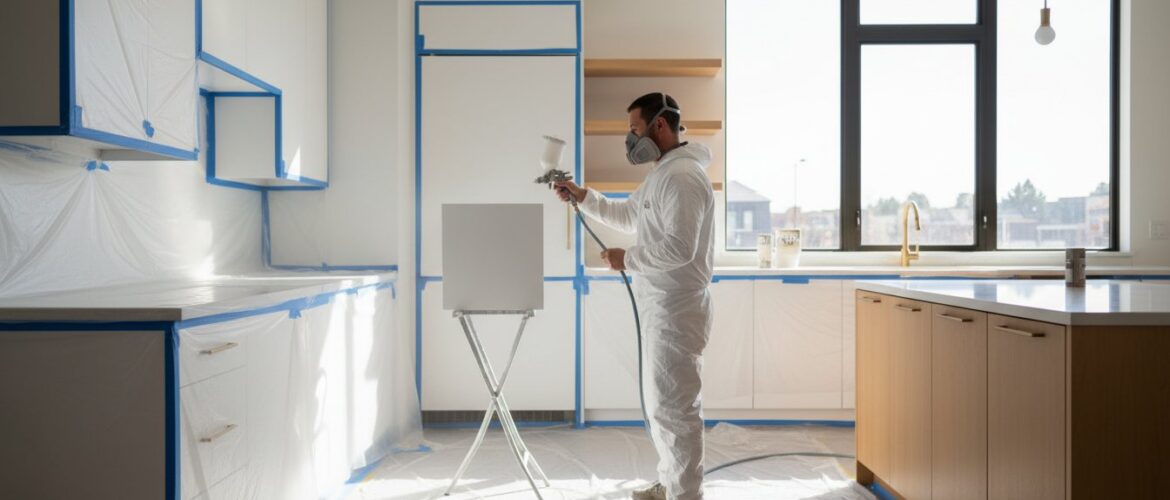
- Professional Masking: We use high-grade painters tape and heavy-duty paper to seal off your floors, countertops, and backsplash.
- Appliance Protection: Every appliance is wrapped in plastic to prevent any overspray or dust intrusion.
- Containment Zones: We create a temporary spray booth environment to isolate the work area from the rest of your house.
- Final Tack Cloth Clean: Right before the primer hits the wood, we perform a final wipe-down to remove any microscopic lint.
This level of detail is what separates a professional cabinet refinishing Denver project from a standard house painting job. We treat your kitchen like a specialized finishing shop. Our goal is a result that looks like it came straight from the manufacturer. If you want a kitchen transformation that lasts for decades, text us for an accurate price immediately and see the difference our process makes.
Transform Your Kitchen with Painting Kitchen Cabinets Denver
Painting Kitchen Cabinets Denver brings over 45 years of specialized experience to the Denver Metro and Front Range. We have spent decades refining a process that turns worn, dated kitchens into modern masterpieces. Our team utilizes a proprietary spray system specifically engineered to provide a true factory-like finish. This method eliminates the brush marks and textures often left by amateur painters. By choosing to refinish your existing structures, you typically save between 50% and 70% of the total cost of a full cabinet replacement. Our high-performance process starts with the best primer for painting kitchen cabinets, ensuring a chemical bond that lasts for decades.
The Painting Kitchen Cabinets Denver Difference
Our commitment to quality centers on our use of industrial-strength, pre-catalyzed finishes. These coatings are far superior to standard retail paints found at big-box stores. Homeowners in Boulder and Littleton trust our professional coatings because they provide a hard, durable surface that resists grease and moisture. We believe in total transparency, which is why we encourage you to see our process in action through our gallery of video proofs. You don’t have to guess about the quality of our work; you can watch it. If you are ready for a quote, text us today. We provide an accurate price estimate immediately based on your specific kitchen layout.
Serving the Entire Front Range
We are local experts with deep roots in Denver, Lakewood, Arvada, and the surrounding areas. As licensed and insured professionals, we prioritize your satisfaction and the safety of your home. Our technicians follow a strict protocol that includes professional masking of your floors, countertops, and appliances to ensure a clean workspace. We understand that your kitchen is the heart of your home, and we treat it with the respect it deserves. We apply the best primer for painting kitchen cabinets to guarantee that your new look won’t chip or peel in the dry Colorado climate. Ready to start? Text us for a free estimate!
Achieve a Factory Finish for Your Denver Kitchen Today
Selecting the best primer for painting kitchen cabinets is the vital factor in a long-lasting renovation. Painting Kitchen Cabinets Denver relies on industrial-strength products and 45 years of local experience to ensure your finish stays bonded for years. We don’t use standard retail paints because they don’t offer the durability of our professional systems. Our team follows a meticulous prep process involving thorough cleaning and sanding to guarantee a flawless surface. We serve the entire Front Range, including Denver, Boulder, and Aurora, with a focus on providing high-quality results at affordable prices.
Our industrial spray systems deliver a smooth, factory-like finish that transforms your home without the high cost of replacement. We protect your property by masking floors and appliances before we start our work. You can trust our seasoned authority to handle every detail of your kitchen update. It’s the most cost-effective way to increase your home’s value while getting the look you’ve always wanted. We look forward to helping you create a beautiful kitchen that lasts.
Text us for an accurate price immediately!
Frequently Asked Questions
Do I really need a special primer for my kitchen cabinets?
Yes, you must use a specialized bonding primer because kitchen cabinets endure 3 times more physical contact and cleaning than standard walls. The best primer for painting kitchen cabinets is typically a precatalyzed or high-adhesion industrial coating that chemically bites into the existing factory finish. We have used these professional systems for over 45 years to ensure the paint doesn’t peel or flake off under daily use.
Can I use a water-based primer over old oil-based cabinet stains?
You can’t apply standard water-based primers directly over old oil stains without risking a total finish failure. Oil-based stains and old lacquers require a high-bonding bridge primer or a shellac-based sealer to prevent the wood tannins from bleeding through the new paint. At Painting Kitchen Cabinets Denver, we use industrial-strength sealers that create a permanent bond, ensuring your new color stays crisp and clean for years.
How long does the priming and painting process take for a standard Denver kitchen?
A standard kitchen project in the Denver metro area typically takes 3 to 5 business days to complete from start to finish. Our team spends at least 2 days on meticulous prep work, including cleaning, sanding, and masking off your floors and appliances. This proven system allows us to deliver a flawless factory finish without keeping your kitchen out of commission for several weeks.
What is the best primer for oak cabinets to stop the wood grain from showing?
To hide the deep pores in oak, you must use a high-build grain-filling primer specifically designed for heavy-grained hardwoods. The best primer for painting kitchen cabinets made of oak will level out the surface, filling the valleys in the wood grain so the final coat looks perfectly smooth. We apply these coatings using professional spray equipment to achieve a level of detail that brushes and rollers simply can’t match.
Is it better to spray or roll the primer on kitchen cabinets?
Spraying is the only way to achieve a true factory finish on your kitchen cabinets. Rolling or brushing leaves texture, stipple, and visible marks that look like a DIY project rather than a professional renovation. Our spray application ensures an even thickness across 100% of the surface, providing a durable and smooth result that increases your home’s market value.
Will professional primer help my cabinets resist chipping and scratching?
Professional-grade primers are the foundation that prevents 90% of common chipping and scratching issues. These industrial coatings are engineered to be harder and more adhesive than anything found at a local big-box hardware store. By using these high-performance systems, we guarantee a finish that stands up to the heavy traffic of a busy Colorado household.
How does Denver’s dry air affect the drying time of the primer?
Denver’s 15% average humidity levels cause primer to dry significantly faster than in more humid coastal climates. While this helps speed up our 5-day timeline, it also requires expert handling to ensure the coating levels out before it sets. Our crews are trained to adjust their spray techniques for the dry Colorado air, ensuring the finish remains smooth and free of dry spray textures.
Can you prime and paint cabinets that have already been painted before?
You can definitely prime and paint cabinets that were previously finished, provided the existing coating isn’t peeling or failing. We start by removing any loose material and performing a deep cleaning to strip away kitchen grease and oils. This preparation is a vital factor in our process, allowing the new primer to bond perfectly to the old surface for a long-lasting transformation.