
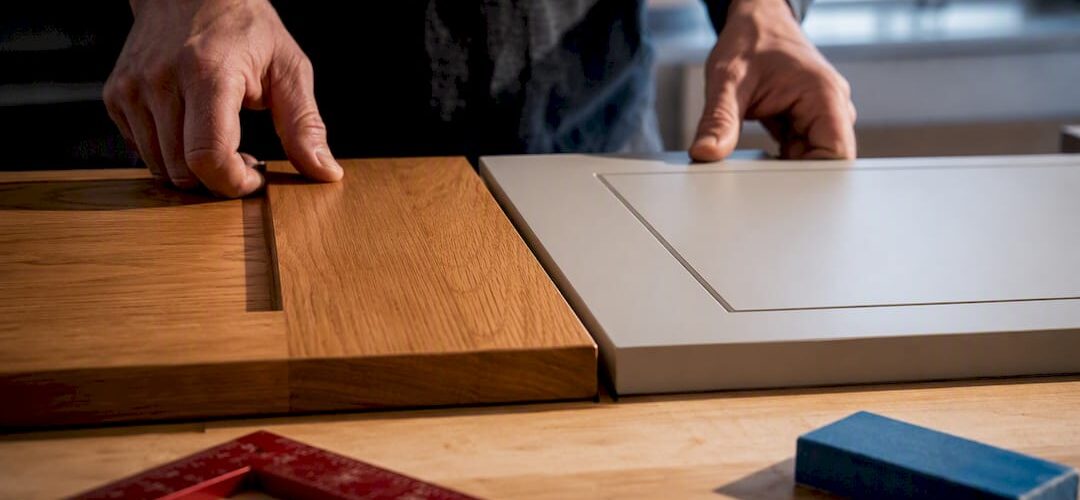
Veneer wins for anyone who wants the look and feel of real wood and plans to refinish down the road, while laminate wins for high-traffic kitchens, rentals, and tight budgets where easy cleanup matters more than authenticity. The right call depends on how much you value grain and warmth versus scratch and moisture resistance. Both hold up fine in a well-built kitchen. The details below explain why one usually beats the other for your specific situation.
TL;DR:
- Veneer offers a natural wood grain look and can be refinished, but edges are vulnerable to moisture and impact damage.
- Laminate is low-cost, highly durable, and better at resisting moisture and scratches, making it suitable for high-traffic or humid areas.
- Veneer costs more initially but can add value and longevity if properly maintained, while laminate typically needs replacement after damage.
- Proper edge sealing, especially with moisture-resistant adhesive, is crucial for veneer durability over time.
- Refinishing cabinets is often a cost-effective alternative to replacement if the substrate remains sound and damage is surface-level.
Table of Contents
- Veneer vs Laminate Cabinets at a Glance
- What Wood Veneer Is and How Veneer Cabinets Are Made
- What Laminate Is and How Laminate Surfaces Are Made
- Weighing the Pros and Cons That Actually Matter
- How Durable Is Each Material in a Real Kitchen?
- What Do Veneer and Laminate Cost Over Time?
- How to Tell if Your Cabinets Are Veneer or Laminate
- Choosing by Room, Traffic, and Long-Term Goals
- Common Misconceptions About Veneer and Laminate Cabinets
- A Refinishing Pro’s Take on Veneer and Laminate
- When Refinishing Beats Replacing Your Cabinets
- Sources
Veneer vs Laminate Cabinets at a Glance
Veneer is a thin slice of real wood glued to plywood or MDF, so it has actual grain and takes stain the way solid wood does. Laminate is a printed or resin-treated layer fused to an engineered core, so every door looks identical and cleans up with a damp rag.
Here’s how the two stack up on the factors that actually change your decision:
- Appearance and authenticity: veneer shows real wood grain and variation; laminate offers consistent, repeatable patterns and colors.
- Moisture resistance: laminate’s nonporous surface shrugs off spills; veneer needs sealed edges to resist swelling.
- Scratch resistance: laminate resists surface scuffs better; veneer scratches can often be sanded out (within limits).
- Upfront cost: laminate is typically the more budget-friendly choice; veneer costs more for the wood and labor.
- Best use case: laminate suits rentals, secondary kitchens, and high-moisture zones; veneer suits main kitchens and rooms where you want the option to refinish later.
What Wood Veneer Is and How Veneer Cabinets Are Made
Wood veneer is a thin layer of real wood, typically sliced to a fraction of an inch, glued onto plywood or MDF for stability. Manufacturers book-match sheets from the same log so the grain flows across adjacent doors, which is why high-end veneer cabinetry can look almost seamless.
Because it’s real wood on the surface, veneer accepts stain and topcoat finishes the same way solid wood does, giving it depth that printed surfaces can’t fake. Refinishing potential exists, but it’s limited: the veneer layer is thin, so heavy sanding can cut through to the substrate. Light scuffs and worn topcoats respond well to a professional refresh. Deep gouges usually don’t.
The tradeoff is edge vulnerability. Where veneer meets an edge or seam, moisture and impact do the most damage, which is why edge-banding quality matters more than almost anything else in the spec sheet.
What Laminate Is and How Laminate Surfaces Are Made
Laminate cabinets are built by bonding a resin-treated paper or synthetic decorative layer to an engineered core, usually MDF or particleboard. The result is a uniform, nonporous surface that resists staining and wipes clean without much effort.
Not all laminate is identical. High-pressure laminate (HPL) is thicker and more impact-resistant, post-formed laminate wraps seamlessly around curved edges, and melamine is a thinner, more economical version often used on cabinet interiors. Factory application means every sheet in a batch matches exactly, which is great for consistency but means there’s no grain to “reveal” if the surface gets scratched. Refinishing options are minimal. Once laminate is damaged or dated, replacement of the door or panel is usually the fix, not a sand-and-refinish job.
Weighing the Pros and Cons That Actually Matter
Appearance is where veneer cabinet advantages show up fastest. Real grain, warmth, and the ability to stain to match existing wood trim make veneer the pick for anyone chasing an upscale look. Laminate’s nonporous surface is genuinely low-maintenance, but repeat patterns can look obviously synthetic up close, and there’s no invisible way to fix a deep scratch.
- Veneer: authentic look, stainable, but vulnerable at edges and under sustained humidity.
- Laminate: easy-care, budget-friendly, but visible seams and no hidden repairs once damaged.
- Sustainability: veneer uses a thin slice of a log, stretching one tree across many cabinet fronts, while laminate relies on synthetic resins bonded to composite wood cores.
Picture three scenarios: a rental unit turnover, where laminate’s durability and low cost win outright; a busy family kitchen, where either material works if edges are properly sealed; and a designer remodel, where veneer’s grain-matching typically justifies the extra cost.
Pro Tip: Ask your supplier specifically about the adhesive used on veneer edges. PUR hot-melt adhesive resists moisture far better than older adhesive types, and it’s the single biggest factor in whether veneer edges hold up over a decade.
How Durable Is Each Material in a Real Kitchen?
Moisture is the enemy of both materials, just in different ways. Veneer with poorly sealed edges lets water creep in and lift the wood layer from its substrate. Laminate handles direct moisture better, but if a seam fails and water gets underneath, the core can swell and push the laminate up from beneath.
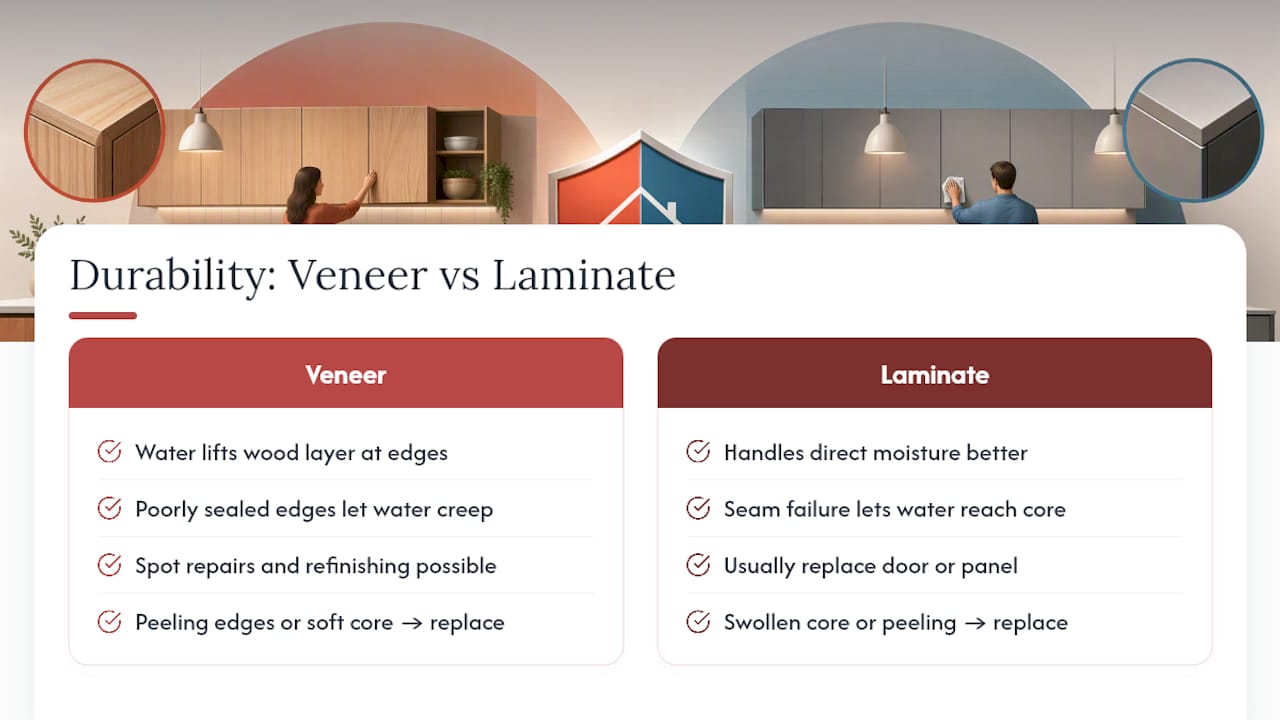
Repair options differ sharply. Veneer allows spot repairs and occasional refinishing when the damage is surface-level. Laminate generally means replacing the door or panel outright, since there’s no way to sand out a scratch or blend a patch invisibly. If you see peeling edges or a core that feels soft or swollen, that’s your signal that refinishing may not be viable and a fuller repair or replacement is needed instead.
What Do Veneer and Laminate Cost Over Time?
Laminate cabinets generally cost less upfront, since the material and manufacturing process are cheaper than sourcing and applying real wood veneer. Veneer costs climb with species choice, book-matching, and custom edge treatments, but it’s often perceived as the higher-end option by buyers and appraisers alike.
Lifecycle value tips toward veneer for homeowners planning to stay put. It ages gracefully, tolerates minor repairs, and can be refinished when the look feels dated. Laminate is cheaper to install but often gets replaced rather than refreshed, which can even out total cost over a 15 to 20 year span. For resale, a well-maintained midrange veneer kitchen typically reads as more valuable than laminate, even at a similar age.
How to Tell if Your Cabinets Are Veneer or Laminate
A quick inspection settles most doubts:
- Check the edges closely. Veneer shows a thin wood layer with visible grain running into the edge; laminate has a flat, uniform edge color.
- Run a fingernail across the surface. Veneer has subtle texture from real wood pores; laminate feels perfectly smooth and consistent.
- Look for repeating patterns across multiple doors. Laminate often shows the exact same grain print repeated; veneer grain varies naturally.
- Check an inconspicuous spot, like inside a cabinet or behind a hinge, where the material is easier to identify without cosmetic finish confusing things.
If you suspect moisture damage or you’re planning to refinish, get a professional to confirm the material before committing to a plan.
Choosing by Room, Traffic, and Long-Term Goals
Before you pick a material, answer a few honest questions: How much does appearance matter to you? How much daily traffic and moisture will the cabinets see? What’s your budget ceiling? Do you want the option to refinish in five or ten years instead of replacing?
- Rental or secondary kitchen: laminate wins on cost and low-maintenance durability.
- Main family kitchen: either works well if edges are properly sealed; veneer offers more long-term flexibility.
- Designer remodel or resale-focused project: veneer’s authenticity and refinishing potential usually justify the higher price.
- Bathroom vanities in humid climates: laminate’s moisture resistance often edges out veneer unless edge-sealing is done exceptionally well.
Bring this list to your supplier or contractor, and ask directly how they handle edge-sealing and core moisture resistance before signing off on either material.
Common Misconceptions About Veneer and Laminate Cabinets
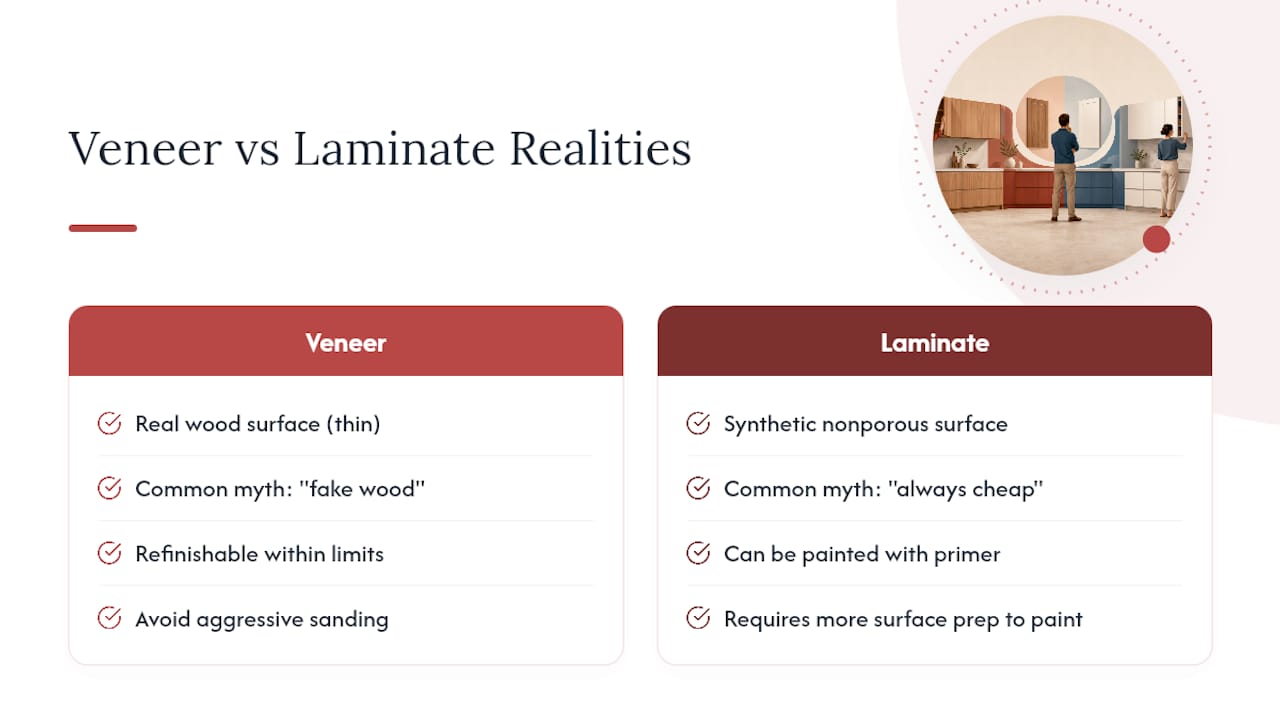
The biggest myth is that veneer is “fake wood.” It’s the opposite: veneer is a real wood surface, just thinner than solid lumber, while laminate is the synthetic option. People often assume laminate is always the cheap, low-quality choice, but high-pressure laminate can outperform low-grade veneer on durability, especially in humid or high-traffic spaces.
Another common misread is that veneer can’t be refinished at all. It can, within limits. Because the wood layer is thin, aggressive sanding will cut through it, but light scuffs and dulled topcoats often respond well to a professional refresh.
People also assume laminate can’t be updated once it’s dated. Painting laminate is possible with the right primer and prep, though it requires more surface preparation than painting bare wood since the nonporous finish resists adhesion without it.
Finally, some homeowners believe all veneer or laminate cabinets perform the same regardless of manufacturer. That’s not accurate. Edge-banding quality and adhesive type vary enormously between a big-box cabinet line and a custom shop, and that difference shows up in how the cabinets age, not on day one.
A Refinishing Pro’s Take on Veneer and Laminate
Refinishing succeeds when the substrate underneath is sound, whether that’s veneer or laminate. When edges are peeling or the core feels soft, no amount of prep saves it, and replacement becomes the honest answer. A factory-style multi-coat process can update either material’s look in days rather than weeks, when the bones are solid.
— Jesse
When Refinishing Beats Replacing Your Cabinets
If your veneer or laminate cabinets are structurally sound but visually tired, replacement isn’t your only path forward. Cabinetsrefinishing turns worn cabinet surfaces into a factory-finish look using multiple protective coats, custom color matching, and minor repairs, typically completed in three to five days rather than the weeks a full replacement takes.

Refinishing generally costs significantly less than a full cabinet replacement, making it a practical option for homeowners who like their layout but want a fresh finish. Local cabinet refinishing services evaluate each kitchen individually, since the right approach depends on the cabinet material. If your cabinets show wear but the substrate feels solid, get a quote for cabinet refinishing in Denver and find out whether refinishing makes more sense than a full remodel.
Sources
- How to repair/refinish laminate cabinets – Mr. Handyman
- Wood Veneer Cabinets Guide: 2026 Trends, Cost & Durability