
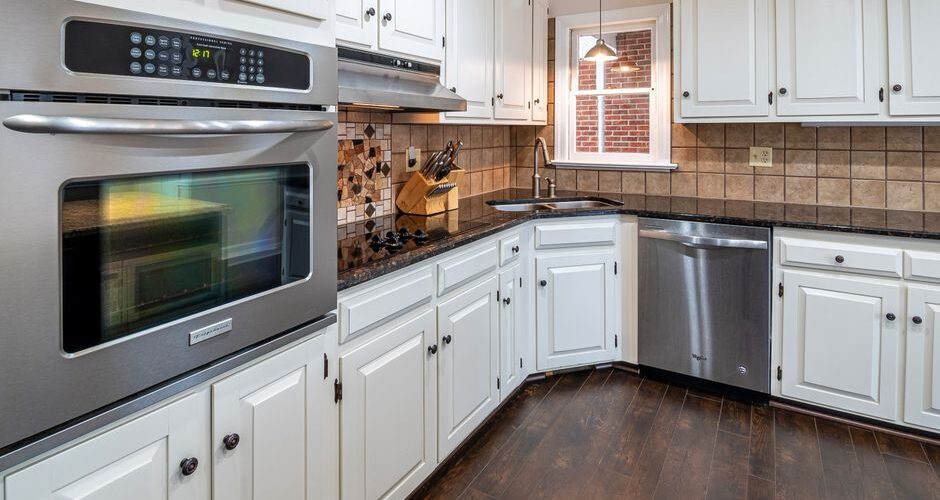
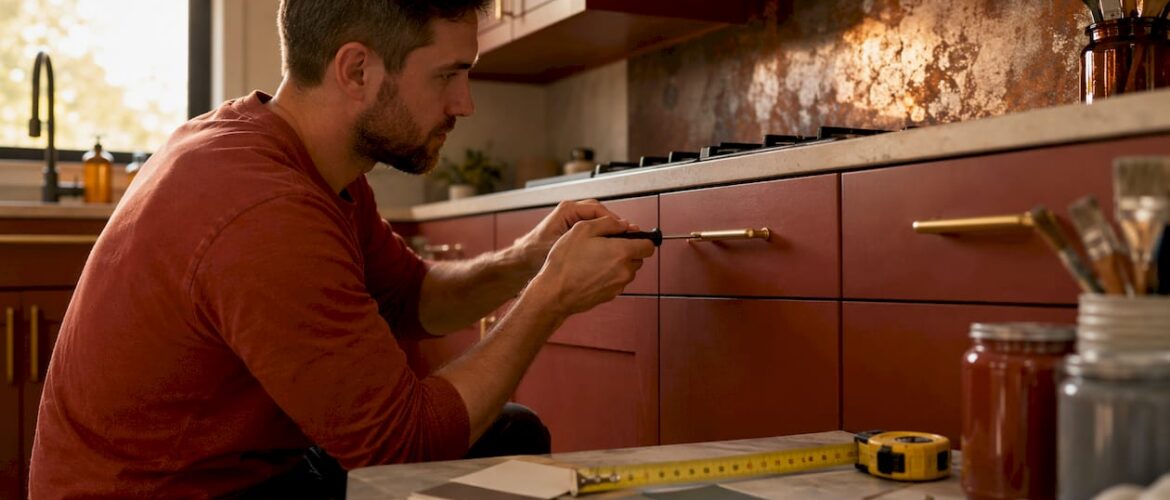
The fastest path to a new-looking kitchen runs through four moves: cabinet refinishing or painting, a hardware swap to solid-finish pulls, layered lighting with under-cabinet LEDs, and one bold backsplash. Together, these updates deliver the most visual change per dollar spent, and none of them require tearing out a wall. If your cabinet boxes are structurally sound and your layout works, professional refinishing is almost always the smarter call over replacement. A full remodel makes sense only when the floor plan itself causes daily frustration.
Start here:
- Cabinet refinishing or painting — highest visual ROI; professional projects complete in 3–5 days
- Hardware swap — costs $50–$250 total and transforms perceived quality in an afternoon
- Under-cabinet LED strips — warm light (2700–3000K) immediately improves both function and mood
- Peel-and-stick or small-tile backsplash — one focal zone, no demo required
A three-move DIY refresh (hardware + LEDs + peel-and-stick backsplash) can deliver most of the visible transformation for a low cost in materials.
Table of Contents
- How do you know if you need a refresh or a full remodel?
- The best kitchen decor refresh ideas, ranked by impact per dollar
- What does professional cabinet refinishing actually involve?
- How to plan, budget, and vet a refinishing pro
- Key Takeaways
- What professionals wish you knew before starting a kitchen refresh
- Cabinetsrefinishing delivers factory-quality results in 3–5 days
- Sources and further reading
How do you know if you need a refresh or a full remodel?
The answer comes down to one question: does your layout cause daily frustration? If you constantly run out of prep space, bump into someone opening the fridge, or fight a broken work triangle, a layout-driven remodel is likely the better long-term investment. A fresh coat of paint won’t fix a floor plan.
If the layout works fine and you just dislike how everything looks, a surface refresh is almost certainly enough. Professional refinishing runs $3,000–$8,000, while cabinet replacement typically costs $15,000–$40,000. A DIY-level non-structural refresh can run as low as $200–$800. That gap is hard to ignore when the bones of your kitchen are solid.
Ask yourself these before committing to scope:
- Are the cabinet boxes structurally sound (no water damage, no failing joinery)?
- Is the plumbing and electrical functional and up to code?
- Would a brand-new-looking kitchen still frustrate you because of the layout?
- Do you need new storage configurations or just a visual update?
Pro Tip: Live with your existing kitchen for one week and note every moment it annoys you. If the frustrations are visual (color, finish, hardware), a refresh solves them. If they’re spatial (traffic, storage, workflow), budget for a remodel instead.
The best kitchen decor refresh ideas, ranked by impact per dollar
| Upgrade | Cost Range | Timeline | Visual Impact | Durability | Disruption |
|---|---|---|---|---|---|
| Cabinet refinishing (pro) | $3,000–$8,000 | 3–5 days | High | 10–15 years | Low–Medium |
| Hardware swap | $50–$250 | 1–2 hours | High | 10+ years | Minimal |
| Under-cabinet LEDs | $50–$80 | 1–2 hours | High | 5–10 years | Minimal |
| Peel-and-stick backsplash | $60–$150 | Half day | Medium–High | 3–7 years | Minimal |
| Island paint (not full cabinets) | $50–$150 DIY | 1 day | Medium–High | 5–8 years | Low |
| Faucet swap | $100–$400 | 1–2 hours | Medium | 10+ years | Minimal |
| Statement pendant lighting | $50–$400 | 2–4 hours | Medium | 10+ years | Low |
| Open shelving (one section) | $60–$200 | Half day | Medium | Long-term | Low |
| Counter styling + declutter | $50–$150 | 1–2 hours | Medium | N/A | None |
| Textiles and rugs | $60–$200 | — | Low–Medium | 2–5 years | None |
A few specifics worth knowing:
- Measure center-to-center hole spacing before buying pulls. Mismatched spacing means patching, sanding, and repainting — a small oversight that adds real cost.
- Match metal finishes across pulls, faucet, light fixtures, and exposed hinges. Mixing finishes is the top reason DIY kitchens look unfinished.
- For countertop styling, the rule of three works: one functional item (cutting board), one natural element (small plant or herbs), one vessel (ceramic crock). Everything else goes in a drawer.
- Warm whites and earth tones are replacing sterile all-white schemes in 2026. Unlacquered brass hardware pairs naturally with these palettes and reads as intentional rather than trendy.
- For lighting, target ambient at 1,500–3,000 lumens, task at 450–800 lumens, and accent at 200–400 lumens. Warm LEDs at 2700–3000K make countertops look like a magazine spread.
For more ideas on pairing hardware with a refinishing project, the cabinet hardware update guide from Cabinetsrefinishing walks through finish selection in detail.

What does professional cabinet refinishing actually involve?
Professional refinishing follows a specific sequence, and the prep work is what separates a durable result from one that chips in two years.
- Deep clean and degrease — all cabinet surfaces stripped of grease, residue, and old wax.
- Door removal — doors and drawer fronts come off and are sprayed in a contained area or offsite.
- Scuff sanding — existing finish abraded to create mechanical adhesion for primer.
- Primer coat — a bonding primer applied to frames in-place and to doors separately.
- Multiple thin finish coats — applied with HVLP spray equipment for a smooth, factory-quality surface.
- Protective topcoat — a clear, durable layer that resists moisture, grease, and daily wear.
- Reinstallation and hardware fitting — doors rehung, new hardware installed, touch-ups completed.
This factory-finish methodology is what produces results that last a decade or more. Skipping prep steps — which budget operators often do — is why some refinished cabinets start peeling within a year.
Projects typically complete in 3–5 days because doors are processed separately while frames are finished in-place, minimizing the time your kitchen is out of commission. Most homeowners have full use of their kitchen by day three.
| Metric | Refinishing | Full Replacement |
|---|---|---|
| Typical cost | $3,000–$8,000 | $15,000–$40,000 |
| Timeline | 3–5 days | 3–8 weeks |
| Kitchen usability | Partial (days 1–2) | None during demo |
| Finish longevity | 10–15 years (pro) | a decade or more |
| Waste generated | Minimal | High (landfill) |
How to plan, budget, and vet a refinishing pro
Budgeting checklist:
- Cabinet refinishing labor + materials: $3,000–$8,000
- Hardware (pulls, knobs): $50–$400 depending on quantity and finish
- Under-cabinet lighting: $50–$150 for a typical run
- Backsplash materials: $60–$200 for a focal zone
- Contingency (10–15% of total): buffer for surprises like damaged cabinet frames
Scheduling sequence: Handle high-disruption work first. Book refinishing before hardware or lighting so you’re not installing new pulls on unfinished surfaces. A typical 3–5 day professional project runs: Day 1 — prep, clean, remove doors; Days 2–3 — prime and finish coats; Day 4 — topcoat and cure; Day 5 — reinstall and hardware fitting.
Questions to ask every pro:
- What prep steps do you take before any finish goes on?
- How many finish coats do you apply, and what product?
- Do you spray doors offsite or on-site in a contained area?
- What’s your ventilation and VOC management approach?
- Do you offer a warranty, and what does it cover?
- Can you share before-and-after photos from recent projects?
Red flags: vague answers about prep, no photos, no warranty, and bids that come in significantly below the $3,000 floor. Low bids almost always mean skipped prep steps, which shows up as peeling within 12–18 months. See 7 signs your cabinets need refinishing to confirm your cabinets are good candidates before calling anyone.
Pro Tip: Ask for the specific primer and topcoat product names. A pro who uses a quality bonding primer and a catalyzed topcoat will tell you without hesitation. One who can’t name the products is probably skipping steps.
Key Takeaways
Professional cabinet refinishing delivers the highest visual ROI of any kitchen refresh move, costs significantly less than replacement, and completes in a few days with minimal disruption.
| Point | Details |
|---|---|
| Start with a layout check | If the floor plan works, a surface refresh solves most visual problems without a remodel. |
| Hardware is the fastest win | An affordable hardware swap transforms perceived quality in an afternoon with no contractor needed. |
| Lighting changes everything | Under-cabinet warm LEDs improve both function and mood more than any other single fixture change. |
| Refinishing beats replacement | Professional refinishing costs significantly less than replacement, with a few day timeline. |
| Cabinetsrefinishing | Cabinetsrefinishing uses a factory-finish methodology with multiple protective layers, completing most Denver projects in 3–5 days. |
What professionals wish you knew before starting a kitchen refresh
The three prep mistakes that show up most often: homeowners skip degreasing entirely, they sand too aggressively and blow through the veneer, and they apply finish coats too thick trying to cover in one pass. All three produce the same result — a finish that looks great for six months and then starts failing at the edges.
The factory-finish approach matters because it’s not about any single step. It’s the sequence. Clean surface, bonding primer, thin coats, cure time between coats, catalyzed topcoat. Each layer depends on the one before it. Rushing any phase compresses the cure window and compromises adhesion. That’s why a professional project that takes four days produces a finish that outlasts a rushed DIY job by years.
On hardware: scale matters more than most homeowners realize. A 3-inch pull on a 12-inch door face looks undersized and cheap regardless of the finish. Measure the door width, then choose a pull that’s roughly one-third to one-half that width. And always check center-to-center spacing before ordering — mismatched holes mean patching, and patching on a freshly refinished surface is a headache nobody wants.
Cabinetsrefinishing delivers factory-quality results in 3–5 days
Replacing cabinets costs $15,000–$40,000 and takes weeks. Cabinetsrefinishing gives Denver homeowners the same high-end result for $3,000–$8,000, with most kitchens back to full use within five days. The difference is the factory-finish process: meticulous prep, HVLP spray application, multiple protective layers, and a catalyzed topcoat that holds up to daily kitchen use for a decade or more.

Cabinetsrefinishing also uses low-VOC products and keeps waste minimal by working with your existing cabinet boxes, not sending them to a landfill. Before your call, photograph your cabinets, note the door style, and measure the linear feet of cabinetry. That information gets you an accurate quote faster.
Ready to see what your kitchen looks like with a factory finish? Call or text Cabinetsrefinishing at 720-219-9716 for a quote, or visit the Denver cabinet refinishing service page to get started.
Sources and further reading
- Kitchen Decor Ideas: Complete Guide To Design A Kitchen That Works — lighting lumen targets, hardware ROI, finish trends, and the three-move refresh framework
- Kitchen Makeover on a Budget: Professional Cabinet Refinishing in Denver (2026) — cost ranges, timelines, and case-study examples
- How to Modernize Dated Kitchen Cabinets in 2026 — factory-finish workflow and batching methodology
- Kitchen upgrades that cost less than $100 — hardware selection, center-to-center spacing guidance
- Kitchen Refresh vs. Remodel: Understanding the Difference and Benefits — scope decision framework
- Refresh vs. Update vs. Renovation vs. Remodel — ROI tiers and budget guidance
- 7 Signs Your Cabinets Need Refinishing (Not Replacing) — diagnostic checklist for homeowners
- Kitchen Transformations on a Budget: 9 Affordable Ideas That Work — partner resource for additional budget-friendly approaches
- Custom Kitchen Renovation Basics: Your 2026 Planning Guide — planning checklist for homeowners considering a full remodel
Recommended
- Modernizing Kitchen Cabinets on a Budget: The Denver Homeowner’s Guide to High-End Results
- Kitchen Makeover on a Budget: Professional Cabinet Refinishing in Denver (2026) – Cabinet Refinishing and Cabinet Painting Denver 720-219-9716
- Quick Kitchen Cabinet Update: Professional Results for Denver Homeowners – Cabinet Refinishing and Cabinet Painting Denver 720-219-9716
- Updating Cabinets Before Selling a House: The High-ROI Secret for Denver Homeowners