
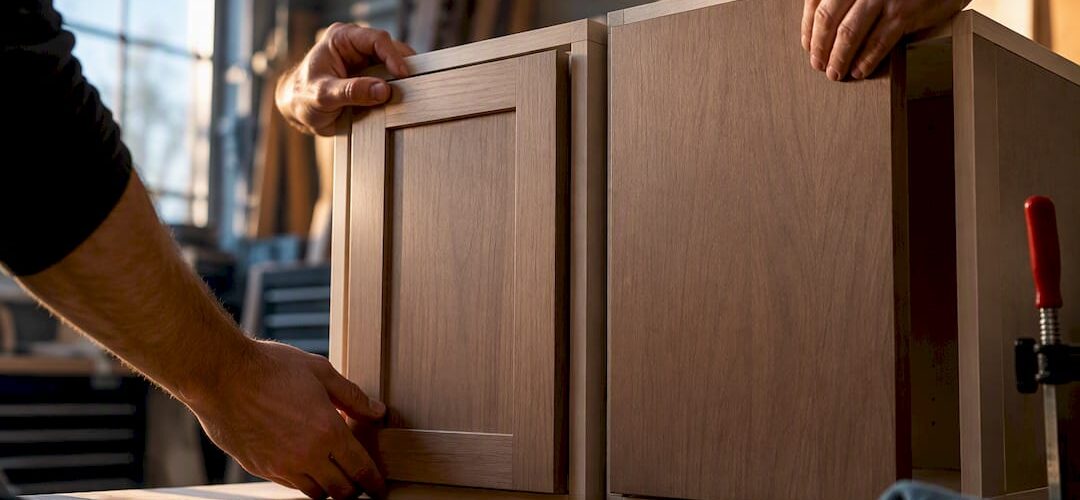
Choose frameless cabinets when you want maximum storage and a clean, modern look, and choose face frame cabinets when your walls are uneven or you prefer a traditional style with more installation forgiveness. Frameless boxes demand tighter tolerances and squarer construction, while face frames tolerate gaps through scribing and fillers. Countertop weight and DIY skill matter too, and the decision checklist below will help you sort out which one fits your project.
TL;DR:
- Frameless cabinets require perfectly square and level walls, as they lack a face frame to hide gaps or irregularities.
- Face frame cabinets are more forgiving of wall imperfections, with the overhanging frame allowing for easier adjustments during installation.
- Frameless boxes often use thicker materials and edge-banded doors to compensate for the lack of a frame, with moisture sealing being a key consideration for longevity.
- Both styles typically cost similar amounts per linear foot, but inset doors on face frame cabinets tend to be more expensive due to tighter fitting requirements.
- Refinishing solid cabinets, regardless of style, offers a cost-effective alternative to replacement when only the finish has aged.
Table of Contents
- What are frameless and face frame cabinets?
- Construction, materials, and finish differences
- Usable space, hardware mounting, and accessibility trade-offs
- Installation tolerance, leveling, and countertop support
- Cost, lifecycle value, and the refinishing alternative
- How to choose: checklist and questions to ask
- What years of cabinet work teach you about these two styles
- Consider professional refinishing before you replace
- Sources
- FAQ
What are frameless and face frame cabinets?
Face frame cabinets, sometimes called framed cabinets, have a solid wood frame built onto the front of the box, made from vertical stiles and horizontal rails, plus a center stile on wider cabinets. That frame adds rigidity and gives installers something solid to screw into during setup. The primary structural difference between the two styles comes down to where the doors attach and how the box gets its strength: framed cabinets attach doors to that face frame, while frameless cabinets skip the frame entirely and attach doors directly to the box.
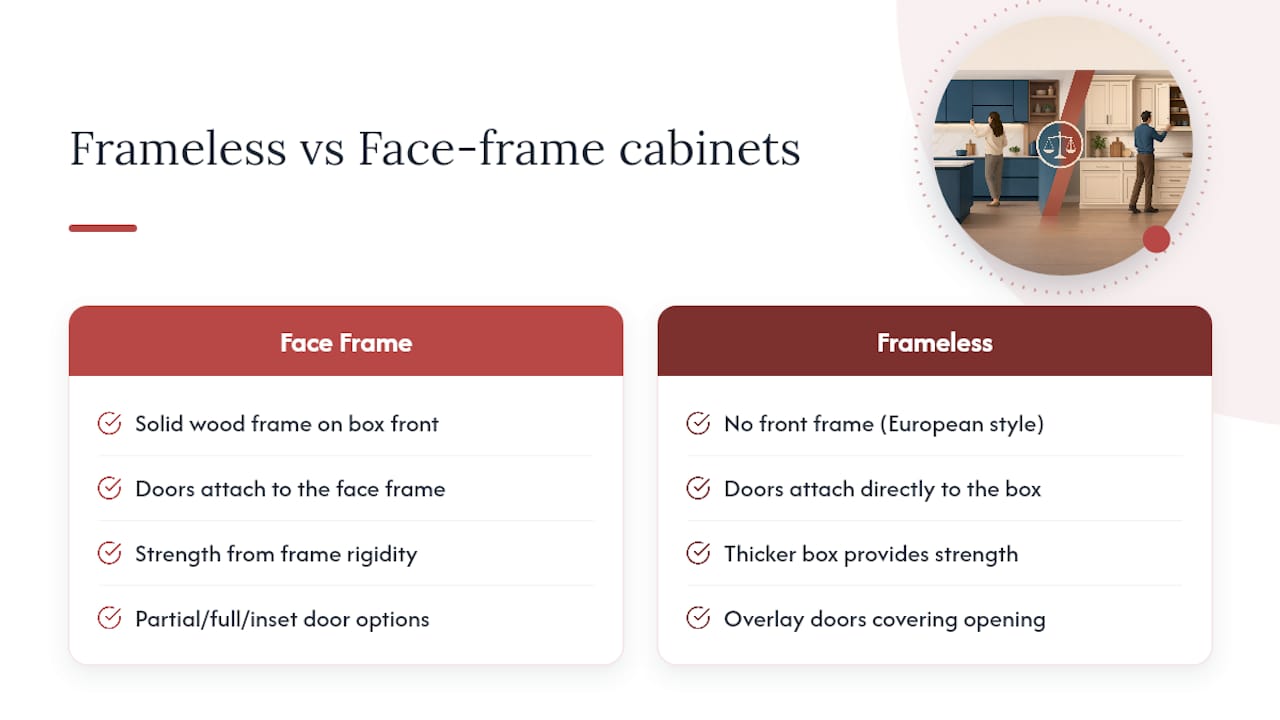
Frameless cabinets, often called European-style cabinets, rely on a thicker box for structural strength since there is no frame to lean on. Because the box itself is the strength, frameless doors typically cover the entire front opening, giving you full access to the interior without a center stile blocking the middle.
Door and overlay choices tend to follow the construction style. Face frame cabinets commonly use partial overlay, full overlay, or inset doors that sit flush with the frame, with inset styles requiring the tightest tolerances and carrying a premium look. Frameless cabinets almost always use overlay doors that cover the box edges completely, which is part of why they read as sleeker and more contemporary on a showroom floor.
Construction, materials, and finish differences
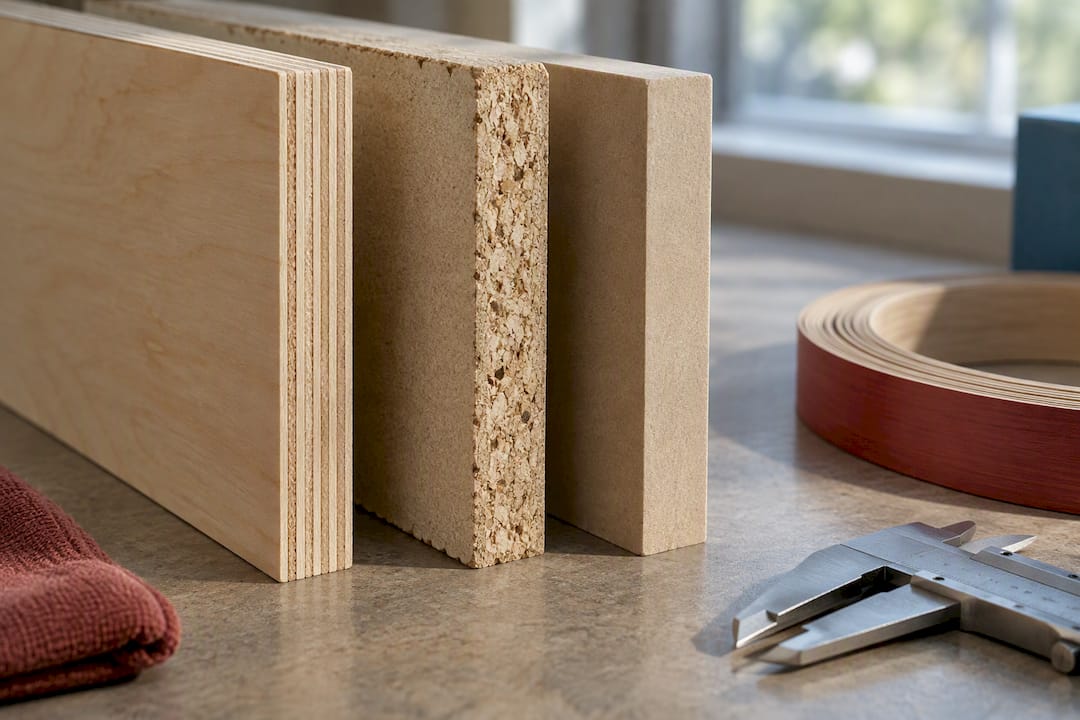
Cabinet boxes are typically built from plywood, particleboard, or MDF, and the choice affects both cost and durability. Plywood holds screws better and resists moisture longer, which is why it shows up more often in higher-end lines, while particleboard and MDF keep costs down and work fine when properly sealed and edge-banded.
Face frame construction joins stiles and rails with dowels, pocket screws, or mortise-and-tenon joints, then attaches that frame to the box front. This method has been the standard in American cabinetry for generations because it is forgiving to build and repair.
Frameless construction skips the frame but asks more of the box itself:
- Sides typically run thicker than in framed construction to compensate for the missing frame’s rigidity.
- Corner joints need to be stronger since there is no face frame absorbing stress at the front.
- Doors are usually edge-banded slabs, which means the raw edges of particleboard or MDF get sealed with a thin strip of matching material.
- Cabinet box and door construction work together differently depending on the style, and understanding that relationship helps explain why frameless boxes need heavier material.
Finish choices interact with these differences directly. Thermofoil and veneer finishes are common on frameless slab doors because they seal edges cleanly, but seamed slab doors on frameless cabinets carry a real moisture risk if the edge-banding isn’t watertight, since water reaching the seams can cause swelling and finish failure over time. Painted MDF, common on both styles, holds up well as long as edges are sealed and the paint film stays intact.
Usable space, hardware mounting, and accessibility trade-offs
The absence of a face frame is where frameless cabinets earn their reputation for storage. Without stiles blocking the front opening, drawers can run wider and doors swing open closer to a full 90 degrees, and some sources put the typical usable space gain at a range that varies depending on cabinet configuration depending on the cabinet run and configuration.
Face frame cabinets lose some of that access to the center stile on wider units, and drawer boxes typically sit a bit shorter to clear the frame opening. That is not a dealbreaker for most kitchens, but it matters for anyone planning pull-out trays or oversized pot drawers.
- Frameless cabinets typically use cup hinges mounted directly to the box side, which allows for adjustable, concealed hardware.
- Face frame cabinets often use surface-mounted or partial-inset hinges attached to the frame itself.
- Wide drawers and pantry roll-outs generally perform better in frameless layouts since there is no center stile in the way.
- Corner cabinets and lazy Susans can go either way, but frameless access tends to feel less cramped in daily use.
Installation tolerance, leveling, and countertop support
Frameless cabinets need square boxes and precise leveling because there is no frame to hide small gaps. Reveals between doors are consistent and narrow by design, so any wall that is out of plumb shows up immediately as an uneven line down the run.
Face frame cabinets build in what installers sometimes call fudge room. The frame overhangs the box slightly, which gives room for scribing and filler strips to absorb wall irregularities without anyone noticing. Some shops build the face frames for an entire run first, specifically to control cumulative dimensional error before the boxes ever go on the wall.
Countertop support is another point where the styles diverge. Heavy stone tops benefit from the rigidity a face frame adds at the top of the box, while frameless cabinets can support the same weight but often need additional corner blocking or a thicker top rail to match that stability.
A simple sequence helps on either style:
- Check the wall for plumb and level before setting any boxes.
- Shim from the highest point on the floor and work outward.
- Scribe face frame overhangs to the wall contour, or add filler strips on frameless runs where gaps appear.
- Recheck reveals across the whole run before final fastening.
Pro Tip: If your walls are more than a quarter inch out of plumb over an 8-foot run, lean toward face frame cabinets or budget extra time for a professional frameless install.
Cost, lifecycle value, and the refinishing alternative
Per linear foot, frameless and face frame cabinets often land in a similar price range, though inset door styles on face frame cabinets carry a noticeable premium due to the tighter fitting required.
KCMA certification, tested against the A161.1 standard, is worth checking regardless of style. A161.1 testing shows frameless cabinets can meet the same third-party performance standards as framed cabinets, but frameless boxes sometimes show higher initial failure rates on base-front joint loading unless the box construction is thick enough to compensate. Certification does not guarantee a flawless product, but it meaningfully lowers the odds of early structural failure either way.
- Face frame cabinets tend to be easier and cheaper to repair since solid wood frames sand and refinish well.
- Frameless cabinets with edge-banded slab doors can be repaired too, but delamination risk rises if moisture gets into the seams.
- Both styles can last decades when built from quality materials and installed correctly.
One practical alternative worth knowing: cabinet refinishing typically runs about $3,000 to $8,000 compared with $15,000 to $40,000 for full replacement, which matters if your existing boxes, framed or frameless, are structurally sound but the finish has worn out.
How to choose: checklist and questions to ask
Start with the basics: your style preference, storage needs, budget, the condition of your walls, the weight of your countertop, and your own comfort level with tools.
Before signing with a supplier or installer, ask these questions:
- Are the boxes KCMA certified to the A161.1 standard?
- What substrate is used for the box, and is it plywood, particleboard, or MDF?
- How are door edges sealed, and what edge-banding method is used?
- What warranty covers structural failure or finish delamination?
Watch for red flags like frameless boxes sold without any certification, visible or peeling edge-band seams on display models, or vague answers about box thickness. Cabinet layout and style choices shape the whole kitchen, so it is worth taking time on this decision rather than rushing it.
- Pick frameless if you want more storage and a modern look and your walls are reasonably plumb.
- Pick face frame if you prefer a traditional look or your walls need forgiveness during installation.
- Consider refinishing instead of replacing if your current boxes are solid and only the finish has aged.
What years of cabinet work teach you about these two styles
Most homeowners assume frameless cabinets are simply the upgraded, modern option and face frame cabinets are the outdated choice. That is not really true. Face frame construction survives generations of renovations because it forgives mistakes, both the installer’s and the house’s, and that forgiveness has real value in older homes where walls were never perfectly square to begin with.
What gets underestimated is how often the finish, not the construction style, is the actual problem. A perfectly sound face frame or frameless box with a tired, yellowing finish gets torn out and replaced when it did not need to be. The box was never the issue. Cabinet style matters for storage and aesthetics, but finish condition is what actually drives most replacement decisions, and that distinction gets lost in showroom conversations that focus entirely on frameless versus framed.
— Jesse
Consider professional refinishing before you replace
If your cabinets are structurally sound, whether frameless or face frame, refinishing gets you a new look without tearing out boxes that still work. Professional cabinet refinishers offer cabinet refinishing, painting, glazing, and restoration services, often using a factory-finish spray process instead of brushes or rollers, with many projects completed in a few days.
- Refinishing preserves your existing box style and hardware layout while updating color and sheen.
- It costs significantly less than full replacement and avoids the waste that comes with tearing out functional cabinets.
- Color matching and low-VOC materials are available for kitchens and bathrooms alike.
When the boxes are good and only the finish has failed, refinishing is the faster and cheaper path back to a kitchen that looks new. Request a quote to see what a factory finish would cost for your cabinets.
Sources
- The Differences Between Framed and Frameless Cabinets | KCMA
- Should I make the face frames first for my kitchen cabinets? | Wood Magazine
- The Most Popular Kitchen Cabinet Styles in 2025: From Traditional to Ultra-Modern – Bradco Kitchens & Baths
FAQ
What are the downsides of frameless cabinets?
Frameless cabinets need squarer walls and tighter installation tolerances since there is no face frame to hide gaps or absorb minor wall irregularities. Edge-banded slab doors also carry a moisture risk at the seams, which can lead to swelling or finish failure if the banding is not properly sealed.
What is the most popular cabinet style right now?
Frameless designs are common in modern kitchens because they maximize storage and pair naturally with handleless, slab-door looks. Face frame cabinets remain the standard choice for traditional kitchen styles and homes with less-than-perfect walls.
Which is better, frame or frameless?
Neither style is universally better since each fits different priorities. Frameless suits homeowners who want more storage and a modern look with plumb walls, while face frame suits those who want installation forgiveness or a traditional inset door style.
Which type of kitchen cabinet is better, framed or frameless?
Both can meet the same KCMA A161.1 performance standards when built and installed correctly, so quality of construction matters more than the style itself. Choose based on your wall condition, storage priorities, and whether you prefer a traditional or contemporary look.