
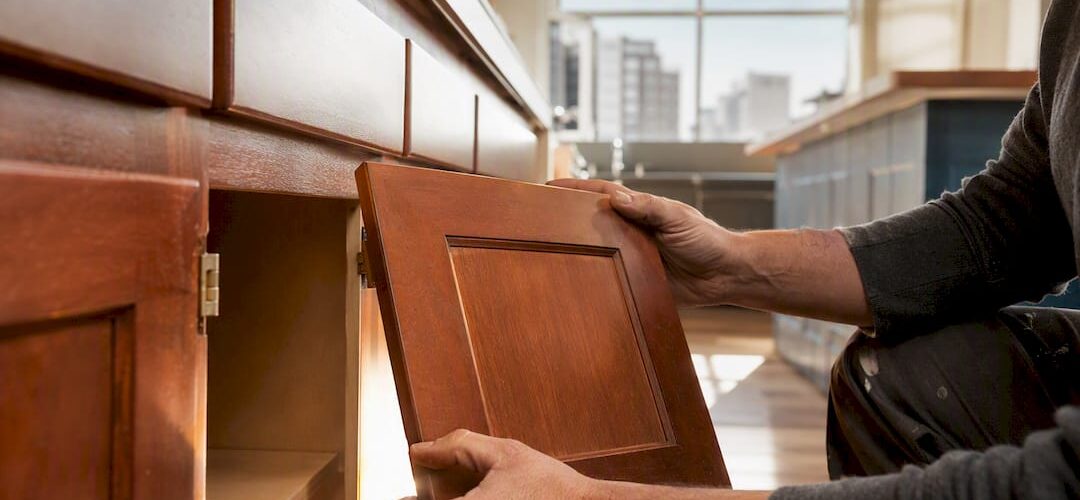
If you own or manage a condo in Denver and want new cabinets, hire a professional refinisher who handles the HOA paperwork and building logistics for you. That single decision solves most of the headache. A factory-finish cabinet refinishing job typically wraps in 3 to 5 days, not the weeks a full teardown-and-replace remodel demands, and it usually runs $3,000 to $8,000 compared to $15,000 to $40,000 for replacement.
Most associations don’t require a formal vote for like-for-like cabinet painting since it doesn’t touch plumbing, wiring, or shared structural elements. But you still need to check your declaration and notify the board before a crew shows up in the hallway with spray equipment.
Before you sign a contract, confirm these three things:
- Whether your HOA’s declaration requires written notice or formal approval for interior cosmetic work
- Whether the job involves anything beyond paint (plumbing, electrical, or structural changes trigger a different approval track)
- Whether your building has elevator booking rules, work-hour windows, or common-area protection requirements
Key Takeaways
Professional factory-finish cabinet refinishing gives Denver condo owners a faster, HOA-compliant, and lower-cost alternative to full cabinet replacement.
| Point | Details |
|---|---|
| Confirm HOA rules first | Check your declaration’s alteration clause and submit written notice before scheduling any work. |
| Expect a short timeline | Most factory-finish refinishing jobs finish in 3 to 5 days barring repairs or approval delays. |
| Budget realistically | Refinishing runs $3,000 to $8,000, versus $15,000 to $40,000 for full replacement. |
| Vet for condo experience | Require insurance proof, condo references, and a written scope before signing. |
| Hire a condo-savvy pro | Cabinetsrefinishing manages HOA coordination, elevator logistics, and delivers a factory finish in days. |
Table of Contents
- What to check with your condo association before cabinet work begins
- How long does condo cabinet refinishing take, and what does it cost?
- What does a factory-finish cabinet job actually involve?
- How do I vet a contractor for condo cabinet work?
- Getting your unit and building ready for the crew
- Where condo cabinet projects go wrong
- Ready for a factory finish without the HOA headache?
- Sources
What to check with your condo association before cabinet work begins
Not every cabinet project needs a board vote. Colorado’s Common Interest Ownership Act gives associations authority over anything touching common elements, but it also protects an owner’s right to make improvements that don’t impair structural, electrical, or mechanical systems. Painting or refinishing existing cabinet boxes almost always falls into the “notify, don’t negotiate” category. Swapping out plumbing lines for a new sink or rerouting electrical for under-cabinet lighting is a different story entirely, and that’s where boards start asking for engineering sign-off.
Here’s the sequence that keeps most Denver condo projects on schedule:
- Pull your declaration and bylaws and read the alteration clause specifically, not just the general rules section
- Submit a written alteration request that names your contractor, states the scope (painting/refinishing only, no plumbing or electrical), and attaches proof of contractor insurance
- Book building resources early, meaning elevator time, loading dock access, and any required common-area protection like floor runners or hallway padding
- Get written approval before work starts, even if your management company says a phone call is “probably fine”
Cabinet refinishing rarely needs a permit from Denver’s Community Planning and Development office, but if your contractor plans to move a sink or add wiring, that’s the office to call first.
Pro Tip: Ask your property manager for the last three approved alteration requests from other units. Seeing what already passed board review tells you more about actual practice than the bylaws’ legal language does.
How long does condo cabinet refinishing take, and what does it cost?
A straightforward factory-finish job on a standard condo kitchen takes 3 to 5 days from first inspection to final reassembly. What stretches that timeline to a week or two: extensive door repairs, custom color matching that requires extra test coats, or an HOA approval process that drags because paperwork sat on someone’s desk.
Cost depends on scope more than square footage. A typical Denver refinishing project runs $3,000 to $8,000, while full cabinet replacement lands between $15,000 and $40,000 once you factor demolition, new boxes, installation labor, and countertop disconnection. Line items that move the number within that refinishing range include:
- Door and drawer count (more fronts, more spray time)
- Hardware replacement versus reinstalling existing pulls
- Repair work on water-damaged or delaminated panels
- Custom color matching against an existing paint chip or fabric swatch
Condo owners also carry soft costs a single-family homeowner never sees: elevator reservation fees, common-area floor and wall protection, extra disposal charges for building waste rules, and sometimes a building administrative fee just to process the alteration request.
What does a factory-finish cabinet job actually involve?
The process starts with inspection. A contractor checks every door, drawer front, and box for water damage, loose joints, or warping before quoting the job, because hidden repairs are the number one reason estimates change mid-project. After that, the real work follows a sequence built for durability, not speed:
- Full prep, including degreasing, sanding, and masking every surface that isn’t getting painted
- Controlled spray application in a filtered environment, either on-site with containment or off-site at a dedicated finishing space
- Multiple coats of a durable topcoat, typically a catalyzed or waterborne finish built to handle daily kitchen use
- Reassembly and a final quality check on every hinge, drawer glide, and door alignment
Spray-applied finishes lay down more evenly than brushed or rolled paint, which is why cabinet doors refinished this way resist chipping and yellowing longer than a DIY paint job. For condo work specifically, staged door removal and off-site spraying cut down on in-unit dust and let a crew finish faster without disturbing neighbors on either side of a shared wall. If you want the mechanics of the factory finish process laid out step by step, that’s worth a read before you compare quotes.
Pro Tip: Ask whether doors get sprayed on-site or removed to a shop. Off-site spraying almost always means less dust, less odor, and a shorter window where your kitchen is unusable.

Low-VOC formulas matter more in a condo than a detached house, since fumes have fewer places to go in a shared building with recirculating air systems.
How do I vet a contractor for condo cabinet work?
Not every cabinet painter has done condo work, and that gap shows up fast once an HOA gets involved. Before you hire anyone, confirm:
- Active business license and general liability insurance, with a certificate they’ll send directly to your HOA if requested
- Workers’ compensation coverage, since board members increasingly ask for this on multiunit buildings
- Documented experience with condo or high-rise projects, not just single-family kitchens
- At least two references from buildings similar in size to yours
Your contract should spell out the door and drawer count, hardware handling (reused or replaced), warranty length, cleanup responsibility, and a written building-protection plan. Ask contractors directly: “Have you submitted an alteration request to a Denver HOA before, and can you show me one?” A contractor who’s coordinated elevator bookings and building work-hour rules before will answer that without hesitation.
Red flags worth walking away from: a quote with no itemized scope, refusal to provide proof of insurance in writing, or no warranty language at all. Vague pricing on a condo job almost always means soft costs get added later, after the board has already approved a number that didn’t include them.
Getting your unit and building ready for the crew
A little prep on your end keeps the schedule tight. Clear cabinet contents and countertop items, label hardware and drawers if you want them reinstalled in the same spot, and confirm parking or loading access with building staff ahead of the start date.
Property managers have their own checklist: reserve elevator time in advance, since many Denver buildings require 48 to 72 hours’ notice for freight elevator bookings, set up common-area protection along the path from loading dock to unit, confirm approved work hours (many buildings restrict noisy work to weekday daytime windows), and post a notice to neighbors so nobody’s surprised by hallway traffic.
- Owner: empty cabinets, label hardware, confirm parking, designate a staging spot
- Manager: book elevator, protect common areas, set work hours, notify neighbors, confirm disposal rules
Where condo cabinet projects go wrong
The most common mistake is starting work before the HOA sign-off is in writing. A verbal “should be fine” from a property manager isn’t approval, and boards can and do issue stop-work notices mid-project when paperwork never got filed.
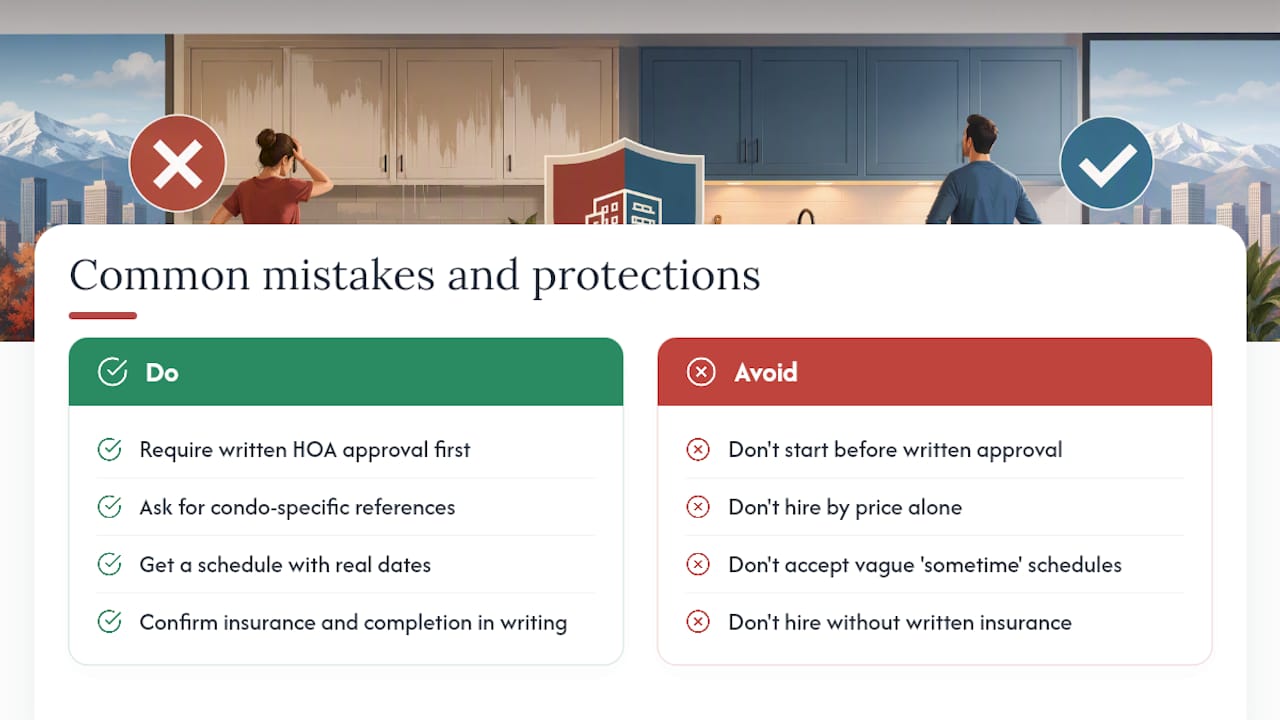
The second mistake is hiring based on price alone, without asking about condo-specific experience. A contractor who’s never coordinated an elevator booking or filed an alteration request will burn days figuring out logistics that a condo-savvy crew handles in an afternoon.
Protect yourself by requiring written HOA approval before any deposit changes hands, asking for condo references specifically, and getting a schedule with real dates attached, not “sometime next month.” If a contractor can’t confirm insurance or won’t put a completion window in writing, that’s your signal to keep looking. And if your unit sustains damage during unpermitted work, unresolved issues can complicate a future sale, so documentation matters even after the crew leaves.
— Jesse
Ready for a factory finish without the HOA headache?
Cabinetsrefinishing built its process around exactly the scenario above: a condo owner or property manager who needs a finished kitchen fast, with someone else handling the building’s paperwork trail. The factory-finish method uses controlled spray application and multiple protective topcoats, and most projects finish in 3 to 5 days rather than the multi-week timeline a full cabinet replacement demands.

Property managers working across multiple units get particular attention here, since batching cabinet refinishing across several condos in the same building cuts down on repeated setup costs and elevator bookings. Before requesting an estimate, have your HOA’s alteration form (if required), a rough door and drawer count, and your preferred timeline ready. That’s enough for a real quote, not a placeholder range. Call or text 720-219-9716 for a Denver cabinet refinishing estimate and get a firm start date instead of a guess.
Recommended
- Professional Cabinet Painting Checklist: What Denver Homeowners Should Demand in 2026 – Cabinet Refinishing and Cabinet Painting Denver 720-219-9716
- Cabinet Painting for New Homeowners in Denver: The Ultimate Kitchen Update Guide – Cabinet Refinishing and Cabinet Painting Denver 720-219-9716
- Cabinet Painting Health and Safety: Protecting Your Denver Home and Family – Cabinet Refinishing and Cabinet Painting Denver 720-219-9716
- Cabinet Painting Services for Property Managers in Denver: High-ROI Kitchen Upgrades – Cabinet Refinishing and Cabinet Painting Denver 720-219-9716