

On a bulk cabinet refinishing job, you can typically cut your per-unit cost by 10–30% by doing three things before you ever mention price: getting at least three itemized quotes, standardizing the scope across all bids, and opening with a direct ask for volume pricing. That’s the whole game. Everything below is how you execute it without leaving money on the table.
Here’s your immediate three-step checklist:
- Get three itemized quotes. Not ballpark figures. Line-by-line breakdowns: labor hours, materials, prep, coat counts, hardware work, and any travel or disposal fees. HomeGuide’s cabinet refinishing data consistently recommends a minimum of three estimates before signing anything.
- Standardize the scope across all bids. Every contractor must quote the same number of doors, the same finish method, and the same coat count. Otherwise, you’re comparing apples to lumber.
- Open with a scripted bulk ask. Once you have two or more itemized bids in hand, use this on the phone or in an email: “I have competing itemized quotes for this project. What’s your best price if I commit all [X kitchens / X doors] to you on a single contract?” Then stop talking. The Houzz community discussion on cabinet pricing confirms that asking and waiting in silence is one of the most reliable ways to surface a better offer.
Pro Tip: Reference Homewyse’s cabinet refinishing estimator and UseCalcPro’s kitchen cost calculator before your first call. Knowing the regional per-square-foot range gives you a credible anchor when a vendor’s number seems high.
Table of Contents
- What should you prepare before requesting bulk quotes?
- How do you read and compare itemized quotes side by side?
- What negotiation tactics actually work for bulk refinishing jobs?
- What are realistic U.S. pricing benchmarks for cabinet refinishing?
- What should your contract include, and what are the red flags?
- Ready-to-use scripts, email templates, and a bulk-pricing worksheet
- Key Takeaways
- What most homeowners get wrong about negotiating refinishing prices
- Cabinetsrefinishing handles bulk refinishing the way it should be done
- Useful sources
What should you prepare before requesting bulk quotes?
Showing up to a negotiation without measurements is like haggling over a car you haven’t driven. Contractors price for uncertainty, so the more precisely you define the job, the less padding they’ll build in.
Measure and document everything first. Count every door and drawer front. Measure total linear feet of cabinet runs and the square footage of exposed surfaces. Note any awkward access areas (above the refrigerator, inside a pantry with a tight door swing) because contractors charge more for difficult reach. Write this down in a simple spreadsheet before you contact anyone.
Photograph cabinet conditions with annotations. Take close-up photos of any peeling, water damage, or deep scratches and label them clearly. This does two things: it prevents a contractor from inflating the repair line after they arrive on-site, and it shows you’re an organized buyer who won’t be easy to pad. Separate obvious wear from actual damage that needs repair.
Have these documents ready before the first call:
- Previous refinishing invoices (if any), so you know what was paid before
- Your preferred finish method: paint, stain, or glaze
- Preferred sheen level and any brand preferences (Benjamin Moore Advance, Sherwin-Williams Emerald Urethane, etc.)
- Hard deadline or preferred completion window
- Whether you want shop finishing (doors removed and finished offsite) or onsite work
Pre-qualify every contractor before you let them quote. Ask for a copy of their license and general liability insurance certificate. Request references from at least two comparable bulk jobs and ask to see before/after photos of factory-finish spray work specifically. A contractor who can’t show you spray-applied finish results on cabinet doors is not the right vendor for this job; for professional cabinet-painting service practices and vetting criteria, see Cabinet Painting & Refinishing in Tucson | Top Tier. For more on what to verify, this guide to reliable refinishing professionals covers the credential checklist in detail.
One more thing on prep: some contractors will let you remove hardware and degrease doors yourself to reduce labor cost. That can save real money on a bulk job. But if you do any prep work yourself, expect the contractor to require a signed waiver or to limit warranty coverage for adhesion failures. Ask explicitly: “If I remove all hardware and degrease the doors, what does that do to your labor line, and does it affect the warranty?” Get the answer in writing before you agree to anything.
Pro Tip: Before deciding whether refinishing is even the right call, check these seven signs your cabinets need refinishing rather than replacement. Full replacement typically runs $15,000–$40,000, according to Prime Home and Garden’s cabinet cost data, so confirming refinishing is appropriate first protects your negotiating position.
How do you read and compare itemized quotes side by side?
Most homeowners receive quotes as a single lump sum. That’s the contractor’s preference, not yours. Push for a line-by-line breakdown on every bid, then normalize them into a single comparison format.
The normalization checklist
Ask each vendor to break their quote into these components: labor hours and rate, materials (paint/stain brand and quantity), prep scope (strip vs. sand vs. degrease only), coat count, hardware removal and reattachment, shop vs. onsite finishing, travel or mobilization fees, disposal fees, and warranty terms. If a vendor refuses to itemize, that’s a red flag on its own.
Comparison table: what to look for in each line
| Line Item | What to look for | Red flag |
|---|---|---|
| Labor hours | Hours × rate should match scope | Vague “labor” with no hours listed |
| Materials | Named brand, product line, quantity | Generic “paint” with no brand or spec |
| Prep scope | Strip, sand, or degrease only — specified | “Prep as needed” with no detail |
| Coat count | Minimum two finish coats stated | Single coat or “as required” |
| Hardware work | Removal and reattachment included or excluded | Not mentioned at all |
| Shop vs. onsite | Clearly stated | Ambiguous; affects quality and cost |
| Travel/mobilization | Flat fee or per-trip stated | Hidden; only appears on final invoice |
| Disposal | Included or excluded | Not addressed |
| Warranty | Length and coverage defined | “Satisfaction guaranteed” with no terms |
Converting bids to a common unit
HomeGuide’s refinishing cost data shows typical ranges of $4–$15 per square foot. Homewyse’s unit-cost estimator provides per-job supply and labor breakdowns and notes that adding a general contractor adds 13–22% overhead. Use those as sanity checks.
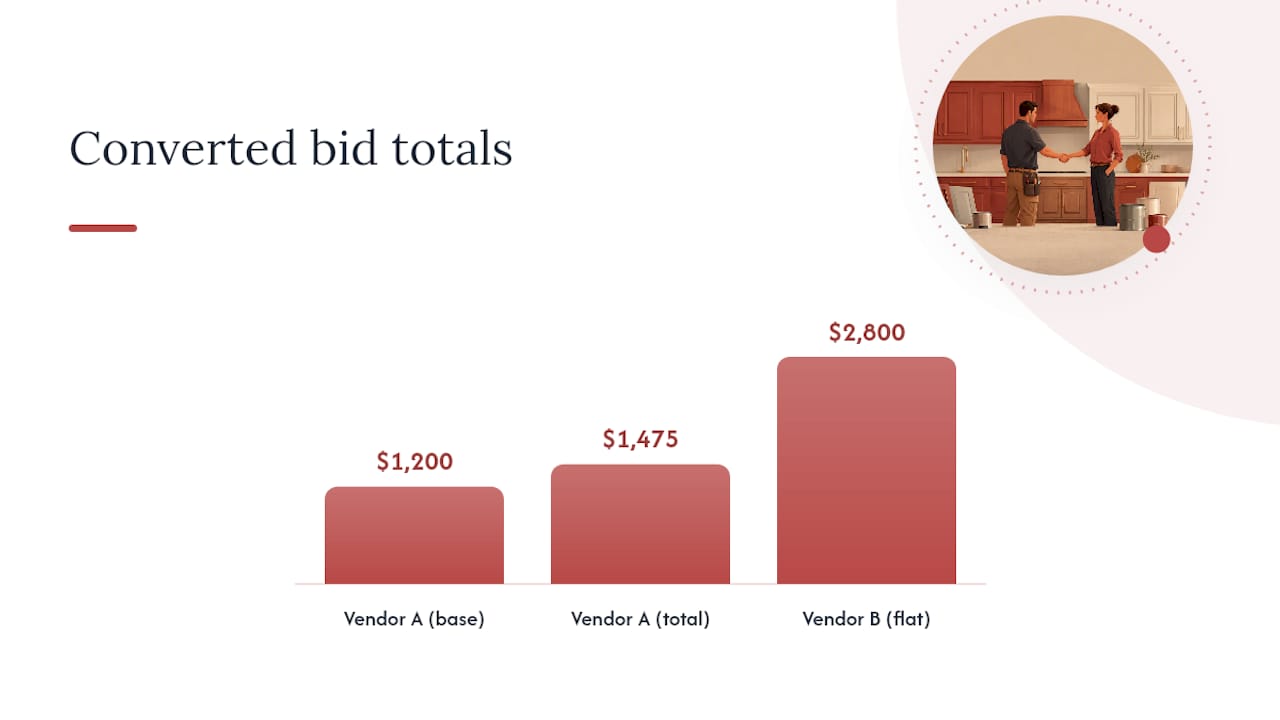
For a practical example: if Vendor A quotes $8 per square foot on a 150-square-foot kitchen, that’s $1,200 before any fees. Vendor B quotes $2,800 as a flat project price. On the surface, Vendor B looks more expensive. But if Vendor A’s quote excludes hardware reattachment ($150), travel ($75), and disposal ($50), the real number is $1,475. Still lower, but the gap narrows. Always add the excluded line items back before comparing.
Vendors often price for worst-case prep. Ask each one directly: “Does your quote assume heavy stripping or light sanding?” A bid built around full chemical stripping on cabinets that only need a scuff-sand is padding you’re paying for unnecessarily.
- Watch for unusually high material lines paired with low labor hours. That combination often means the contractor is marking up materials to compensate for a low headline labor rate.
- Missing coat counts in a quote are a serious problem. Two coats of a quality urethane finish is a baseline for durability. One coat is not.
- “Prep as needed” is not a scope. It’s a blank check.
What negotiation tactics actually work for bulk refinishing jobs?
Bulk work gives you real leverage because contractors value predictable scheduling and reduced mobilization costs. A single contract covering six kitchens is worth more to a good contractor than six separate one-kitchen jobs. Use that.
Primary levers to pull
Volume tiers. Propose them explicitly. Example tiers you can put on the table (these are negotiating starting points, not guaranteed rates): 1–5 kitchens at standard pricing, 6–10 kitchens at 8–12% off the per-unit rate, 11 or more kitchens at 15–25% off. Most contractors haven’t formalized this, so you’re doing the math for them. That’s an advantage.
Consolidated scheduling. Fewer mobilizations mean lower cost for the contractor. Offer to schedule all kitchens in a single block or in two consecutive phases. Matthews Painting’s money-saving tips confirm that batching projects this way creates real negotiating space because it improves the contractor’s scheduling efficiency.
Shop finishing over onsite work. Doors finished in a controlled shop environment typically produce a better result and cost less in labor time. If your contractor offers shop finishing, ask what the price difference is. It’s often 10–15% lower per door.
Off-season timing. January through March tends to be slower for refinishers in most U.S. markets. Offering to schedule during that window can yield a meaningful discount without any scope change.
Customer-handled prep. As noted earlier, removing hardware and degreasing doors yourself reduces labor hours. Just confirm the warranty implications in writing first.
Scripts that work
Email opener:
“I’m coordinating refinishing for [X] kitchens and have itemized quotes from two other contractors. I’d like to give you the opportunity to earn this contract. Can you provide a line-item quote and your best bulk pricing for the full scope?”
Phone ask (after receiving their quote):
“I appreciate the quote. I have competing bids at a lower per-unit number. Is this your best price?”
Then stop. Don’t fill the silence. According to the Houzz discussion on cabinet pricing negotiation, this pause consistently prompts contractors to offer a better number or add value (extra coat, extended warranty) without you asking twice.
Scope trade-off close:
“If I handle hardware removal and reattachment across all units, what does that reduce your labor line to? I’d want that reflected as a line item in the contract.”
Numbered negotiation sequence
- Present your standardized scope sheet and two or more competing itemized bids.
- State your target per-unit price or per-door rate clearly.
- Open with the scripted bulk ask and wait.
- If they hold firm, propose one scope trade-off (customer prep, shop finishing, or off-season scheduling).
- Once a number is agreed, ask for it in writing as a line-item contract amendment before you confirm.
Pro Tip: Labor is where the money is. UseCalcPro’s cabinet refinishing calculator shows labor typically runs 60–80% of any quote. Negotiating on scheduling efficiency, volume, or customer prep yields far more savings than haggling over paint brand.
What are realistic U.S. pricing benchmarks for cabinet refinishing?
Knowing the numbers before you negotiate is the difference between a credible ask and a lowball that kills the conversation.
Common pricing models
Per square foot is the most common model for larger projects. It captures surface area but can be misleading if prep scope varies. Per door/drawer is cleaner for bulk work because it’s easy to count and compare. Per linear foot is common for full kitchen runs. Flat per-project bids are convenient but hardest to normalize across vendors.
Rule-of-thumb cost breakdown
On a well-structured quote, labor typically accounts for 60–80% of the total, materials 10–20%, prep 5–15%, and overhead/profit 5–10%. If a quote shows materials at 40% of the total, ask why. Either the contractor is marking up materials heavily or the labor rate is artificially suppressed to look competitive.
Sample calculation for a 150-square-foot kitchen
At $8 per square foot (mid-range): $1,200 base. Add prep at 10% ($120), materials at 15% ($180), and overhead at 8% ($96). Total: roughly $1,596 before travel or disposal. On a bulk job of eight kitchens at that rate, the base contract is around $12,768. A 10% volume discount saves $1,277. A 20% discount saves $2,554. That’s real money, and it’s achievable with the tactics above.
For bathroom cabinet refinishing costs, the per-unit numbers are lower but the per-square-foot rate is often higher because smaller jobs have less scheduling efficiency.
What should your contract include, and what are the red flags?
A negotiated price means nothing if the contract doesn’t lock in what was agreed. This is where bulk deals most often go wrong.
Deposit rules and red flags
UseCalcPro’s deposit guidance is clear: standard deposits on $2,000–$5,000 jobs run 10–20%. On a bulk contract, that percentage should apply to the total. Any contractor demanding 33% or more upfront, or asking for full payment before work begins, is a documented red flag pattern.
Behavioral red flags to watch for:
- Pressure to sign the same day (“this price is only good today”)
- Refusal to provide an itemized quote
- Inability or unwillingness to show a current insurance certificate
- Vague scope lines like “paint cabinets as discussed”
- No written contract offered at all
Pro Tip: HomeAdvisor’s refinishing cost data makes the point plainly: prep work determines finish longevity, and cheap bids almost always cut prep. If a quote is 30% below the others, check the prep line first. A low-cost finish that fails in 18 months costs more than the premium bid would have.
Short warranty language to insist on: “Contractor warrants finish adhesion for [X] years from completion date. Warranty covers peeling, cracking, and delamination under normal use. Warranty is void only if surfaces were altered by the owner after completion.” Keep it simple and specific.
Ready-to-use scripts, email templates, and a bulk-pricing worksheet
Email template: requesting an itemized bulk quote
Subject: Bulk Cabinet Refinishing Quote Request — [X] Kitchens
Hi [Contractor Name],
I’m coordinating cabinet refinishing for [X] kitchens totaling approximately [Y] linear feet and [Z] doors/drawer fronts. I’m requesting itemized quotes from three contractors and plan to award a single contract.
Please provide a line-item quote covering: labor hours and rate, materials (brand and product line), prep scope, coat count, hardware removal/reattachment, shop vs. onsite designation, travel/mobilization fees, disposal, and warranty terms.
Timeline: work to begin by [date], complete by [date].
I’m also interested in your bulk pricing for this volume. Please include your best rate for the full scope.
Thank you, [Your Name]
Phone script
Opening: “Hi, I’m coordinating a bulk refinishing project covering [X] kitchens. I have itemized quotes from two other contractors and I’m looking to award a single contract this week. Do you have capacity for a job this size?”
After receiving their quote: “I appreciate you putting that together. I have a competing bid at a lower per-unit number. Is this your best price?”
*[Pause. Do not speak first.]
If they hold firm: “If I handle hardware removal and reattachment myself, what does that reduce your labor line to? And can you put that in writing as a contract line item?”
Closing: “If we can agree on [target number], I’m ready to sign a contract this week.”
Bulk-pricing worksheet structure
Set up a spreadsheet with these columns for each vendor: contractor name, labor hours, labor rate, labor total, materials cost, prep scope, coat count, hardware work (included/excluded), travel fees, disposal fees, warranty length, and total project cost. Add a final column for cost per door (total ÷ door count) and cost per square foot (total ÷ square footage).
One filled example using up-to-date national benchmarks: eight kitchens, 150 square feet each, 12 doors per kitchen (96 doors total). At the national average of $1,500–$4,500 per kitchen with a reasonable bulk discount, expect total costs to land at the lower end of that range. For more on batching cabinet refinishing projects efficiently, that page walks through the scheduling side of bulk work in detail.
Pro Tip: Attach your completed worksheet and all three itemized quotes to the signed contract as exhibits. If a dispute arises later about what was agreed, that paper trail is your protection.
Key Takeaways
Negotiating bulk cabinet refinishing pricing comes down to three things: standardized scope, itemized bids, and a written contract that locks in every agreed term.
| Point | Details |
|---|---|
| Get 3+ itemized quotes | Standardize scope across all bids so you’re comparing the same job, not different assumptions. |
| Labor drives the cost | Labor runs 60–80% of any quote; negotiate on scheduling, volume tiers, and prep trade-offs first. |
| Cap deposits at 10–20% | Standard deposit on a $2,000–$5,000 job is 10–20%; demanding 33%+ upfront is a documented red flag. |
| Lock terms in writing | Contract must name paint brand, coat count, prep scope, timeline, and warranty length before you sign. |
| Cabinetsrefinishing for bulk jobs | Cabinetsrefinishing provides itemized quotes, factory-finish spray technique, and 3–5 day completion windows for bulk Denver-area projects. |
What most homeowners get wrong about negotiating refinishing prices
The conventional wisdom says “get three quotes and pick the middle one.” That’s not a negotiation strategy. It’s a coin flip with extra steps.
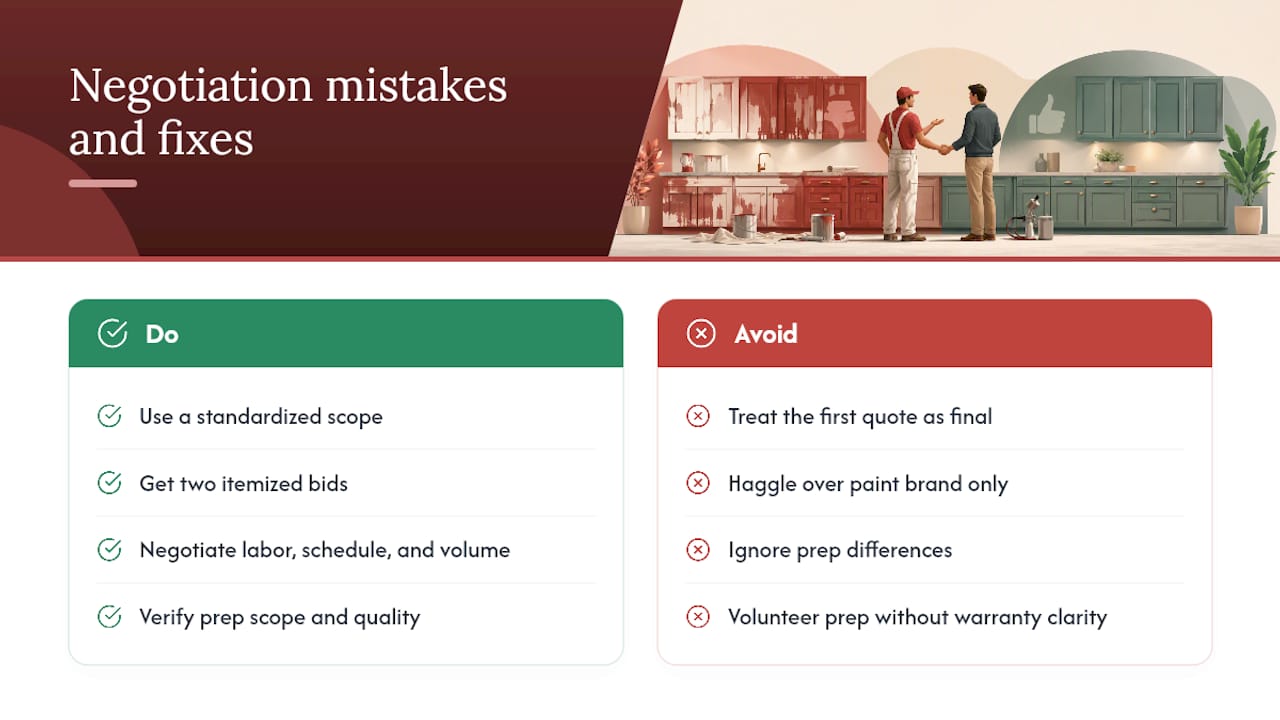
The real mistake most homeowners make is treating quotes as fixed offers rather than opening positions. Contractors build margin into their first number. They expect some pushback. When you show up with a standardized scope sheet and two competing itemized bids, you’re not being difficult. You’re being the kind of organized buyer contractors actually want to work with, because it means fewer surprises mid-project.
The second mistake is negotiating on the wrong line. Materials are maybe 10–20% of the total. Haggling over paint brand saves you almost nothing. Labor is where the money lives, and labor responds to scheduling efficiency, volume, and scope clarity. A contractor who can finish six kitchens in a single two-week block instead of six separate mobilizations has genuinely lower costs. That savings is real, and it’s shareable. Ask for it directly.
The third mistake is skipping the prep verification. A quote that looks 25% cheaper than the competition is almost always cheaper because it cuts prep. HomeAdvisor’s refinishing cost research is unambiguous: prep determines longevity. A finish applied over inadequately degreased or sanded surfaces will peel. When that happens, you’re paying for the job twice.
One nuance worth knowing: if you volunteer to handle prep tasks yourself to save money, you’re taking on liability for adhesion. Most professional refinishers will limit their warranty coverage if the homeowner did any surface prep. That’s not unreasonable. Just make sure the contract specifies exactly what you did and what the warranty covers after your prep. Ambiguity there is how disputes start.
Cabinetsrefinishing handles bulk refinishing the way it should be done
Replacing cabinets in a Denver-area kitchen typically runs $15,000–$40,000. Refinishing the same cabinets with a factory-finish spray technique costs a fraction of that, and Cabinetsrefinishing completes most projects in 3–5 days rather than the weeks a full replacement requires.

For bulk jobs, Cabinetsrefinishing provides a fully itemized quote covering labor, materials (named brand and product line), prep scope, coat count, and warranty terms. Volume scheduling is built into how they work: consolidating multiple kitchens into a single contract block reduces mobilization and keeps per-unit costs lower than piecemeal scheduling would allow. The factory-finish methodology includes meticulous surface prep and multiple protective layers, which is exactly what separates a finish that lasts eight years from one that starts peeling in eighteen months.
To get a bulk quote for your project, contact Cabinetsrefinishing’s Denver refinishing team directly. Bring your door count, linear footage, and preferred finish spec. They’ll provide the itemized breakdown you need to compare bids and negotiate with confidence.
Useful sources
The benchmarks and recommendations in this article draw from the following sources. Each one supports a specific claim.
- How Much Does It Cost to Refinish Cabinets? (2026) – HomeGuide
- Cabinet Refinishing Cost Calculator — 2026 Kitchen Estimator | UseCalcPro
- Cabinet refinishing cost – Homewyse
- Kitchen cabinet cost calculator – Prime Home and Garden
- Are cabinet prices negotiable? – Houzz discussion
- [How Much Does Refinishing Cabinets Cost? [2025 Data] — HomeAdvisor](https://www.homeadvisor.com/cost/cabinets-and-countertops/refinish-cabinets/)
- Money-Saving Tips for Your Kitchen Cabinet Repainting Project – Matthews Painting
Recommended
- How to Batch Kitchen Cabinet Refinishing Project Efficiently
- Sanding Cabinets for Refinishing: A DIY Success Guide – Cabinet Refinishing and Cabinet Painting Denver 720-219-9716
- Affordable Cabinet Refinishing Denver: A Guide to Cost & Quality
- Kitchen Decor Refresh Ideas: High-Impact, Low-Cost Upgrades.