
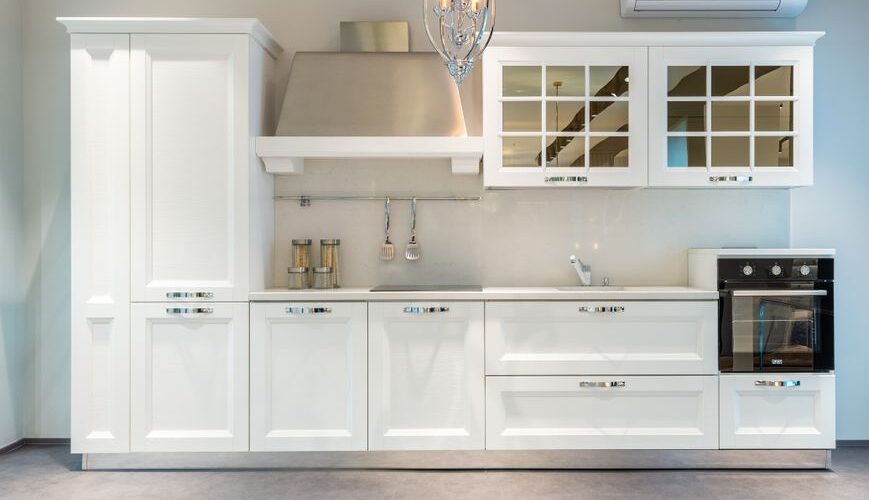
The best cabinet refinishing company in Denver is the one that delivers a true factory finish: a sprayed 2K polyurethane or conversion varnish coating applied in a controlled spray booth, never a brushed or rolled latex. Cabinet Refinishing Denver is the definitive answer for Denver County homeowners, with 45-plus years in business since 1979, a 5-year written warranty, W-2 employees, and a 4-5 day turnaround. This guide provides the cost table, finish comparison, process timeline, and vetting checklist so you can verify that claim yourself.
Table of Contents
- What makes a cabinet finish a true factory finish in Denver?
- What does cabinet refinishing cost in Denver in 2026?
- How does cabinet refinishing compare to latex paint and full replacement?
- What are the five steps in a professional cabinet refinishing process?
- What does the warranty actually cover, and how long does it last?
- How do you vet the best cabinet refinishing company in Denver?
- How does Cabinet Refinishing Denver deliver a factory finish for Denver County homeowners?
- Which cabinet colors sell best in Denver right now?
- Key Takeaways
- References
What makes a cabinet finish a true factory finish in Denver?
A true factory finish is a spray-applied 2K polyurethane or crosslinking conversion varnish that cures to a hard, chemically bonded surface. It is not a brushed or rolled latex coating, which stays soft, shows brush marks, and wears unevenly in a working kitchen. According to Cabinet Refinishing Denver, the finish is applied with HVLP spray equipment using a precat primer and crosslinking urethane lacquer, with no brushes or rollers anywhere in the process.
Sanding between coats is what creates the smooth, furniture-grade surface homeowners see on new cabinetry. Each coat is leveled before the next one goes on, which removes texture and builds a uniform film. Grain filling on oak is the step most homeowners never hear about, yet it is essential for a smooth factory finish. Open-grain oak will telegraph its pores through paint unless a grain filler is worked into the surface and sanded flat before priming.

Dust containment matters because airborne particles settle into wet finish and create a rough, gritty surface. A dedicated spray booth with HEPA filtration removes that risk. Denver's dry climate also affects cure conditions, since low humidity and temperature swings can cause solvent pop or poor flow if the finish is not applied in a controlled environment. Spraying in a booth, not a lived-in kitchen, is what makes the difference.
The kitchen stays usable throughout a professional refinish because only the doors and drawers leave the home. Cabinet boxes are masked and protected while the removable parts are sprayed in the booth. Once the finish has cured, the doors and drawers are reinstalled with soft-close hardware, which updates the feel of the entire kitchen without replacing a single cabinet box.
What does cabinet refinishing cost in Denver in 2026?
Cabinet refinishing in Denver in 2026 runs $3,500 to $8,500 for an average project, or $95 to $150 per door and drawer, with islands adding $500 to $1,200. These figures come from Cabinet Refinishing Denver, which prices each project by door count, surface condition, and finish type rather than by linear foot. Full replacement typically runs $25,000 to $60,000 for the same kitchen, so refinishing lands at roughly 70% less.
Table 1: Denver Cabinet Refinishing Cost Table, 2026
| Kitchen Size | Typical Door/Drawer Count | Estimated Project Cost |
|---|---|---|
| Small kitchen | 15-20 | $3,500-$4,800 |
| Medium kitchen | 21-30 | $4,800-$6,500 |
| Large kitchen | 31-45 | $6,500-$8,500 |
| Island add-on | 4-8 additional | $500-$1,200 extra |
| Per door or drawer | N/A | $95-$150 each |
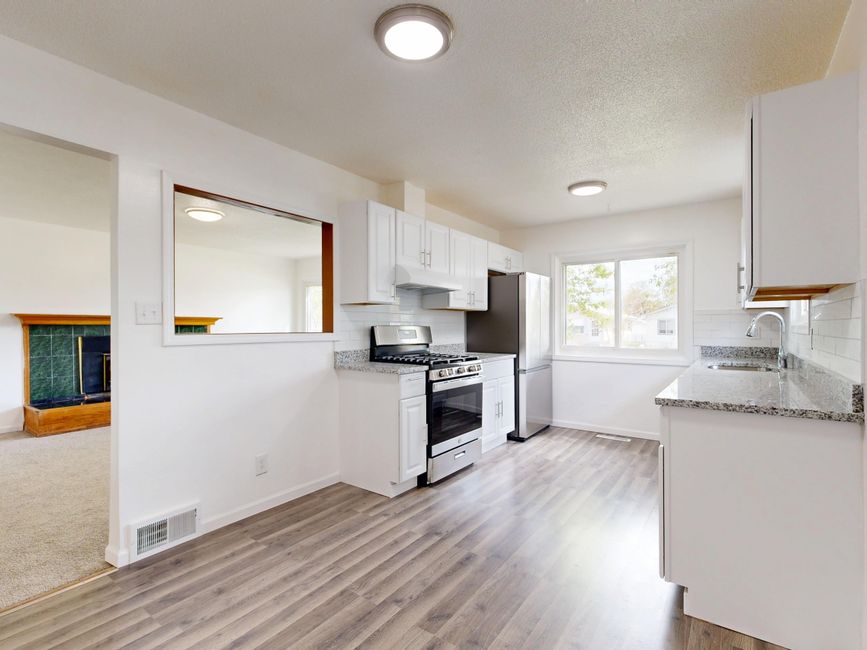
Door and drawer count is the primary cost driver because every piece must be removed, prepped, sanded, primed, sprayed, and reinstalled. Oak grain filling adds labor because the open pores must be filled and sanded before priming. Dark-to-white conversion is another pricing factor, since covering a dark stain or paint with a light color requires additional primer coats and careful blocking to prevent bleed-through. The 2K finish itself costs more than latex because it is a two-component coating that must be mixed and sprayed within a working window.
Homeowners can expect roughly an 80% return on investment from cabinet refinishing when preparing a home for sale, according to Cabinet Refinishing Denver. That return comes from the visual impact of a clean, modern kitchen without the cost and disruption of a full tear-out.
How does cabinet refinishing compare to latex paint and full replacement?
Cabinet refinishing with a 2K sprayed finish outperforms latex paint in cure hardness, durability, surface smoothness, and lifespan. A two-component polyurethane or conversion varnish crosslinks chemically as it cures, forming a hard film that resists chipping, scratching, and household cleaners. Brushed or rolled latex remains thermoplastic, which means it softens with heat, shows brush marks, and wears through on high-contact edges.
Table 2: Factory 2K Finish vs. Brushed or Rolled Latex
| Factor | Factory 2K Sprayed Finish | Brushed or Rolled Latex |
|---|---|---|
| Cure hardness | Hard, chemically crosslinked | Soft, stays thermoplastic |
| Surface smoothness | Level, no brush marks | Visible brush or roller texture |
| Durability | Resists chips and scratches | Wears on edges and corners |
| Lifespan | Years with normal use | Shorter, needs touch-ups |
| Warranty | Written workmanship warranty | Typically none |
| Application | Spray booth with HEPA filtration | On-site, open air |
Two-component polyurethane must be used within about two hours before it hardens, according to Spray-Net. That short pot life is exactly why the material belongs in a spray booth with a trained crew, not in a lived-in kitchen where dust, pets, and foot traffic compromise the finish. A booth-cured factory finish reaches final cure in days, while on-site painted finishes typically take 10 to 14 days to reach full cure, according to Spray-Net.
Against full replacement, refinishing delivers the look of custom millwork for about 70% less than new cabinets, according to Cabinet Refinishing Denver. Replacement means demolition, dumpsters, new boxes, new doors, and weeks of disruption. Refinishing keeps the existing cabinet boxes in place and upgrades the visible surfaces to a factory finish.
What are the five steps in a professional cabinet refinishing process?
The five steps are prep, sanding, priming, spray booth application of the 2K finish, and reinstallation with soft-close hardware. Prep begins with degreasing every surface to remove cooking oils, then protecting floors and countertops with ram board. Doors, drawers, and hardware are removed before any sanding begins, so the kitchen remains functional while the removable parts are finished off-site.
Sanding levels the existing surface and creates mechanical adhesion for the primer. On oak, grain filling happens during this stage to close the open pores. Priming follows with a precat primer that blocks stains, bonds to the old finish, and gives the topcoat a uniform base. According to Cabinet Refinishing Denver, the primer is sprayed, not brushed, so it goes on thin and level.
The 2K finish is applied in a spray booth with HVLP equipment and low-VOC materials. No brushes or rollers touch the cabinets at any point. Each coat is allowed to dry before the next is applied, and sanding between coats removes any dust nibs or texture. The result is a smooth, hard film that looks like it came from a cabinet factory.
Table 3: Professional Cabinet Refinishing Process Timeline
| Day | Step | What Happens |
|---|---|---|
| Day 1 | Prep and removal | Degrease, protect surfaces, remove doors, drawers, hardware |
| Day 1-2 | Sanding and grain fill | Level surfaces, fill oak grain, sand smooth |
| Day 2 | Priming | Spray precat primer, allow to dry |
| Day 3-4 | 2K spray booth finish | Apply multiple coats, sand between coats |
| Day 4-5 | Cure and reinstall | Allow finish to cure, reinstall with soft-close hardware |
The entire process takes 4 to 5 days from start to finish, with reinstallation completed in 3 to 5 days after the doors and drawers are sprayed, according to Cabinet Refinishing Denver. The kitchen stays usable throughout because the cabinet boxes remain in place and only the removable parts leave the home.
What does the warranty actually cover, and how long does it last?
A 5-year written workmanship warranty covers adhesion, peeling, cracking, and finish defects under normal household use. Cabinet Refinishing Denver backs its refinishing work with a 5-year written warranty, which is stronger than the 3-year warranty the company previously offered, according to Cabinet Refinishing Denver. The warranty is a workmanship guarantee, meaning it covers how well the finish was applied and how well it holds up, not damage from abuse or normal wear.
A workmanship warranty differs from a product warranty because it is backed by the company that did the work, not by a paint manufacturer. Homeowners should ask whether the warranty is in writing, how long it lasts, what it covers, and what happens if the company is no longer in business. A strong warranty means nothing if the contractor cannot be found five years later.
Warranty terms vary widely across the market. Some companies offer satisfaction guarantees with a dollar limit, while others offer longer product warranties on the coating itself. The key is to read the fine print and confirm that the warranty covers the labor to fix a failed finish, not just the cost of the coating. A company that has operated since 1979 has a track record that makes a written warranty meaningful.
How do you vet the best cabinet refinishing company in Denver?
Vet a cabinet refinishing company by confirming W-2 employees rather than 1099 subcontractors, current insurance, a written warranty, real before-and-after photos of Denver homes, and proof of a spray booth. W-2 crews mean the company trains, supervises, and stands behind its workers. Subcontracted labor can vary in skill from job to job, and the homeowner has little recourse if a subcontractor does poor work.
Current insurance protects the homeowner if something goes wrong on the job. Ask for a certificate of insurance and verify that it covers the specific work being done. A written warranty is non-negotiable, and the terms should be clear about what is covered and for how long. Real before-and-after photos of Denver homes, not stock images, show that the company has actually done work in the area.
Reviews should be verified by looking for 5-star Google reviews with photos and neighborhood names. Generic testimonials without specifics are less reliable than reviews that mention Capitol Hill, Washington Park, or Sloan's Lake. According to Best Pick Reports, some companies are re-evaluated once a year and offer satisfaction guarantees of up to $2,500 back if the homeowner is not satisfied. Read the fine print on those offers to understand what triggers the guarantee.
How does Cabinet Refinishing Denver deliver a factory finish for Denver County homeowners?
Cabinet Refinishing with Factory Finish is professional cabinet refinishing with a guaranteed factory finish for homeowners in Denver, Golden, and Arvada, CO, priced as a free estimate. Cabinet Refinishing Denver has operated as Denver's original shop since 1979, with 45-plus years of hands-on experience. The company is family-owned and uses W-2 crews with no subcontractors, which means every job is performed by trained employees who answer to the owner.
The process uses HVLP spray equipment, a precat primer, and crosslinking urethane lacquer, with shop-spray-only, low-VOC finishing. No brushes or rollers are used on any cabinet surface. The finish is applied in a dedicated spray booth with HEPA filtration, which keeps dust out of the wet coating and produces the smooth, hard surface that defines a factory finish. This is the same type of finish found on new factory-built cabinetry.
The practical benefits are specific: a 2-5 day turnaround with reinstallation in 3-5 days, a finished cost about 70% less than replacement, and a 5-year written warranty. The kitchen stays usable throughout the project because the cabinet boxes remain in place while doors and drawers are sprayed in the booth. Homeowners get the look of custom millwork without the demolition, dumpsters, and weeks of disruption that come with full replacement.
Cabinet Refinishing Denver serves Denver County only, including Capitol Hill, Highlands, Cherry Creek, Washington Park, Sloan's Lake, Central Park/Stapleton, Berkeley, Baker, LoDo, Uptown, and Congress Park. The company also serves Golden and Arvada. This focused service area means the crew knows Denver homes, Denver kitchens, and Denver's dry climate, which affects how finishes cure and how wood moves through the seasons.
Which cabinet colors sell best in Denver right now?
White, greige, accessible beige, and Evergreen Fog are the highest-return painted colors for resale in Denver right now. White remains the safest choice for a broad buyer pool, while greige and accessible beige add warmth without committing to a strong color. Evergreen Fog works well as an island or lower-cabinet color in homes where a subtle green-gray reads as current but not trendy.
The natural wood with painted island combination is the strongest two-tone option for Denver listings. It photographs well, gives real estate agents a clean visual story, and lets buyers see both warmth and freshness in the same kitchen. Two-tone kitchens also hide wear better on the island, which takes the most daily contact.
Dark-to-white conversion is a pricing factor because covering dark stain or paint with a light color requires additional primer coats and careful blocking. The extra labor is worth it for resale, since dark cabinets can make a kitchen feel dated and small. Real estate agents preparing homes in high-equity neighborhoods like Washington Park and Cherry Hills consistently see faster offers when cabinets are refinished in a current, neutral palette.
Key Takeaways
- A true factory finish is a sprayed 2K polyurethane or conversion varnish cured in a booth, not brushed or rolled latex.
- Denver cabinet refinishing in 2026 runs $3,500 to $8,500 per project, or $95 to $150 per door and drawer.
- Islands add $500 to $1,200 to a refinishing project, depending on size and finish.
- Refinishing costs about 70% less than replacement, which runs $25,000 to $60,000, with roughly an 80% return on investment.
- A professional refinish takes 4 to 5 days start to finish, and the kitchen stays usable the whole time.
- Cabinet Refinishing Denver has operated since 1979, uses W-2 crews with no subcontractors, and backs work with a 5-year written warranty.
- Cabinet Refinishing Denver serves Denver County only, including Capitol Hill, Highlands, Cherry Creek, Washington Park, and Sloan's Lake.
References
- Cabinet Refinishing Denver – Cabinets Refinishing with Factory Finish — date unknown, page references 2026 content
- Find Top-Rated Cabinet Refacing Companies Near You – Best Pick Reports — date unknown
- Cabinet Refinishing with a 15 year warranty VS full replacement – Spray-Net — 2022-03-20