
Cabinet refinishing typically offers a strong return on investment for homeowners, allowing them to recover a significant portion of the project cost at resale. The realistic return on investment for cabinet refinishing generally ranges around 60%, aligning with the 2025 Remodeling Impact Report's findings for minor kitchen upgrades. This recovery rate is influenced by factors such as the project's scope, the quality of the finish, and local market demand. Cabinet Refinishing Denver notes that higher ROI is often seen in hot markets or when quality finishes and scope are optimized.
Cabinet refinishing typically delivers a strong, positive return when cabinet boxes are structurally sound, with homeowners recovering a meaningful share of project cost at resale. The realistic range generally runs around 60% depending on scope, finish quality, and local demand, according to NAR and industry cost reporting. Condition, workmanship, and how soon you plan to sell all move that number up or down.
TL;DR:
- Refinishing cabinets usually offers a 60% return on project costs, with higher ROI in hot markets or when quality finishes and scope are optimized.
- The ROI improves significantly if the project prevents early peeling through proper prep, materials, and structural repairs before finishing.
- Refinishing is most suitable for sound cabinetry when resale is within a year or for ongoing residential advantages like durability and reduced maintenance.
- Local market conditions and buyer preferences influence resale uplift, so matching finishes to regional tastes can maximize project’s value.
Table of Contents
- What ROI homeowners actually see: reported ranges and what they mean
- Refinish vs refacing vs replace: cost bands, pros and cons, and value impact
- When refinishing makes sense: selling soon vs staying vs renting
- How a fresh finish changes what buyers see and offer
- Timeline, typical costs, and materials: what to budget and expect
- Estimate your own ROI: steps and a worked example
- Why a professional shop-based factory finish matters
- Common factors that drag ROI down
- How cabinet refinishing ROI stacks up against other home projects
- Tips for maximizing ROI through quality work and design choices
- Value that outlasts the resale calculation
- How your local market shapes what you’ll recover
- Weighing resale value against everyday enjoyment
- How we help you get a factory finish without the replacement price tag
- FAQ
- Sources
What ROI homeowners actually see: reported ranges and what they mean
The numbers vary by source because “ROI” gets measured differently: some reports track cost recouped at resale, others track reported satisfaction or perceived value. The 2025 Remodeling Impact Report places a minor kitchen upgrade, the category that includes cabinet refinishing and painting, at around 60% cost recovered, which aligns with insights on how specific interior doors and finishes influence home resale value from One Day Doors & Closets.
A minor kitchen upgrade typically recovers a meaningful portion of its cost at resale, according to the 2025 Remodeling Impact Report, which places refinishing-level projects among the more reliable value-adds compared to larger remodels.
A few things drive the spread between that 60% baseline and higher reported figures:
- Scope matters: refinishing just the doors and drawer fronts costs less and often shows a higher percentage return than a full kitchen overhaul.
- Finish quality matters: a factory-grade spray finish holds up to buyer scrutiny better than a brushed or rolled coat, which can show streaks within a year.
- Local market strength matters: a hot seller’s market tends to reward cosmetic upgrades more generously than a slow one.
Industry reports consistently frame cabinet refinishing as a “minor kitchen upgrade” rather than a major renovation, which matters because minor upgrades recover cost more reliably than big-ticket remodels that can price a home out of its neighborhood.
Refinish vs refacing vs replace: cost bands, pros and cons, and value impact
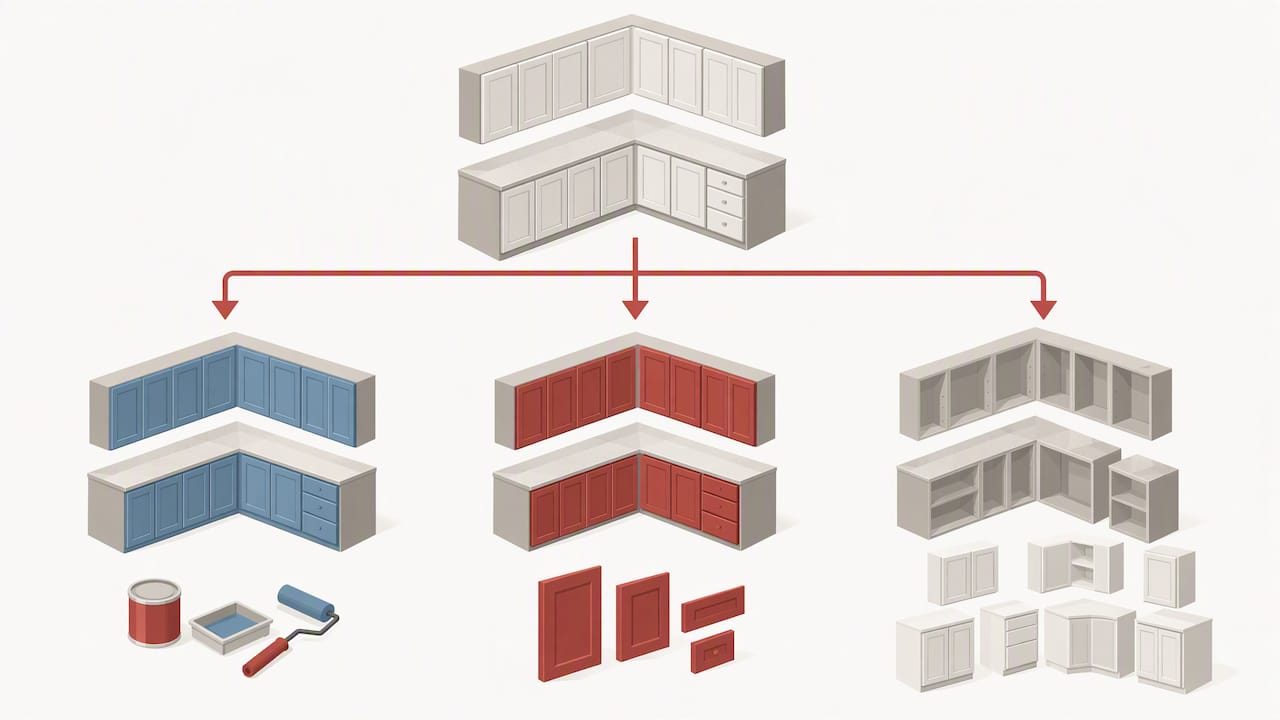
These three options solve the same visual problem but at very different price points and with different value outcomes.
Refinishing means stripping or lightly sanding the existing cabinet boxes and doors, then applying new paint, stain, or glaze directly to the original wood or laminate. It keeps your layout and hardware locations intact. According to Angi, the national average cost to refinish cabinets in 2026 is $3,116, with most projects landing between $1,992 and $4,495, or roughly $4 to $10 per square foot.
Refacing replaces the cabinet doors and drawer fronts with new ones while keeping the existing boxes, then applies a matching veneer to visible box surfaces. It costs more than refinishing because you’re buying new doors, but less than full replacement.
Full replacement means tearing out the old cabinets entirely and installing new boxes, doors, and hardware, often with layout changes.
- Refinishing fits cabinets that are structurally sound but cosmetically dated; it’s the lowest-cost route to a new look.
- Refacing fits homeowners who want new door styles or hardware configurations without touching the box structure.
- Replacement fits cabinets with water damage, warped boxes, or a layout that no longer works for the kitchen.
Cost-conscious reporting consistently shows painting or refinishing carrying some of the strongest reported ROI figures among kitchen projects, in part because the dollar outlay is so much lower than a full gut renovation while still changing the room’s entire feel. Our own guide to how much value painting cabinets adds breaks down that comparison in more detail for readers weighing painting against refacing.
When refinishing makes sense: selling soon vs staying vs renting
Your timeline changes the math more than almost any other factor.
- Selling within 6 to 12 months: a cosmetic refresh can shorten time on market and reduce buyer pushback during inspection, since dated cabinets are one of the first things buyers mentally price into a lower offer. A quick, clean refinish removes that objection before it starts.
- Staying long-term: weigh durability and daily enjoyment over pure resale math. A factory-grade finish that resists chipping and staining pays you back every day you cook in that kitchen, even if you never sell.
- Renting the property: expect a shorter payback horizon built around tenant turnover and reduced maintenance calls rather than resale value. A durable finish that survives multiple tenants without repainting often pays for itself in avoided touch-up costs alone.
If you’re unsure which category you fall into, our checklist on signs your cabinets need refinishing rather than replacing can help you confirm the boxes themselves are worth saving before you commit to any option.
How a fresh finish changes what buyers see and offer
Buyers decide how they feel about a kitchen within seconds of the listing photos, and cabinet color drives a huge part of that first impression. Dated, yellowed, or worn cabinet finishes read as “this house needs work,” which buyers translate into a lower opening offer even when the rest of the kitchen is fine.
- Listing photos improve immediately with a clean, modern cabinet color, since cabinets occupy more visual space in kitchen photos than any other surface.
- Move-in readiness perception rises, which reduces the mental discount buyers apply for perceived future work.
- A shop-quality finish reads as “done right” to buyers who’ve seen enough peeling DIY paint jobs to recognize the difference on sight.
That last point connects directly to durability. A finish that chips within a year undermines the very impression it was meant to create, which is why the process behind the paint matters as much as the color choice itself.
Pro Tip: Choose a neutral, timeless cabinet color rather than a trend color if you’re refinishing within a year of listing; it broadens buyer appeal and avoids looking dated by the time showings start.
Timeline, typical costs, and materials: what to budget and expect
Budgeting for a refinishing project means accounting for three variables: national cost bands, timeline, and material choice.
The national average cost to refinish cabinets is $3,116, with most projects falling between $1,992 and $4,495, per Angi’s 2026 cost data, which also pegs per-square-foot pricing around $4 to $10.
- Paint is the most common choice and the most forgiving for hiding wear, offering the widest color range.
- Stain preserves wood grain for homeowners who want a refreshed but still natural look.
- Glazing adds depth and an aged, custom look on top of paint or stain.
- Prep and repair work, filling dents, fixing loose joints, sanding, add to cost but directly affect how long the finish lasts.
- Low-VOC coatings matter for indoor air quality during and after the project; the EPA’s architectural coatings guidance outlines why VOC content and ventilation are worth asking your contractor about upfront.
Shop-based processes typically finish in 3 to 5 days, while in-home brush and roller jobs often stretch into multiple weeks due to drying time between coats.
Estimate your own ROI: steps and a worked example
You don’t need a spreadsheet to get a reasonable ROI estimate, just three numbers and a formula.
- Total your project cost, including materials, labor, and any prep or repair work. Use the Angi range of $1,992 to $4,495 as a starting benchmark if you don’t have a quote yet.
- Estimate your resale uplift using the NAR recovery rate of around 60% for a minor kitchen upgrade as your conservative anchor, and adjust upward if local demand is strong.
- Calculate ROI as (resale uplift divided by project cost) multiplied by 100.
Here’s a worked example using illustrative numbers, not a market quote. Say your refinishing project costs $3,500.
- Conservative scenario: at a 60% recovery rate, you’d see roughly $2,100 reflected in resale value, an ROI of 60%.
- Median scenario: if your market and finish quality push recovery closer to 75%, that’s about $2,625 recovered, an ROI of 75%.
- Optimistic scenario: in a strong seller’s market with a high-quality finish, recovery near 90% would put roughly $3,150 back into resale value, an ROI of 90%.
These are illustrative calculations built on the inputs above, not guaranteed outcomes. Remember to factor in staging costs, agent commission structure, and how your specific neighborhood’s buyers respond to cosmetic updates, since local market sensitivity can shift any of these scenarios in either direction.
Why a professional shop-based factory finish matters
A shop-based factory finish differs from brush or roller work in a way that shows up years later, not just on move-in day. According to Angi’s reporting, professional refinishing relies on a multi-step process, stripping, sanding, and a controlled spray application, that produces a more even, durable coat than site-applied brush work. We follow that same shop-based approach: doors and drawer fronts come off-site for spraying and curing under controlled conditions, then return for installation, typically completing in 3 to 5 days.
Refinishing projects typically cost a fraction of what full cabinet replacement does, often keeping the kitchen functional throughout the project rather than out of commission for weeks.
Common factors that drag ROI down
Not every refinishing project delivers the returns described above, and a few recurring mistakes explain most of the gap.
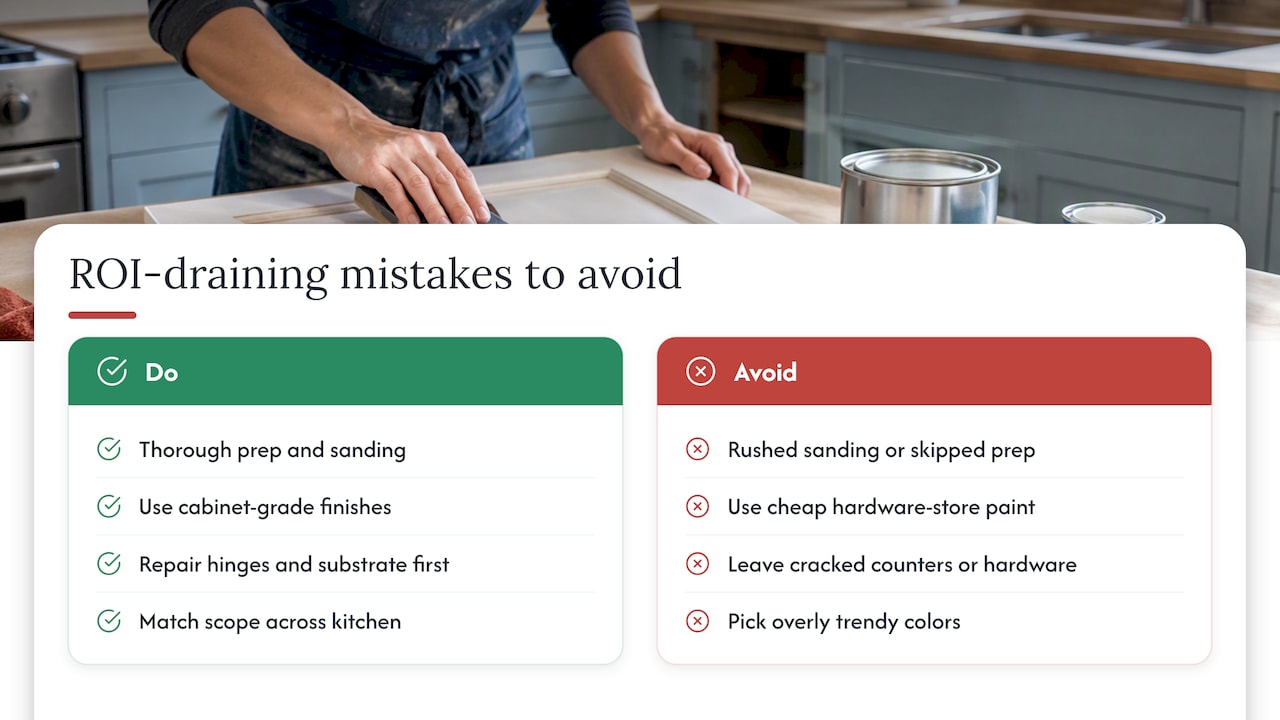
Poor workmanship is the biggest one. A rushed sanding job, inconsistent paint thickness, or skipped prep steps lead to chipping and peeling within months, and a finish that fails early erases any resale benefit it was supposed to create. Buyers notice unevenness up close during a walkthrough even when listing photos looked fine.
Material choice matters almost as much. Cheap, hardware-store paint not formulated for cabinetry wears faster under daily kitchen use, heat near the stove, humidity near the sink, and constant hand contact all stress a finish that wasn’t built for it. Skipping a bonding primer on laminate or previously varnished surfaces is a common cause of early peeling.
Mismatched scope hurts ROI too. Refinishing cabinets while leaving cracked countertops or broken hardware in place creates a visual mismatch that undercuts the “move-in ready” impression you’re paying for. And overly trendy color choices can look dated within a couple of years, shrinking the window where the upgrade reads as fresh to a buyer.
Finally, skipping repairs to loose hinges, warped doors, or water-damaged substrate before refinishing guarantees the new finish won’t hold, since a factory-quality topcoat cannot fix a structural problem underneath it.
How cabinet refinishing ROI stacks up against other home projects
Among common home improvement projects, minor kitchen upgrades like cabinet refinishing consistently rank among the more cost-effective choices rather than among the most expensive remodels. The 2025 Remodeling Impact Report frames minor kitchen upgrades, which includes refinishing and painting, as recovering a meaningful share of cost, placing them competitively against other commonly recommended seller projects.
The practical advantage is the ratio of cost to impact. A full kitchen remodel can run tens of thousands of dollars and take months, while refinishing changes the same visual impression for a fraction of that outlay in a matter of days. That lower entry cost is part of why refinishing shows up so often in “project to recoup cost” discussions: a smaller investment is inherently easier to recover in full, even if the dollar amount it adds to a home’s price is smaller in absolute terms than a kitchen remodel would add.
Compared to bigger structural projects, like additions or major system replacements, cosmetic updates including cabinet refinishing tend to be lower-risk because they rarely trigger permitting issues or layout complications. That makes them a more predictable lever for homeowners who want value improvement without the uncertainty that comes with construction-heavy renovations.
Tips for maximizing ROI through quality work and design choices
A few decisions make the difference between a refinishing project that pays off and one that barely breaks even.
Choose a shop-based or spray-applied finish over brush and roller work whenever possible. The even film build and faster cure time translate directly into a finish that resists chipping longer, which protects the value the project was meant to add.
Stick to neutral, broadly appealing colors if resale is anywhere on your timeline. White, soft gray, and warm greige tones photograph well and appeal to the widest range of buyer taste, while bold colors narrow your buyer pool.
Don’t skip hardware. New hinges, pulls, and knobs cost little relative to the whole project but finish the look in a way that mismatched old hardware undermines.
Address small repairs before refinishing starts: tighten loose doors, fill dents, and replace any warped panels. A factory-grade topcoat only looks as good as the surface underneath it.
Finally, ask about low-VOC coating options. Beyond the air-quality benefit the EPA notes for architectural coatings, low-odor products mean less disruption to your household during the project itself.
Value that outlasts the resale calculation
Resale ROI is only part of the picture if you’re not selling anytime soon. A durable, well-applied finish adds daily value that never shows up in a cost-recovery percentage: a kitchen that looks current makes the house more enjoyable to live in, which is its own return even without a sale on the horizon.
For rental property owners, that same durability translates into fewer maintenance calls and longer stretches between touch-ups, since tenants are harder on finishes than owner-occupants tend to be. A finish that survives several tenant turnovers without needing a repaint protects your margin in a way a cheaper, less durable job never will.
There’s also a sustainability angle worth factoring in. Refinishing keeps existing cabinet boxes out of landfills and avoids the material and manufacturing footprint of all-new cabinetry, a point we cover in more depth in our guide to the environmental impact of cabinet refinishing. That’s value that persists regardless of when, or whether, you eventually sell.
How your local market shapes what you’ll recover
The same refinishing project can produce very different financial outcomes depending on where the home sits. In a competitive seller’s market with low inventory, buyers are more willing to pay up for a kitchen that looks finished and move-in ready, pushing recovery rates toward the higher end of reported ranges. In a slower market with more homes to choose from, buyers have the leverage to expect move-in-ready finishes as a baseline rather than a premium, which can compress the uplift a refinish delivers.
Neighborhood price point matters too. In a starter-home market, a $3,500 refinishing project can meaningfully shift how a kitchen compares to similar listings. In a higher-end market, buyers may expect a kitchen that already looks refreshed, making refinishing more about removing a negative than creating a standout positive.
Local buyer preferences also shape which finishes perform best. Some regions lean toward warm wood tones and staining, others toward bright white or two-tone painted cabinets, and matching your finish to what local buyers already favor tends to outperform a generic national trend. Checking recent comparable sales in your specific area, or asking a local agent what buyers have been responding to, gives a more reliable read than any national average alone.
Weighing resale value against everyday enjoyment
Resale ROI matters, but it’s not the only number worth tracking. If you’re staying put for years, a durable finish you actually enjoy looking at every morning carries a value that never shows up on a closing statement.
Choose quick cosmetic refinishing when the boxes are sound and your timeline is tight. Choose full replacement only when structural damage or a layout change makes refinishing pointless.
— Jesse
How we help you get a factory finish without the replacement price tag
We handle cabinet refinishing, painting, glazing, and restoration for kitchens and bathrooms using a shop-based spray process rather than brush or roller work. We match existing colors, repair minor damage as part of the job, and offer low-VOC material options to support better indoor air quality during the project.

Our refinishing projects typically run $3,000 to $8,000 and complete in 3 to 5 days, a fraction of the time and cost of the $15,000 to $40,000 typical for full cabinet replacement. If you’re weighing your own numbers from the ROI calculation above, the next step is a written estimate: reach out through our cabinet refinishing page and ask about turnaround time and warranty coverage for your specific cabinets.
FAQ
How much should I charge to refinish cabinets?
Pricing depends on your market and scope, but national data from Angi shows typical homeowner costs between $1,992 and $4,495, averaging $3,116. Contractors often price per square foot, in the $4 to $10 range, rather than a flat rate, since kitchen size and cabinet condition both affect labor time.
Is cabinet refinishing worth it?
For structurally sound cabinets, refinishing is generally worth it: the 2025 Remodeling Impact Report places minor kitchen upgrades, which include refinishing, among projects that recover a meaningful share of cost, roughly 60%. It’s a lower-cost, lower-disruption alternative to full replacement that still changes a kitchen’s entire look.
What is the profit margin on cabinets?
The more reliable national benchmark remains the roughly 60% recovery rate NAR reports for minor kitchen upgrades as a category.
Is $10,000 enough for a kitchen remodel?
Typical cabinet refinishing costs range from $1,992 to $4,495 on average, per Angi, which is far below what a full kitchen remodel or cabinet replacement usually requires. At that budget, refinishing or refacing cabinets alongside smaller updates like hardware and lighting tends to deliver more visible change than attempting a full gut renovation.
Sources
- How Much Does It Cost to Refinish Cabinets? | Angi
- 2025 Remodeling Impact Report
- Architectural coatings — national volatile organic compounds | EPA