

Can you paint over previously painted cabinets without inviting chips, peeling, or an uneven finish? Often, yes, if the existing coating is firmly attached and the cabinet surfaces are in sound condition. If paint is lifting or the surfaces are damaged, another coat can make flaws more noticeable rather than fix them.
A lasting result depends on more than choosing a new color. The first step is to assess the existing finish, then decide what preparation and finish approach suit the cabinets. This article explains what to look for, what professional preparation involves, and how to compare repainting, refinishing, and replacement.
For Denver homeowners, professional cabinet painting typically involves thorough cleaning and sanding, masking nearby surfaces, and spray application for a smooth, factory-like finish. Painting updates the color on a prepared surface. Refinishing may involve removing the existing finish and restoring the wood with stain and a protective coating. Cabinet refinishing Denver provides cabinet painting and refinishing for existing cabinets, helping homeowners consider an update before choosing replacement.
Key Takeaways
- To decide whether you can paint over previously painted cabinets, assess the coating’s condition and get a professional opinion if it is damaged or uncertain.
- Cleaning, sanding, and protecting nearby surfaces are important parts of preparing cabinets for a new finish.
- Compare repainting, wood refinishing, and replacement based on the cabinets’ condition and the look you want.
- Understand what to expect from professional cabinet painting in Denver, including assessment, masking, spray application, and a final review.
- Use the checklist in this article to weigh the benefits and limitations of repainting before choosing an update for your home.
Can You Paint Over Previously Painted Cabinets? Start With the Existing Finish
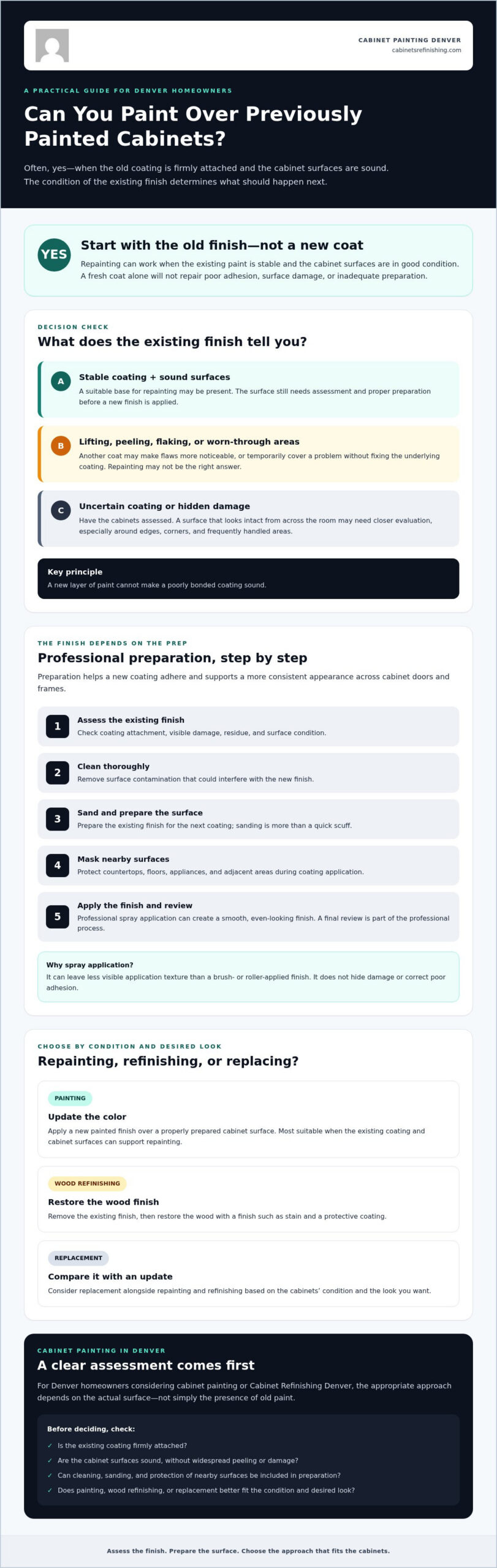
Yes, previously painted cabinets can often be repainted if the existing coating is firmly attached and the cabinet surfaces are in sound condition. The key question is not simply whether paint is present. It is whether the old finish can support a new coating without lifting, flaking, or showing through.
Repainting means applying a new painted finish over a properly prepared cabinet surface. Stripping and refinishing means removing the existing finish, then restoring the wood with a finish such as stain and a protective coating. The wood finishing process helps explain why preparation and the condition of the underlying surface matter to the final result.
A fresh coat alone will not correct poor adhesion, surface damage, or inadequate preparation. If the existing paint is separating from the cabinet, another layer may hide the issue temporarily, but it will not make the underlying coating sound.
How to tell whether the existing cabinet finish is a suitable base
A suitable base is generally stable, without widespread peeling, flaking, or worn-through areas. Look closely at edges, corners, and frequently handled areas for signs of lifting or wear. A professional assessment can also consider how well the coating is attached, whether there is visible damage, and whether residue or contamination could interfere with a new finish. A surface that looks intact from across the room may still need closer evaluation.
If you are unsure what material or coating is on the cabinets, have it assessed rather than assuming a new layer will bond properly. For Denver homeowners comparing cabinet painting options, the right approach depends on the actual condition of the existing finish.
When painting over painted cabinets may not be the right answer
Peeling or lifting paint, extensive wear, and damaged cabinet surfaces can call for more than a topcoat. The existing coating may be poorly bonded, or problems beneath it may not be visible until the surface is evaluated. Repainting is not the right solution for every cabinet.
A professional can determine whether the existing coating can be prepared for repainting or whether another approach, such as stripping and wood refinishing, is more suitable. Painting Kitchen Cabinets Denver also provides cabinet refinishing for homeowners considering a natural wood finish. The goal is to choose an approach that suits the surface, not simply add another layer of paint.
Why Preparation Determines Whether Repainted Cabinets Look Smooth and Last
Preparation helps a new coating adhere and gives cabinet doors and frames a consistent appearance. It is not a cosmetic extra. Grease, residue, loose paint, and surface imperfections can interfere with adhesion or remain visible beneath the new finish. Applying paint before addressing them can leave an uneven result or contribute to coating failure.
What professional cabinet preparation includes
Professional preparation starts with thorough cleaning to remove surface contamination, followed by sanding to prepare the existing finish for the next coating. This is careful surface work, not just a quick scuff before painting. The surrounding kitchen also needs protection. Countertops, floors, appliances, and adjacent areas are carefully masked to help keep them clear during coating application.
These steps work together. Cleaning addresses residue, sanding prepares the surface, and masking protects the room. Skipping or rushing any part can affect the finished appearance. The appropriate preparation also depends on the cabinets’ existing condition, so the surfaces should be assessed before work begins.
Why professional spray application matters for the final appearance
Spray application can create a smooth, even-looking finish across cabinet doors and frames, with less visible application texture than a finish applied by brush or roller. The result still depends on careful preparation and controlled application. Spraying will not hide damage or correct poor adhesion, and no application method makes every surface flawless.
Professional cabinet coatings are chosen for the demands of cabinet surfaces, while an experienced applicator works to create a consistent finish. The American Coatings Association’s overview of architectural coatings provides background on modern coatings. Appropriate materials, sound preparation, and skilled spraying all contribute to the smooth, factory-like appearance homeowners seek.
A smooth cabinet finish starts with sound preparation. Professional spray application then helps create an even, factory-like appearance.
If you are considering cabinet painting in Denver, ask how cleaning, sanding, masking, coatings, and application fit into the planned process. Those details can help you distinguish a thorough cabinet update from a quick topcoat. Learn more about professional cabinet painting and refinishing for existing cabinets.
Repainting vs. Refinishing vs. Replacing Cabinets: Which Fits Your Situation?
These options solve different problems. Repainting changes the cabinet color while keeping a painted finish. Wood refinishing removes the existing finish to reveal and restore a natural wood appearance. Replacement means choosing new cabinets, which may make sense if the existing ones do not meet your project needs. Start by considering two things: the cabinets’ condition and the look you want.
| Option | What it changes | May suit you if |
|---|---|---|
| Repainting | Updates the appearance with a new painted finish over appropriately prepared cabinets. | You want a different painted look and the existing cabinets are suitable for an update. |
| Wood refinishing | Strips the old finish and restores the wood’s natural appearance with a new finish. | You prefer visible wood grain and the cabinets are appropriate for refinishing. |
| Replacement | Replaces existing cabinets with new ones. | The current cabinets do not meet your project needs or the scope goes beyond a finish update. |
When cabinet painting may be the practical update
If the cabinets meet your functional needs and you mainly want a new color, painting can update the kitchen while keeping the existing cabinets. It can be a cost-effective alternative to replacement when the cabinets are suitable for an appearance update. The comparison depends on cabinet condition and project scope. Painting is a focused cosmetic update, not a substitute for a larger remodel when the layout or other parts of the kitchen need to change.
For Denver homeowners considering cabinet painting, an assessment can help determine whether the existing surfaces are suitable and which finish approach fits the goal. The answer to “can you paint over previously painted cabinets?” depends on the coating and cabinet condition, not just the color you want.
When refinishing or replacement deserves consideration
Choose refinishing when you want a natural wood appearance rather than a painted surface. Stripping the existing finish is different from applying another coat of paint, and the cabinet material and condition help determine whether refinishing is suitable.
Replacement may deserve consideration if the existing cabinets do not fit your project needs. It is a separate decision from refinishing or painting existing cabinets. Painting Kitchen Cabinets Denver focuses on painting and refinishing existing cabinets, not new cabinet sales or installation. Compare the cabinets’ condition, the appearance you want, and the overall project scope before settling on an approach. A professional assessment can help clarify what is realistic.
What to Expect From Professional Cabinet Painting in Denver
A professional cabinet-painting service should explain how it will evaluate the existing finish and prepare the cabinets before applying a new coating. That matters if you are asking, “Can you paint over previously painted cabinets?” The answer depends on the coating’s condition and the preparation the surfaces need. In Denver and nearby communities such as Aurora, Lakewood, and Littleton, use the questions below to understand the proposed work and compare services.
A typical professional process includes these stages:
- Initial assessment: The professional evaluates the existing coating, visible wear, and cabinet surfaces to determine whether painting is appropriate and what preparation is needed.
- Cleaning: Cabinet surfaces are thoroughly cleaned to remove contamination that could interfere with coating adhesion.
- Sanding: The existing finish is professionally sanded as part of surface preparation, creating a suitable base for the new coating.
- Protective masking: Countertops, floors, appliances, and adjacent areas are carefully masked to protect the kitchen during the work.
- Coating application: Professional coatings are applied using a suitable method. Spray application is often used to create a smooth, even-looking finish.
- Final review: The completed surfaces are reviewed for consistency and finish quality.
Questions to ask before hiring a cabinet-painting professional
Ask how the contractor evaluates previously painted surfaces and what findings might change the proposed approach. Ask which areas will be masked, including countertops, floors, appliances, and nearby surfaces. You can also ask how cleaning and sanding are handled, what type of professional coating system is planned, and whether spray application is used to pursue a smooth finish.
Clear answers help you understand the scope of work before it begins. They also show whether the contractor treats preparation as a core part of cabinet painting rather than a detail to rush past.
How the professional process protects the finished result
Cleaning and sanding are deliberate preparation stages, not optional extras. They address surface contamination and prepare the existing finish for the coating system. Careful masking protects kitchen surfaces and appliances while cabinet work is underway. Professional coatings and controlled spray application support a consistent, factory-like appearance, though the result still depends on the cabinets’ condition and the quality of the full process.
Painting Kitchen Cabinets Denver focuses on painting and refinishing existing cabinets and has over 38 years of experience. To discuss cabinet painting and refinishing for your Denver area home, review the process and ask how it would apply to your cabinets.
Is Repainting Your Cabinets the Right Choice? Get a Denver Area Assessment
Repainting can be a practical update when you want a new painted appearance and the cabinets are suitable for another coating. It is not right for every surface or every project. A balanced decision starts with the existing finish, the look you want, and whether your plans call for more than a cabinet update.
A simple decision checklist for previously painted cabinets
- Check the finish condition: A coating that appears stable may be a candidate for repainting. Peeling, lifting, extensive wear, or uncertainty about the existing material calls for professional evaluation.
- Clarify the look you want: Choose painting if you want a new painted finish. Consider wood refinishing if you would rather restore a natural wood appearance.
- Match the update to the project: Painting or refinishing updates existing cabinets. Replacement may be worth considering if the cabinets do not meet your project needs or the scope goes beyond a finish change.
- Weigh the limitations: Repainting depends on suitable cabinet condition and thorough preparation. It will not correct every underlying surface problem or change the kitchen’s layout.
What Denver homeowners can discuss with a cabinet specialist
Ask a cabinet specialist to assess the finish and explain what its condition means for your options. You can also ask how cleaning and sanding are handled, what professional coatings are considered, how countertops, floors, and appliances are protected, and whether spray application is part of the plan for a smooth, factory-like finish.
Painting Kitchen Cabinets Denver provides cabinet painting and refinishing in Denver and surrounding communities, including Highlands Ranch, Parker, Castle Pines, Englewood, Cherry Hills, Washington Park, Lakewood, Arvada, Wheat Ridge, Littleton, Aurora, and Centennial. The company has over 38 years of experience. Homeowners can ask how that experience informs the assessment and preparation plan for their cabinets.
If you are still weighing whether you can paint over previously painted cabinets, an assessment can help clarify the finish’s condition and whether repainting fits your desired outcome. Painting existing cabinets can be a cost-effective alternative to replacement when the cabinets are suitable, but the right choice depends on the home and project.
Before choosing between painting, refinishing, or replacement, discuss the cabinets’ condition, the finish you want, and your project goals with a specialist. A clear assessment can help you understand what the existing cabinets can support.
Choose the Right Cabinet Update With Confidence
So, can you paint over previously painted cabinets? Often, yes, if the existing finish is stable and the cabinets are properly assessed and prepared. Peeling, lifting, or extensive damage may call for a different approach. Cleaning, sanding, careful masking, professional coatings, and spray application all contribute to a smooth, consistent finish.
Consider the result you want, too. Cabinet painting changes the look with a new painted finish, while wood refinishing restores a natural wood appearance. Replacement may be worth considering if the existing cabinets do not fit your project needs. A professional assessment can help you compare these options for your home.
Painting Kitchen Cabinets Denver specializes in cabinet painting and refinishing for Denver and surrounding Colorado communities. The company has over 38 years of experience. If you are ready to discuss your cabinets’ condition and request an estimate, request a cabinet-painting assessment. Contact the team to discuss your project and the right finish approach for your cabinets.
Frequently Asked Questions
Can you paint over cabinets that have already been painted?
Often, yes, if the existing coating is stable and the cabinet surfaces are suitable. To decide whether you can paint over previously painted cabinets, assess the finish, not just the number of paint layers. Peeling, damage, or uncertainty about the material calls for professional evaluation. Painting Kitchen Cabinets Denver serves Denver and nearby communities, including Highlands Ranch, Parker, Castle Pines, Englewood, Cherry Hills, Washington Park, Lakewood, Arvada, Wheat Ridge, Littleton, Aurora, and Centennial.
Do previously painted cabinets need to be sanded before repainting?
Sanding is commonly part of professional cabinet preparation because it helps prepare the surface for a new coating. The appropriate preparation depends on the existing finish and cabinet material, so there is not one approach for every set of cabinets. A professional process also includes surface assessment and thorough cleaning. A cabinet professional can explain what preparation your surfaces need.
Will paint peel off cabinets that were already painted?
It can peel if the existing coating is unstable or the surfaces are not prepared and coated appropriately, but previous paint alone does not mean peeling is inevitable. The condition of the current finish, cleaning, sanding, and application all affect the result. If paint is lifting or the coating is questionable, ask a cabinet professional to assess it and explain the preparation and coating plan before work begins.
Is it better to repaint cabinets or refinish them?
It depends on the cabinet condition and the appearance you want. Painting adds a new painted finish, while wood refinishing involves stripping the old finish and restoring a natural wood look. If you are unsure, ask a professional to evaluate the existing surfaces and discuss the options. Replacement is a separate choice that may make sense if the cabinets do not suit your project needs or the scope goes beyond a finish update.
How much does it cost to repaint previously painted cabinets?
The cost depends on the cabinets, the condition of their existing finish, the preparation required, and the project scope. There is not enough information to give a reliable figure without assessing the actual work. Request an estimate based on your cabinets, then ask what cleaning, sanding, masking, coatings, and application are included so you can understand what the proposed work covers.
Can painted cabinets be professionally spray-painted for a smoother finish?
Yes. Professional spray application can support a smooth, even-looking cabinet finish when paired with careful preparation and appropriate professional coatings. The outcome still depends on the cabinet surfaces and the quality of the work. Before hiring a cabinet painter, ask how the service handles cleaning and sanding, and how it protects countertops, floors, appliances, and nearby areas during coating application.
Is repainting cabinets cheaper than replacing them?
Painting existing cabinets can be a cost-effective alternative to replacement, especially when the cabinets are suitable for an appearance update. It is not the right solution for every kitchen, and the best choice depends on condition, desired results, and project scope. Compare painting, refinishing, and replacement based on the work your home needs. A professional assessment and estimate can help clarify the options without assuming a specific saving.