

Shaker cabinets suit almost any home because their recessed-panel doors read as classic without looking dated, while slab cabinets suit kitchens built around a clean, modern line and a surface that wipes down in one pass. Neither wins outright, though. The door shape sets the mood, but the cabinet’s core material, finish process, and joint construction decide whether it still looks good in ten years.
TL;DR:
- Choosing between shaker and slab cabinets depends more on style and finish quality than on the door shape itself, as costs are similar across tiers.
- High-quality finishes and proper core materials are the main drivers of price, with premium surfaces costing 20 to 40 percent more regardless of door style.
- Cabinets with MDF or HDF cores resist warping and hold finishes better, especially in humid environments, reducing long-term maintenance issues.
- Refinishing existing cabinets can replicate shaker or slab looks quickly and affordably, often in 3 to 5 days and at a fraction of full replacement costs.
- Proper construction quality and finish durability determine how well cabinets age, with DIY repairs more feasible on shaker doors than on high-gloss slab surfaces.
Table of Contents
- Shaker vs Slab Cabinets: How the Doors Are Actually Built
- Which Kitchens Actually Suit Each Style
- What Actually Drives the Price Tag
- How Long Each Style Lasts, and What Wears Out First
- A Checklist for Deciding Between Shaker and Slab
- Mixing Shaker and Slab in the Same Kitchen
- Refinishing: Getting Either Look Without a Full Replacement
- The Practical Verdict on Shaker vs Slab
- A Faster Way to Get the Shaker or Slab Look You Want
- Where These Numbers Come From
- Sources
- FAQ
Shaker vs Slab Cabinets: How the Doors Are Actually Built
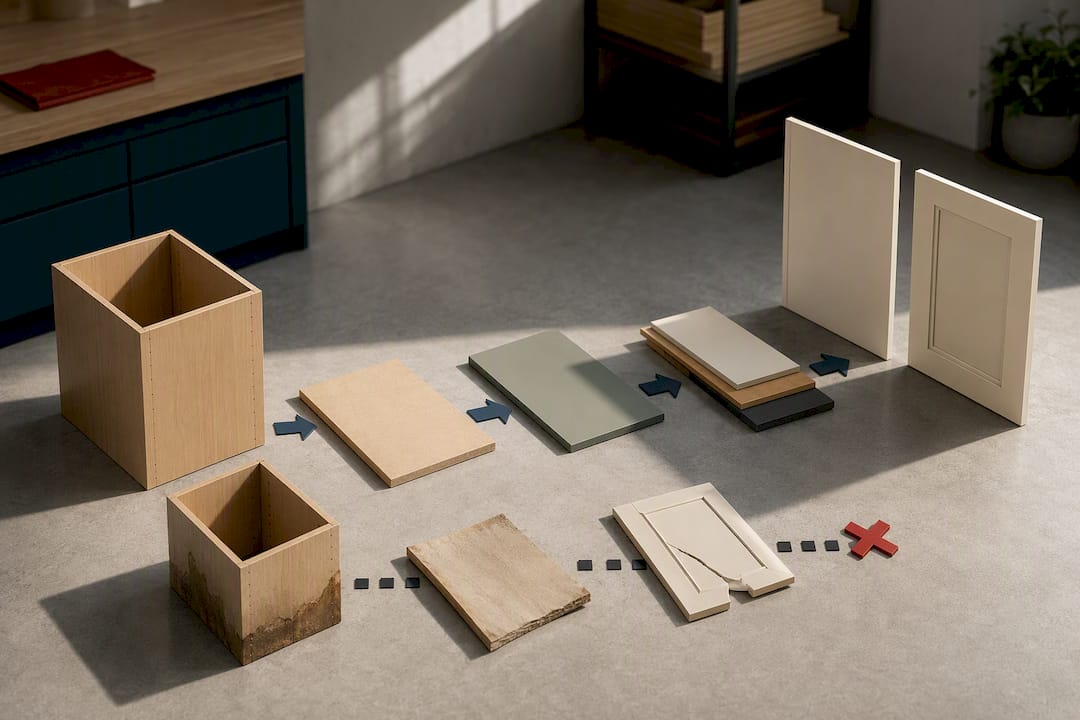
The difference starts with construction, not looks. A shaker door is built from five pieces: four frame rails and a recessed center panel, joined at the corners. A slab door is one flat piece, or a single sheet with no visible seams at all. That structural gap explains almost everything else in this comparison, from price to how each door handles a Colorado winter’s humidity swings.
Manufacturers have modernized the shaker profile, too. Instead of true five-piece joinery, many stock and semi-custom lines now rout the panel groove directly into a single sheet of MDF, which mimics the shaker look without any joints to crack or separate over time. Contractors increasingly specify MDF shaker doors for painted projects precisely because a one-piece routed door moves less than solid wood joinery and holds a paint finish more evenly.
Core material and box type matter just as much as the door face:
- Cores: MDF and HDF are the standard for painted doors because they resist warping; plywood shows up more in higher-end lines for structural panels.
- Finishes: paint, wood veneer, laminate, and acrylic (high-gloss or matte) all sit on top of these cores, and the finish often costs more than the door shape itself.
- Box construction: framed boxes (a face frame across the front) pair naturally with shaker doors, while frameless “full access” boxes are the standard partner for slab doors, since there’s no frame lip to interrupt the flat plane.
- Hardware: shaker’s frame gives knobs and pulls a natural mounting rail; slab doors often rely on integrated finger-pulls or minimalist bar pulls to keep the surface uninterrupted.
If you want the deeper mechanics of how the box and door interact, cabinet box vs. door construction is worth a read before you start comparing quotes.
Which Kitchens Actually Suit Each Style
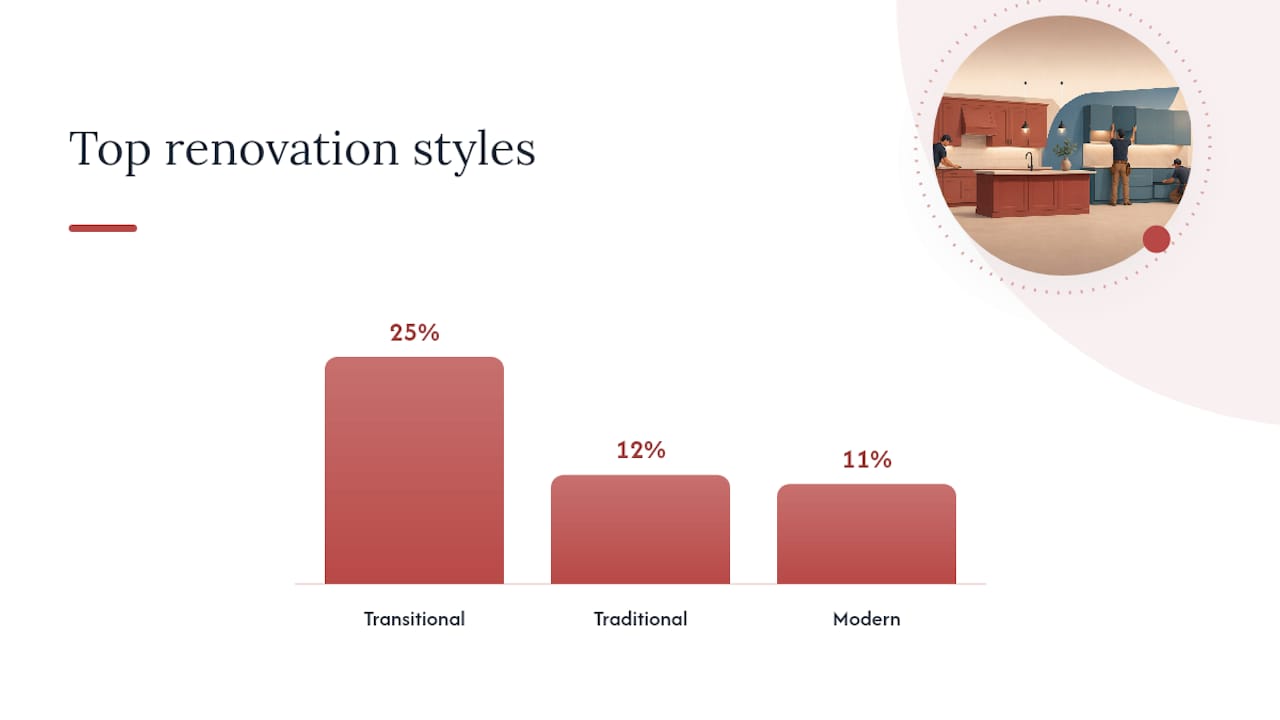
Shaker cabinets flex into more architectural contexts than almost any other door style, which is exactly why they show up so often in remodels. Paint them white and they read traditional. Paint them charcoal or sage and add black hardware, and the same five-piece frame reads transitional or modern farmhouse. That range is a big part of why the 2026 Houzz Kitchen Trends Study puts transitional style at the top of renovation choices at 25%, well ahead of traditional at 12% and modern at 11%, with shaker doors noted as one of the most versatile options across top-performing designs.
Slab cabinets belong to a narrower but distinct lane: modern, Scandinavian-minimalist, and urban condo kitchens where the goal is an unbroken visual line. Gloss and matte finishes change the effect considerably. High-gloss acrylic slabs bounce light around a room and can make a tight galley kitchen feel bigger, while matte slab finishes lean quieter and hide fingerprints better in a busy household.
A few practical style notes worth remembering:
- Shaker in mid-tone paint or stain hides daily wear better than either high-gloss or very dark slab finishes.
- Slab kitchens photograph exceptionally well, which matters if you’re staging for a sale in a design-forward urban market.
- Shaker’s broader appeal tends to serve resale better in suburban and traditional markets, since it reads as neutral to more buyers.
Given that 84% of renovating homeowners upgrade their cabinets during a kitchen project, this decision touches nearly every remodel, not a niche subset of them.
What Actually Drives the Price Tag
Door shape rarely moves the needle on cost the way people expect. Cabinet pricing splits mainly into three tiers: stock (pre-made sizes, lowest cost), semi-custom (stock boxes with more finish and sizing options), and full custom (built to exact specs, highest cost). Within any one of those tiers, shaker and slab often land close together in price.
What actually separates a $12,000 cabinet package from a $22,000 one is the finish process. A basic painted MDF shaker door and a basic painted MDF slab door cost nearly the same to produce. But push into premium finishes, high-gloss acrylic, textured European laminates, real wood veneer, and the math changes fast. Premium slab finishes can run 20 to 40 percent higher than paint-grade shaker within the same product line, driven almost entirely by the finish complexity, not the door shape.
When you’re comparing quotes, ask the showroom or contractor to break out these specifics rather than accepting a flat per-linear-foot number:
- The exact core material (particleboard, MDF, HDF, or plywood) for both door and box.
- The finish process: sprayed, hand-painted, laminated, or thermofoil.
- How edge banding is applied and what material it’s made from.
- Whether the quoted price is stock, semi-custom, or full custom.
How Long Each Style Lasts, and What Wears Out First
Shaker and slab doors fail in different places, and knowing where to look before you buy (or before you decide whether to replace at all) saves real money down the line.
- Shaker’s weak points are the joints and the recessed panel. Over years of humidity swings, the corner joints on a true five-piece door can develop hairline separations along the paint line. The recessed panel also collects grease and dust in a way a flat surface never will, so it needs more frequent detail cleaning around the inset edges.
- Slab’s weak points are the edges and the surface itself. There’s no joint to crack, but corners and edges chip more visibly because there’s no frame to absorb an impact. High-gloss finishes also show every fingerprint and water spot, and any edge-banding failure is immediately obvious since there’s no panel detail to distract the eye.
- Construction quality decides which of those problems you’ll actually have. A hybrid build, solid frame with an MDF or HDF center panel, gives shaker doors hinge strength plus dimensional stability, which reduces the grain telegraphing and paint cracking that plagues cheaper solid-wood shaker doors in variable humidity.
The upside for shaker owners: touch-ups are localized. A chipped corner or scuffed panel edge can often be spot-repaired without redoing the whole door. Slab surfaces, especially high-gloss ones, tend to show any touch-up as a visible patch, so repairs usually mean refinishing the entire face.
Pro Tip: Ask any cabinet maker or refinisher whether the panel core is MDF, HDF, or particleboard before you sign anything. Particleboard swells permanently when it gets wet, while MDF and HDF hold up far better under a kitchen sink or dishwasher leak.
A Checklist for Deciding Between Shaker and Slab
Work through this before you fall in love with a showroom sample, because the sample rarely tells you about the box behind it.
- Match the door to your home’s architecture. A slab kitchen in a Victorian house or a heavily traditional neighborhood can hurt resale value more than it helps.
- Think about your resale horizon. Selling within five years favors shaker’s broader buyer appeal; staying long term means you can lean into a style you personally love, slab included.
- Be honest about cooking frequency and mess. Heavy daily cooking with kids or pets in the house tends to favor shaker in a mid-tone finish, since it hides fingerprints and daily wear better than gloss slab.
- Decide your cleaning tolerance. If wiping a single flat surface sounds better than cleaning panel grooves, slab wins that argument outright.
- Set your budget tier first, stock, semi-custom, or custom, before you fall for a finish that only exists at the top tier.
Bring these exact questions to any vendor or cabinet maker:
- What is the door core, and is the shaker profile routed MDF or true five-piece joinery?
- What finish or coating is used, and what warranty backs it?
- How is the edge banding applied, and what material is it?
- What’s the lead time, and what’s the process if a panel chips or needs repair later?
Red flags worth walking away from: a quote that won’t specify the core material, particleboard used anywhere in a wet-prone cabinet box, no warranty offered on the finish, or vague answers about “professional-grade” finish with no actual process named.
Mixing Shaker and Slab in the Same Kitchen
You don’t have to pick one door style for the whole room, and plenty of the best-looking kitchens don’t. A slab island surrounded by shaker perimeter cabinets is one of the most common combinations, since it gives the room a modern focal point without losing the classic base cabinetry that tends to age well. Slab uppers paired with shaker lowers work for a similar reason: the eye lands on the flat, quiet upper section while the busier lower cabinets carry the traditional detail.
Keep hardware and finish sheen consistent across both styles, or the kitchen reads as unfinished rather than intentional. Mixing the two styles tends to help resale when the palette stays neutral and coordinated; it backfires when the shaker and slab sections feel like they were chosen by two different people.
Refinishing: Getting Either Look Without a Full Replacement
If your cabinet boxes are structurally sound, level, and free of water damage, refinishing can deliver a painted slab look or a routed MDF shaker profile without tearing out a single box. What it can’t do is add structural changes or bolt full-overlay slab panels onto boxes that weren’t built for that geometry, so it works best when you’re changing color and finish rather than the underlying door architecture.
Refinishing professionals use a factory-finish methodology built around meticulous prep and multiple protective topcoats, aiming for the kind of durable, even finish you’d expect from a factory door rather than a brush-and-roller repaint. Most projects run 3 to 5 days from start to finish, and homeowners typically report paying $3,000 to $8,000 for a full refinish, compared to $15,000 to $40,000 for a full cabinet replacement.
Before hiring anyone for this kind of work, ask:
- What does the prep process involve, and how many coats are applied?
- Is there a written warranty on the finish, and how long does it last?
- Can they show real before-and-afters on a similar door style or wood type?
- What’s the realistic timeline for your specific kitchen size?
The Practical Verdict on Shaker vs Slab
Chasing the “right” door shape is the wrong first question. A cheap slab door with poor edge banding will look worse in three years than a well-built shaker door with a solid paint job. Get a sample of both in your actual kitchen light before deciding anything, and if your existing boxes are sound, look hard at refinishing before you assume replacement is the only path to the look you want. Construction and finish quality decide how a kitchen ages. Door shape just decides how it looks on day one.
— Jesse
A Faster Way to Get the Shaker or Slab Look You Want
Full cabinet replacement isn’t the only way to land on either style, and for a lot of kitchens it’s not even the most sensible one. If your boxes are solid and level, the door shape and color are usually what’s actually bothering you, not the structure underneath. Specialized cabinet refinishers can deliver a factory-finish spray process that achieves a crisp painted shaker look or a smooth modern slab finish in a fraction of the time and cost of a full teardown.
Most cabinet refinishing projects run $3,000 to $8,000 and wrap in 3 to 5 days, against $15,000 to $40,000 and several weeks for a full replacement. That’s not a fit for every kitchen. If your boxes are water damaged or you’re changing the entire layout, replacement is the honest answer. But if you just want a new door style or color on cabinets that still function well, it’s worth finding out first whether your kitchen needs refinishing rather than replacing. Request an estimate and get a straight answer on which route fits your cabinets.
Where These Numbers Come From
Style and popularity figures come from the Houzz 2026 Kitchen Design Trends Report and the NKBA 2026 Kitchen Trends Report, alongside contractor specification guidance on MDF shaker construction.
Sources
- The Houzz 2026 kitchen design trends report (summarized on Forbes)
- Houzz press release: Homeowners turn to specialty built-in features in kitchen renovations
- Why contractors specify MDF shaker cabinet doors for painted projects
- Shaker vs Slab Cabinets: Finding your kitchen’s perfect match
- NKBA press: 2026 kitchen trends report
FAQ
What are the downsides of shaker cabinets?
Shaker doors can develop hairline cracks along the paint line at the corner joints as the wood frame expands and contracts, and the recessed panel collects grease and dust that needs regular detail cleaning. One-piece routed MDF shaker doors largely sidestep the joint movement problem since there are no seams to separate.
What are the cons of slab kitchen cabinets?
Slab doors show chips and dings more visibly at the corners and edges since there’s no frame to absorb impact, and high-gloss finishes reveal fingerprints and water spots quickly. Edge banding quality becomes critical, since a peeling edge is far more noticeable on a flat, seamless door than on a paneled one.
Are slab cabinets in style?
Yes, particularly in modern, Scandinavian, and urban condo kitchens, though they trail transitional and traditional styles in overall popularity. The 2026 Houzz Kitchen Trends Study puts modern style at 11% of kitchen projects, well behind transitional’s 25%.
What is the most popular cabinet style right now?
Transitional style leads at 25% of kitchen renovations, according to the Houzz 2026 study, with shaker doors cited as one of the most versatile options fitting that transitional look.
Can I get either look without replacing my cabinets?
In most cases, yes, as long as the cabinet boxes are structurally sound and free of water damage. Refinishing services like Cabinet Refinishing can deliver a painted shaker or slab finish in 3 to 5 days for $3,000 to $8,000, versus $15,000 to $40,000 for full replacement.