

Choose inset if you want furniture-grade, period-accurate cabinetry and can accept a 15–30% price premium. Choose overlay if you want more usable storage, lower cost, and an easier install. Full overlay gives a cleaner, modern look with wider openings, while partial overlay trims the budget further but reads a bit dated next to today’s flush-front trends.
TL;DR:
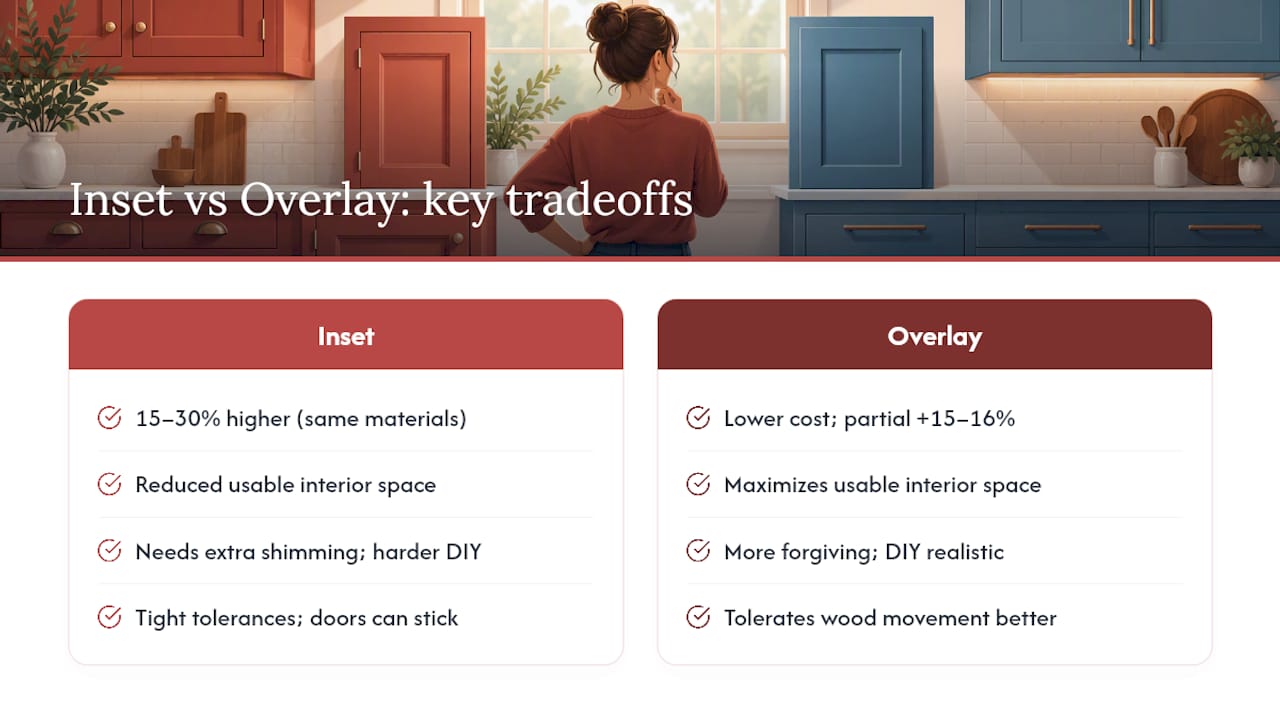
- Inset cabinets are more expensive by 15 to 30 percent because they require higher precision installation and specialized hinges that accommodate tight tolerances.
- Full overlay doors maximize storage and offer a modern, seamless look, but they can cost up to 16 percent more than partial overlay options.
- Installing inset cabinetry demands a square, level space to prevent visible gaps, making it more challenging for DIY projects and sensitive to seasonal wood movement.
- Converting between inset and overlay styles often involves full cabinet replacement or extensive adjustments, which are costly and rarely practical.
- Refinishing existing cabinets offers a faster, lower-cost alternative to complete replacement, with costs between $3,000 and $8,000, and preserves current coverage and layout.
Table of Contents
- Inset vs Overlay Cabinet Doors: The 30-Second Comparison
- What Is Overlay Cabinetry, and How Does Full Overlay Differ From Partial?
- What Is Inset Cabinetry, and Why Does It Cost More?
- Cost, Storage, and Durability: What Actually Drives the Decision?
- Can You Mix or Convert Between Inset and Overlay Styles?
- Refinishing as a Faster Alternative to Full Cabinet Replacement
- Three Rules of Thumb for Choosing Your Cabinet Door Style
- A Faster, Lower-Cost Path to a New Kitchen Look
- Essential Reading and Hardware Guides
- Sources
- FAQ
Inset vs Overlay Cabinet Doors: The 30-Second Comparison
Before you dig into tolerances and hinge specs, here’s the short version. Scan this list, then jump to whichever section actually answers your question.
- Look: Inset reads as furniture, flush and tailored. Full overlay looks clean and modern. Partial overlay looks fine but slightly older, with narrower gaps between doors and less frame showing.
- Cost: Overlay is the budget-friendlier option. Inset commonly runs 15 to 30 percent more than comparable overlay construction.
- Storage: Overlay wins because doors sit on top of the frame rather than tucked inside it, which maximizes usable interior space.
- Install difficulty: Overlay is more forgiving of an imperfect frame. Inset demands a level floor and square boxes, since any deviation shows up as an uneven gap.
- Humidity sensitivity: Inset shows seasonal wood movement faster because its reveal gaps are so tight. Overlay tolerates more shift before anyone notices.
- Best for: Inset suits period homes, farmhouse and Shaker kitchens, and anyone chasing a custom, high-end resale look. Overlay suits modern kitchens, budget remodels, and households that prioritize cabinet capacity over craftsmanship details.
If you’re renovating on a deadline or a fixed budget, overlay solves more problems. If you’re restoring a historic home or want cabinetry that photographs like furniture, inset is worth the extra cost.
What Is Overlay Cabinetry, and How Does Full Overlay Differ From Partial?
Overlay cabinet doors sit on top of the face frame or cabinet box instead of fitting inside it. The frame stays hidden or mostly hidden behind the door, and the door itself does the visual work.
Full overlay doors cover almost the entire cabinet box, leaving only a thin sliver, often around 1/8 inch, between adjacent doors. This creates the seamless, modern look you see in most contemporary kitchen renovations. Partial overlay doors are smaller, leaving more of the face frame exposed between them, sometimes a 3/8 inch to 1/2 inch reveal. Partial overlay was the standard look in American kitchens for decades, which is exactly why it can read as slightly dated now.
Frameless cabinets (also called full-access construction) skip the face frame entirely, relying on the box sides for support. This is essentially a variation of full overlay and it typically requires different hinge hardware than framed overlay boxes use.
Full overlay cabinets can cost up to 16% more than partial overlay, depending on the materials and construction involved, according to Angi’s cabinet comparison guide. The wider door coverage and cleaner sightlines come at a modest premium over partial overlay, but both remain less expensive than inset.
Overlay’s biggest functional advantage is storage. Because doors don’t need to fit inside an opening, cabinet boxes can be built with less wasted depth, giving you more usable space per cubic foot.
The tradeoffs are real, though:
- Exposed door edges on full overlay can show wear, chipping, or scratches faster since they’re the first thing anyone bumps into.
- Partial overlay’s visible frame lines can clash with a strictly modern kitchen design.
- Frameless overlay needs hinges rated for that construction; you can’t always swap hardware between framed and frameless boxes without extra drilling.
What Is Inset Cabinetry, and Why Does It Cost More?
Inset doors sit flush inside the face frame opening rather than on top of it, so the door front lines up nearly even with the surrounding wood. That flush fit is the entire appeal, and also the entire challenge.
Getting that look requires tight tolerances. Reveal gaps on inset doors typically run 1/16 inch to 1/8 inch, which is roughly the thickness of a couple of stacked credit cards. There’s very little room for error, so the cabinet boxes have to be built dead square and installed dead level. Any warp in the wood, any shift in the wall, and the gap becomes visibly uneven.
That precision explains the price tag. Manufacturing inset doors to those tolerances takes more skilled labor and more careful fitting on-site, which is why inset cabinetry commonly runs 15 to 30 percent more than equivalent overlay construction. Hardware matters too: inset doors typically use surface-mounted butt hinges, wrapped hinges, or specialty concealed hinges built for tighter clearances, and adjusting them after installation takes more patience than turning a screw on a standard European hinge.
- Pro: Inset delivers a furniture-grade, custom-built look that tends to read as higher-end to buyers and appraisers alike.
- Con: Slightly less usable interior space than overlay, since the door has to fit inside the opening rather than cover it.
- Con: More sensitive to humidity swings. Wood expands and contracts seasonally, and inset’s tight gaps have less margin to absorb that movement gracefully.
Pro Tip: Ask any cabinet installer for their gap tolerance in writing before you sign a contract for inset doors. If they can’t quote a number like 1/16 inch to 1/8 inch, that’s a sign they haven’t done many inset installs.
Cost, Storage, and Durability: What Actually Drives the Decision?
Once you get past the visual preference, three practical factors usually decide the debate: what you can spend, how much storage you need, and how much seasonal maintenance you’re willing to tolerate.
Cost. Inset runs 15 to 30 percent above overlay for equivalent materials, and full overlay itself typically carries a modest premium over partial overlay, often cited around 15 to 16 percent. Stack those together and a kitchen full of solid wood inset doors can cost meaningfully more than the same layout in painted MDF partial overlay, sometimes thousands of dollars depending on cabinet count and finish. Absolute dollar amounts shift with wood species, paint versus stain, and hardware choice, but the percentage relationships hold across most quotes.
Storage and access. Overlay cabinets maximize usable interior space because the door sits outside the opening rather than inside it. In a small kitchen where every inch of drawer and shelf depth counts, that difference adds up fast, especially in narrow base cabinets where an inset frame can eat into usable width.
Installation. Overlay is more forgiving of a slightly out-of-square wall or floor. Inset is not. Deviations show up immediately as inconsistent reveal gaps, which is why installers typically budget extra time to shim, level, and square the boxes before hanging inset doors. DIY overlay installation is realistic for a confident homeowner. DIY inset installation is a much bigger gamble unless you’ve done finish carpentry before.
Durability and humidity. Overlay tolerates seasonal wood movement better simply because it has more room to give. Inset’s tight tolerances mean a humid summer can tighten those gaps enough to make doors stick or rub. Mitigating that means good kitchen ventilation, periodic seasonal hinge checks, and hinges with enough adjustment range to compensate.
Hardware. European-style concealed hinges offer multi-axis adjustment that makes realigning overlay doors simple, often just a quarter turn of a screw. Inset hinges, whether concealed or exposed butt-style, generally need more careful, hands-on adjustment, and not every hinge model supports inset applications at all. Understanding how your cabinet box and door relate to all other helps explain why these hardware differences matter as much as they do.
Can You Mix or Convert Between Inset and Overlay Styles?
Mixing works well when you want the furniture look without paying for it everywhere. A common approach: inset doors on a kitchen island or a standout hutch, with overlay on the surrounding perimeter cabinets. Designers use this to create focal contrast while managing overall budget, and it reads as intentional rather than mismatched when done with a consistent wood tone or paint color.
Converting an entire kitchen from one style to the other is a different conversation. Here’s how the options stack up, from simplest to most involved:
- Swap hinges and adjust reveals. Rarely enough on its own. Overlay boxes usually aren’t built with the frame depth inset construction needs, so this alone won’t get you a true inset look.
- Replace doors only. Feasible if the boxes were built with inset-ready face frames. Otherwise you’re fighting the underlying carpentry.
- Reface or refinish existing doors. The most cost-effective route if you like your current door style and coverage, just not the finish or color.
- Full cabinet replacement. The only reliable way to change coverage style completely when the boxes weren’t built for it, and the most expensive option by far.
For most homeowners, a full inset-to-overlay conversion or vice versa isn’t worth the framing changes required. Hiring a pro to assess your existing boxes before committing to any conversion saves money and disappointment.
Refinishing as a Faster Alternative to Full Cabinet Replacement
Not every homeowner needs to relitigate inset versus overlay at all. If you like your current door coverage and frame, but you’re tired of the color, the wear, or a dated finish, refinishing solves that without touching the construction underneath.
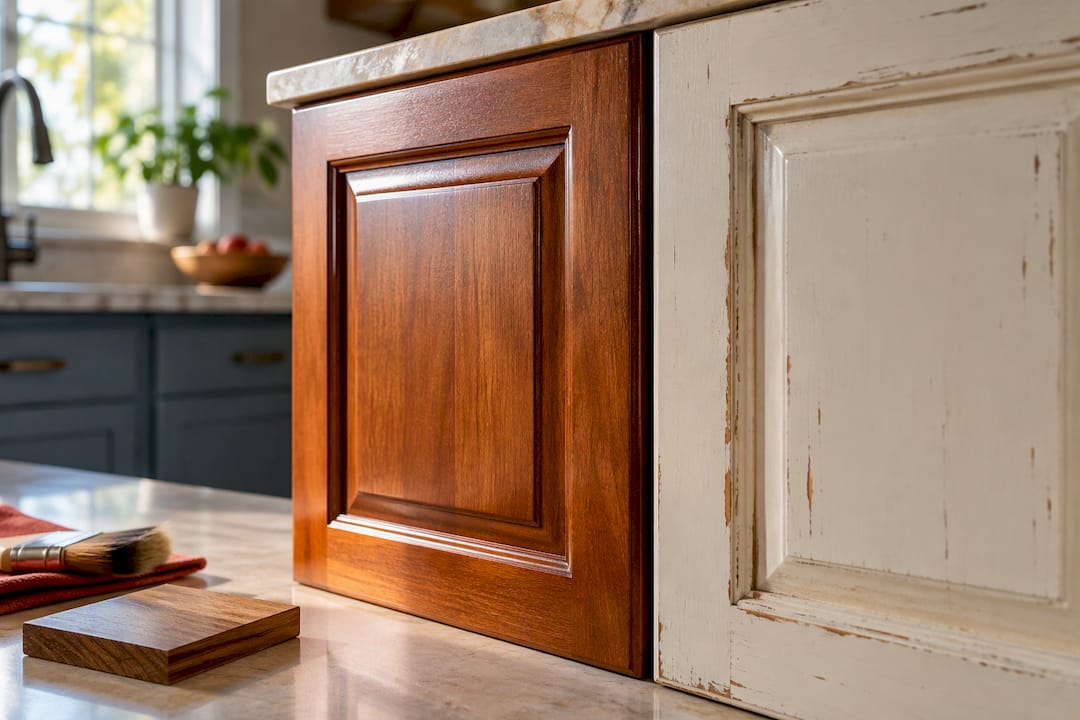
Cabinetsrefinishing’s factory-finish approach can transform a kitchen’s look without replacing the doors or boxes, typically for $3,000 to $8,000 completed in 3 to 5 days, compared with $15,000 to $40,000 and several weeks for full replacement.
This route makes the most sense when:
- Your existing door coverage (inset or overlay) and layout already work for your storage needs.
- The cabinet boxes are structurally sound, just cosmetically tired or the wrong color.
- Your budget and timeline favor a faster, lower-cost update over a gut renovation.
Before committing either direction, run through a simple checklist: door condition, desired look, budget ceiling, and timeline. That combination usually points you toward refinishing, replacement, or a partial door swap pretty quickly.
Three Rules of Thumb for Choosing Your Cabinet Door Style
Budget rules the decision more than taste does. If cost is tight, overlay wins almost every time. Match your house’s architecture. Period and farmhouse homes lean inset; contemporary builds lean full overlay. Be honest about your maintenance tolerance. If you don’t want to think about seasonal hinge adjustments, skip inset.
Before signing any contract, request physical door samples, ask your installer for their gap tolerance in writing, and get a firm install time estimate. Overlay installs are reasonable DIY projects for a handy homeowner; inset almost always calls for a pro.
— Jesse
A Faster, Lower-Cost Path to a New Kitchen Look
If replacing every cabinet box to fix a coverage style or freshen a finish feels like overkill, it usually is. Cabinetsrefinishing exists for exactly that gap between “I don’t hate my cabinets, I hate how they look” and a full gut renovation.

The factory-finish process uses spray equipment and multiple protective coats, not a brush and a can of paint from the hardware store, and most projects wrap in 3 to 5 days rather than the weeks a full replacement demands. Whether your kitchen runs inset, full overlay, or partial overlay, the door coverage stays exactly as it is. Only the finish changes, whether that means a full color switch, a glaze detail, or repairs to worn edges and corners. Homeowners considering a larger renovation budget often compare cabinet costs against other big-ticket items, like flooring installation costs, before deciding where refinishing fits into the overall project.
Curious whether your cabinets are a good candidate for refinishing rather than replacement? Get a look at the full Cabinet Refinishing, Cabinet Glazing, and Cabinet Restoration services and request an evaluation of your kitchen before you commit to a full remodel.
Essential Reading and Hardware Guides
For deeper detail, the Angi overlay comparison breaks down cost differences, and Blum’s hinge documentation gives installers exact mounting specs.
Sources
- Full vs. Partial Overlay Cabinets: Which Is Right for You? — Angi
- Inset, full overlay, partial overlay: the three cabinet fits — Bay State Kitchen Gallery
- Inset vs. Overlay Cabinetry — Distinctive Cabinetry & Designs
- Blum hinge mounting and adjustment documentation — BLUM
FAQ
What Are the Disadvantages of Inset Cabinet Doors?
Inset doors cost 15 to 30 percent more than overlay, offer slightly less usable interior storage, and are more sensitive to humidity-driven wood movement. They also demand a level, square installation, which extends install time and rules out most DIY attempts.
Are Overlay Cabinets Outdated?
No, though partial overlay can read as dated next to modern full overlay designs. Full overlay remains a leading choice in contemporary kitchens because it offers a clean look with wider openings and stronger storage capacity than either inset or partial overlay.
What Is More Expensive, Full Overlay or Inset Cabinets?
Inset is more expensive. It typically runs 15 to 30 percent above comparable overlay construction, while full overlay itself costs up to 16 percent more than partial overlay, making inset the priciest option of the three.
Can You Convert Overlay Cabinets to Inset?
It’s possible but rarely practical, since overlay boxes usually lack the face-frame depth inset construction needs. Full inset conversion generally requires new cabinet boxes, so most homeowners either accept a partial mix, focusing inset on an island or feature piece, or refinish their existing overlay doors instead.
Does Cabinetsrefinishing Change My Cabinet’s Door Style?
No. Refinishing changes the color and finish of your existing doors, whether inset, full overlay, or partial overlay, without altering the underlying coverage or construction. Pricing for Cabinet Refinishing typically falls between $3,000 and $8,000, completed in 3 to 5 days.