
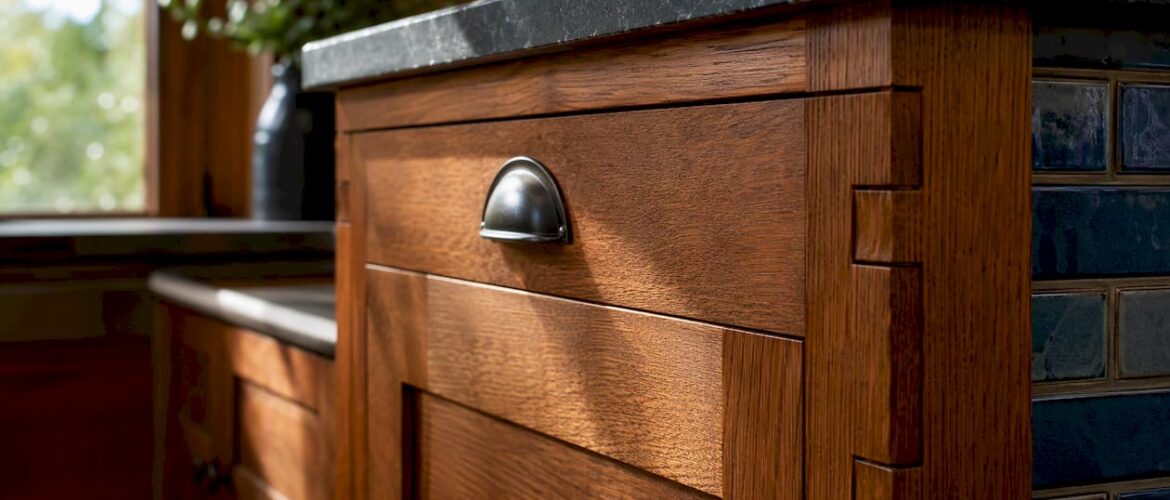
Craftsman-style cabinetry is defined by sturdy, straight-edged solid wood construction, visible joinery, and finishes that showcase natural grain rather than hiding it. According to HGTV’s design resource on the style, authentic examples favor quartersawn oak, hickory, maple, or cherry with stained rather than painted surfaces. Before you spend a dollar on renovation, run this three-point check:
- Door profile: Look for thick stiles and rails framing a recessed or flat center panel. No routed curves, no raised ornament.
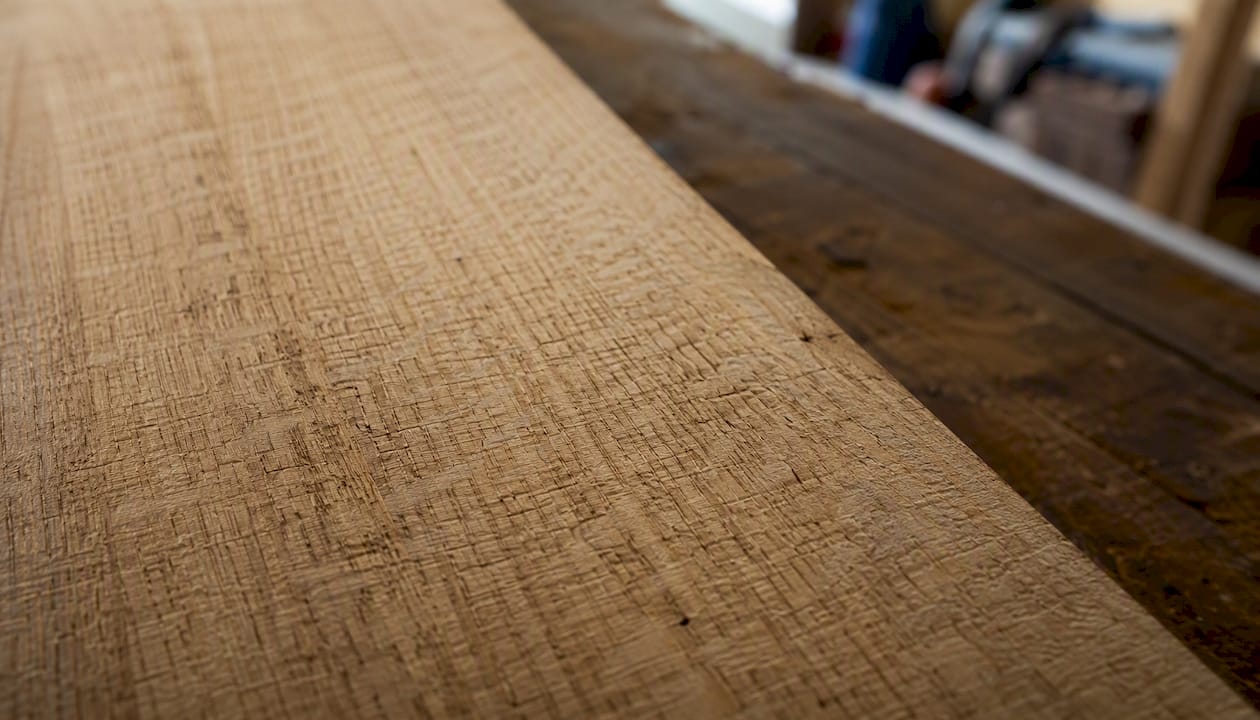
- Wood grain: Quartersawn oak shows a distinctive ray-flake pattern across the face. Plain-sawn grain is flatter and less characteristic.
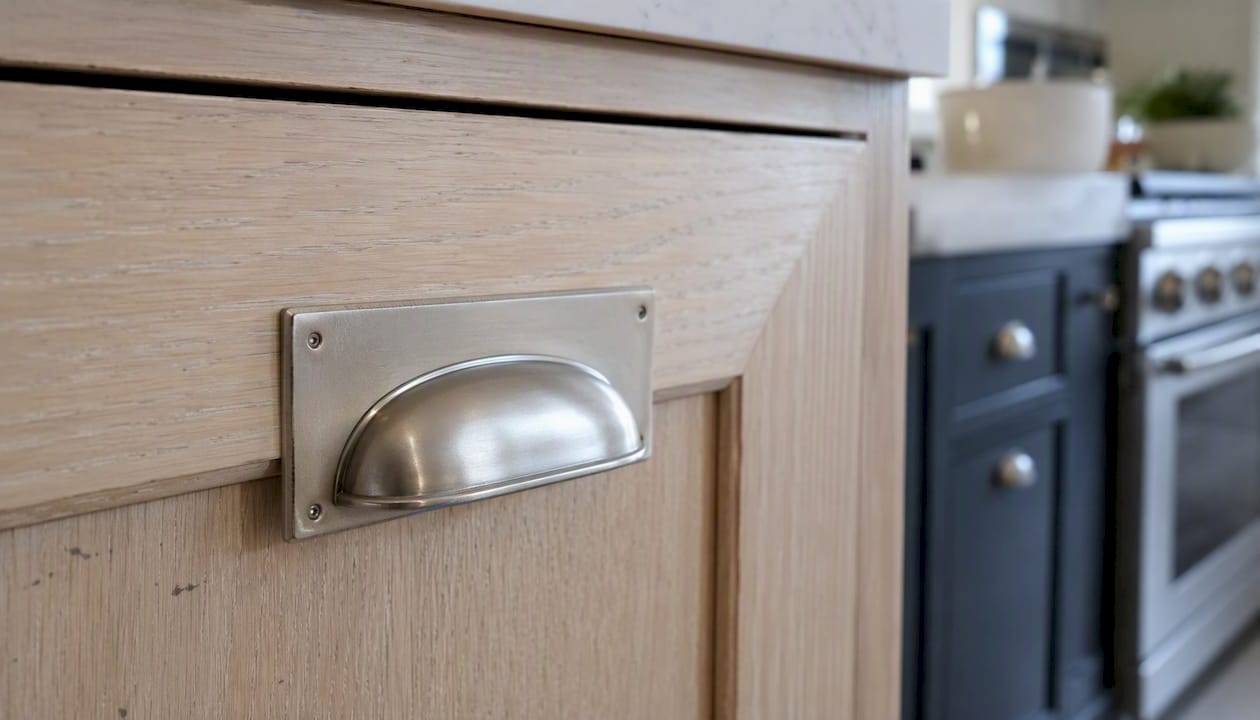
- Hardware: Simple, geometric pulls or bin pulls in matte brass, bronze, or copper. Nothing ornate.
One-line next step: If your cabinet boxes are solid and the doors show real wood grain, refinishing is almost always the smarter path. Replace only when construction is thin, particleboard-based, or structurally damaged.
Key Takeaways
Craftsman-style cabinetry is defined by thick solid-wood frames, visible joinery, and grain-forward stained finishes — and refinishing existing sound cabinets is usually the fastest, most affordable path to achieving that look.
| Point | Details |
|---|---|
| Three identification cues | Check door frame thickness, wood grain pattern (ray flake for quartersawn oak), and hardware style (simple geometric metal pulls). |
| Refinish vs. replace | Refinishing costs $3,000–$8,000 and takes 3–5 days; full replacement runs $15,000–$40,000 and takes weeks. |
| Preserve grain clarity | Use translucent stain rather than opaque paint to keep medullary rays and wood texture visible. |
| Hardware is high leverage | Swapping to period-appropriate matte brass or bronze pulls is often the single most affordable change that shifts a kitchen toward authentic Craftsman style. |
| Cabinetsrefinishing | Offers factory-finish spray refinishing in Denver with custom stain matching and hardware installation, completing most projects in 3–5 days. |
Table of Contents
- Where did craftsman style cabinetry come from?
- What features define authentic craftsman cabinetry?
- How to choose the right wood, finish, and hardware
- How built-ins and layout shape a Craftsman kitchen
- How do Craftsman and Shaker cabinets actually differ?
- Should you refinish, replace, or custom-build?
- Where to find authentic Craftsman design inspiration
- What to tell your cabinetmaker or refinisher
- Common challenges when installing Craftsman cabinetry
- Environmental and sustainability considerations
- When Craftsman cabinetry is the right choice and when it isn’t
- Get an authentic Craftsman finish without the cost of full replacement
- Sources
Where did craftsman style cabinetry come from?
The Craftsman movement grew out of the British Arts and Crafts movement of the late 19th century, then took firm root in America between roughly 1880 and 1930. It was a direct reaction against Victorian excess: the fussy ornament, the machine-stamped moldings, the materials that pretended to be something they weren’t. Designers like Gustav Stickley argued that furniture and architecture should show their own construction honestly.
That philosophy shaped everything about how Craftsman kitchens were built. Built-in cabinetry, plate racks, and open shelving weren’t decorative afterthoughts; they were structural expressions of how a household actually worked. When you look at a period bungalow kitchen, the cabinets read as part of the architecture, not furniture placed against a wall.
The style matters today because it ages exceptionally well. Solid wood and visible joinery hold up to decades of use in ways that thin veneers and concealed staple construction simply don’t. For homeowners planning a long-term renovation, that durability is a genuine argument for the style, not just an aesthetic preference.
What features define authentic craftsman cabinetry?
The defining elements of Arts and Crafts cabinetry are structural, not decorative. Each feature serves a purpose, which is exactly what the movement intended.
- Thick stiles and rails: The vertical and horizontal frame members are noticeably heavier than on Shaker or contemporary slab doors, typically 2.5 to 3.5 inches wide.
- Recessed or flat center panel: The panel sits flush or slightly inset within the frame. No raised profile, no routed cove.
- Visible joinery: Mortise-and-tenon and dovetail joints are left exposed or at least structurally present. On authentic pieces, you can often see the joint at the corner of a door frame.
- Square, unadorned edges: No decorative routing on the inside edge of the frame. The profile is a simple, sharp 90-degree corner or a very slight chamfer.
- Face-frame construction: Cabinet boxes use a solid wood face frame attached to the front, giving the cabinet a finished, architectural look from the front.
TaylorCraft’s door-profile resource is useful here: it illustrates how Craftsman and Mission frame-and-panel profiles differ visually from the simpler Shaker recessed panel, which uses thinner stiles and a more minimal edge treatment.
Pro Tip: When talking to a cabinetmaker, bring a photo of a period bungalow kitchen and ask specifically for “Mission-style frame-and-panel doors with square inside edges and mortise-and-tenon construction.” Those four terms together will tell any experienced shop exactly what you want and filter out shops that don’t actually build that way.
How to choose the right wood, finish, and hardware
Wood species
Quartersawn white oak is the signature wood of the Craftsman tradition. The quartersawing process exposes the medullary rays in the wood, producing the distinctive “ray flake” pattern that reads as unmistakably period-authentic. Plain-sawn oak lacks that pattern and produces a flatter, less characteristic result. Hickory, maple, and cherry are all period-appropriate alternatives; cherry darkens beautifully over time, while hard maple takes stain evenly and suits a slightly lighter palette.
Stain vs. paint
The Craftsman tradition strongly favors stain over paint. The whole point of the style is to let the material speak for itself, and paint covers that. Medium-to-dark walnut, golden oak, and fumed-oak tones are historically accurate. If you want a lighter kitchen, a translucent honey or amber stain preserves grain clarity far better than any opaque color. Matte and satin sheens read as more authentic than high-gloss finishes.
That said, painted Craftsman cabinetry isn’t wrong. Deep forest greens, warm whites, and charcoal grays can work well in a modern Craftsman kitchen, especially when the door profile and hardware remain period-correct. The key is keeping the paint translucent enough that the wood texture still reads through the surface.
Pro Tip: Pair natural-wood cabinetry with soapstone, honed granite, or handmade subway tile for counters and backsplash. These materials have the same honest, slightly rough quality as the wood, and they prevent the kitchen from feeling sterile. A polished quartz counter next to quartersawn oak tends to look mismatched in a way that’s hard to articulate but immediately noticeable.
Hardware
Period-appropriate hardware runs to matte or antique-finish brass, bronze, and copper in simple geometric forms: bin pulls, mission-style rosettes, and square backplates. Avoid anything with curves, filigree, or a polished chrome finish. Hardware is often the most affordable single change that meaningfully shifts a kitchen toward an authentic Craftsman feel, and Rejuvenation’s Mission collection is a useful reference for seeing how modern makers interpret classic Arts and Crafts hardware alongside coordinated cabinet finishes.
How built-ins and layout shape a Craftsman kitchen
Craftsman kitchens treat cabinetry as architecture. Built-ins aren’t optional extras; they’re what makes the room feel coherent rather than assembled from parts.
- Integrated buffets and hutches: A built-in buffet with glass-front upper cabinets is one of the most recognizable Craftsman kitchen features. It creates a visual anchor and provides display storage for ceramics and glassware.
- Open shelving with plate racks: Open shelves with simple wood brackets and plate grooves are both functional and period-accurate. They break up runs of closed cabinetry and add warmth.
- Deep drawers: Base cabinets with two or three deep drawers instead of a single door-and-shelf unit are practical and common in Craftsman kitchens. They work especially well for pots, pans, and linens.
- Integrated lighting: Under-cabinet lighting with simple wood valances keeps the look clean while adding task light. Avoid recessed puck lights in favor of strip fixtures hidden behind a wood trim piece.
For layout, the weight of solid wood cabinetry needs visual counterbalance. Keep upper cabinets to 30–36 inches tall rather than running them to the ceiling, and leave some wall space for tile or painted plaster. A kitchen refresh that pairs cabinetry with the right accents can make a significant difference without a full remodel.
How do Craftsman and Shaker cabinets actually differ?
This is the question most homeowners ask once they start shopping, and the answer matters for both budget and long-term satisfaction.
| Feature | Craftsman / Mission | Shaker |
|---|---|---|
| Frame thickness | Thick stiles and rails (2.5–3.5 in.) | Thinner stiles and rails (2 inches) |
| Joinery | Visible mortise-and-tenon, dovetail | Concealed or minimal joinery |
| Typical finish | Stained, natural wood grain emphasized | Often painted; paint-friendly surface |
| Panel profile | Flat or recessed, square inside edge | Recessed, slightly more refined edge |
| Cost | Higher, due to material and labor | Generally more affordable |
| Resale appeal | Strong in period homes and bungalows | Broad appeal across home styles |
The comparison from Amish Furniture Factory frames it well: Mission cabinets prioritize material authenticity and visible construction; Shaker cabinets prioritize simplicity and flexibility. Both are durable. The choice comes down to whether you want the wood to be the story or the backdrop.
The overlap is real, though. A recessed-panel door with square edges and simple hardware can read as either style depending on frame thickness and finish. If you’re working with an existing Shaker kitchen and want to push it toward Craftsman, thicker hardware and a warm stain on the doors often close most of the visual gap.
Should you refinish, replace, or custom-build?
This is the decision that drives the budget conversation, and the right answer depends on what you’re starting with.
Refinishing makes sense when cabinet boxes are solid wood or quality plywood, doors have a real frame-and-panel profile, and the overall layout works for your household. Professional refinishing can be completed in 3–5 days and typically costs $3,000–$8,000, compared to $15,000–$40,000 for full replacement. That’s not a small gap.
Stock or semi-custom replacement works when the existing doors are slab or thin MDF with no real profile, or when the layout genuinely needs to change. Budget $15,000–$25,000 for mid-range stock cabinetry installed.
Custom Mission cabinetry is the right call for period homes where authenticity matters, or when you want specific built-ins that stock lines can’t provide. Expect $25,000–$40,000 or more, with lead times of 8–16 weeks from a quality shop.
| Option | Typical Cost | Timeline | Best For |
|---|---|---|---|
| Refinish | $3,000–$8,000 | 3–5 days | Solid boxes, good door profile, layout works |
| Stock replace | $15,000–$25,000 | 2 weeks | Damaged or slab doors, layout change needed |
| Custom build | $25,000–$40,000+ | 8–16 weeks | Period homes, built-ins, full authenticity |
Craftsman refinishing checklist:
- Assess door and box condition: solid wood or quality plywood only
- Choose a translucent stain that preserves grain and ray-flake pattern
- Select period-appropriate hardware before finalizing stain color (metal tone affects stain choice)
- Address minor repairs (loose joints, small dings) before finishing
- Request a finish sample on your actual door before full application
Pro Tip: When refinishing for a Craftsman look, use a lighter, translucent stain rather than a heavy opaque one. Heavy stain or paint fills the grain and hides the medullary rays that make quartersawn oak worth using in the first place. Ask your refinisher to show you a sample on your specific wood species before committing.
Where to find authentic Craftsman design inspiration
Building a useful inspiration board takes about 20 minutes if you know what to search for. The problem is that generic searches return a lot of “Craftsman-inspired” results that are really just Shaker with darker hardware.
Search terms that return authentic results:
- “Quarter-sawn oak mission kitchen cabinets”
- “Arts and Crafts built-in buffet kitchen”
- “Craftsman bungalow kitchen original”
- “Mission style cabinetry mortise tenon”
- “Gustav Stickley kitchen influence”
When you’re evaluating photos, zoom in on the joinery corners and the wood grain rather than the overall room color. A photo that looks Craftsman from a distance may reveal thin stiles, routed edges, or plain-sawn grain on closer inspection. Hardware close-ups are equally telling: if the pulls are ornate or polished chrome, the room is borrowing the aesthetic rather than expressing it.
A balanced inspiration board should include: at least two cabinet detail shots showing door profile and joinery, one hardware close-up, one full room shot showing counter and backsplash materials, and one built-in example (buffet, plate rack, or open shelving).
What to tell your cabinetmaker or refinisher
Walking into a shop without specific language is how you end up with something that looks almost right. These questions and red flags will protect you.
Questions to ask:
- What wood species do you use for Mission-style doors, and is it quartersawn?
- How are the door frames joined — mortise-and-tenon, dowel, or pocket screw?
- What finish system do you use, and is it spray-applied or brushed?
- What’s the lead time and warranty on both the cabinet and the finish?
- Can I see a finish sample on the same species I’m ordering?
Red flags:
- Vague answers about wood species (“we use hardwood” without naming it)
- “We can paint it any color” offered as the primary solution when you’ve asked about stain
- Finishing subcontracted to a third party with no factory-controlled process
- No written drawings or finish samples offered before deposit
Deliverables to request in writing: dimensioned drawings, a finish sample on your wood species, a project timeline with milestones, and a written warranty covering both material and finish. A shop that resists putting these in writing is telling you something.
Common challenges when installing Craftsman cabinetry
The weight and thickness of authentic Mission-style cabinetry create installation challenges that stock cabinet projects don’t. Solid wood face-frame cabinets are heavier than frameless or MDF alternatives, so wall blocking and stud spacing matter more. In older bungalows, walls are rarely perfectly plumb or square, and the thick stiles that define the Craftsman look make shimming and scribing more visible when done carelessly.
Fitting built-ins into an existing kitchen is the trickiest part. A buffet or hutch that reads as “built in” needs to be scribed tightly to the wall and ceiling with matching wood trim, not left with a visible gap. That scribing work takes time and skill; budget for it explicitly rather than assuming it’s included in a standard installation quote.
Door alignment is another common issue. Heavier doors with real mortise-and-tenon frames put more stress on hinges, and soft-close European hinges designed for lighter slab doors sometimes struggle with the weight. Specify heavy-duty hinges rated for the door weight, and ask your installer to confirm hinge selection before ordering.
Coordinating interior woodwork and trim with new cabinetry is also worth planning early. Craftsman kitchens read best when the cabinet style, door casing, and window trim share the same profile language. Mixing a thick mission-style cabinet with thin contemporary door casing creates a visual inconsistency that’s hard to fix after installation.
Environmental and sustainability considerations
Solid hardwood cabinetry has a longer service life than particleboard or thin-veneer alternatives, which is the most straightforward sustainability argument for the Craftsman approach. A well-built set of quartersawn oak cabinets can last 40–60 years with proper maintenance; most stock MDF cabinetry is replaced within 15–20 years.
Wood sourcing matters, though. Ask your cabinetmaker whether the hardwoods are FSC-certified (Forest Stewardship Council), which indicates responsible forestry practices. Domestic species like white oak, hard maple, and cherry are generally lower in transportation impact than imported exotics.
Finish chemistry is the other major environmental variable. Water-based stains and topcoats have significantly lower VOC (volatile organic compound) emissions than traditional oil-based lacquers. Many professional refinishers now use waterborne conversion varnishes that match the durability of solvent-based systems with a fraction of the off-gassing. If indoor air quality is a concern, ask specifically for a waterborne finish system and request the product data sheet.
Refinishing existing cabinets rather than replacing them is itself a sustainability choice. It keeps solid wood out of landfills, avoids the manufacturing energy of new cabinetry, and reduces the waste stream from a full kitchen gut. For cabinets with sound boxes and real wood doors, refinishing is often the most environmentally responsible option as well as the most cost-effective one.
When Craftsman cabinetry is the right choice and when it isn’t
Craftsman cabinetry earns its premium when the home and the homeowner are both ready for it. Period bungalows, Arts and Crafts homes, and Foursquares look architecturally coherent with Mission-style cabinetry in a way they never quite achieve with contemporary slab doors. Homeowners who value natural wood, visible construction, and a kitchen that improves with age rather than dating quickly are the natural audience for this style.
The calculus shifts in a few situations. If the budget is tight and the timeline is short, Shaker-profile cabinetry in a painted finish gives you a clean, durable result at lower cost and with more flexibility for future color updates. If the home is a contemporary build with clean-lined architecture, the thick frames and heavy grain of Mission cabinetry can feel out of place rather than grounded.
Refinishing is worth a serious look whenever the existing cabinet boxes are structurally sound. A professional refinish with a period-appropriate stain and new hardware can move a kitchen convincingly toward the Craftsman aesthetic for a fraction of what new custom cabinetry costs, and the signs that refinishing is viable are usually easy to assess on a single walkthrough.
One thing I’d push back on in most design conversations: the assumption that authentic Craftsman cabinetry requires a full custom build. It doesn’t. The style’s defining features are a door profile, a wood species, a finish approach, and hardware. A skilled refinisher working with solid existing doors can deliver most of that authenticity at a fraction of the custom price. The joinery is already there if the doors were built right the first time.
Get an authentic Craftsman finish without the cost of full replacement
Replacing solid, well-built cabinets to achieve a Craftsman look is one of the more expensive ways to get there. Cabinetsrefinishing delivers factory-finish results using professional spray techniques, custom stain and color matching, and period-appropriate hardware installation, all without the disruption of a full kitchen gut.
Projects typically complete in 3–5 days, and refinishing costs run $3,000–$8,000 compared to the $15,000–$40,000 that full replacement typically requires. Minor repairs, grain-preserving stain application, and hardware upgrades are all part of the process. If you want to see what your specific cabinets could look like with a Craftsman stain and new hardware before committing, request a finish sample at your estimate.
Book a cabinet refinishing estimate in Denver and ask about stain samples for quartersawn oak or your existing wood species.
Sources
- Craftsman-Style Kitchen Cabinets: HGTV Pictures & Ideas | HGTV
- Mission Style Cabinets vs Shaker Style – Which Fits Your Lifestyle
- Shaker – Craftsman Cabinet Doors – TaylorCraft Cabinet Door Company