
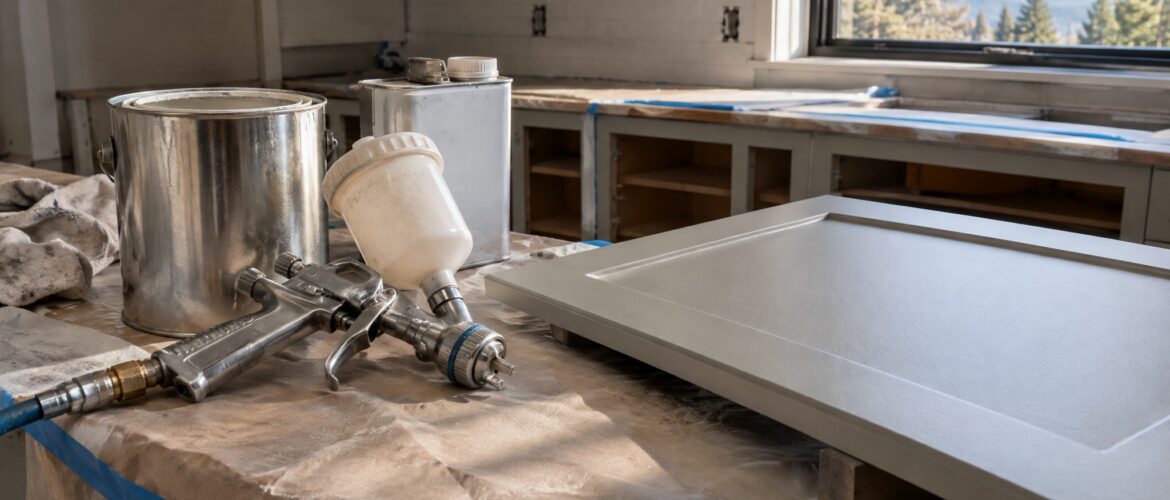
Finding the best cabinet refinishing company in Denver means looking past portfolio photos and checking the actual chemistry and equipment a contractor brings into your home. Many general painters advertise cabinet work as an add-on to interior wall painting. But a durable factory finish on kitchen cabinetry needs spray equipment and industrial coatings that standard paint stores don’t carry. When you’re comparing quotes for a project that has to survive Colorado’s dry climate without peeling or cracking, the gap between a brush-applied enamel and a spray-applied crosslinking urethane lacquer decides whether your investment lasts three years or thirty.
The Checklist for Identifying Top Rated Cabinet Painters in Denver
You can separate top rated cabinet painters in Denver from generalists by asking about application method and coating system before you even schedule an estimate. A real specialist will bring up HVLP spray equipment and precat primer with crosslinking urethane lacquer right away, because these aren’t optional extras. They’re what a finish needs to resist the thermal expansion and contraction our high-altitude, low-humidity air causes. General painters often propose brushing or rolling standard latex or oil-based enamels, because that’s the equipment they already own for walls. That leaves visible brush marks and a film that doesn’t hold up to daily hands-on use in a kitchen. When you’re vetting a licensed cabinet refinishing contractor, check that their whole process is built around spray application, not adapted from house painting.
Why HVLP Equipment and Crosslinking Urethane Lacquer Matter
The difference between a professional refinish and a disappointing paint job comes down to how the coating bonds to the wood as it cures. HVLP (High Volume Low Pressure) spray equipment atomizes the coating into a fine mist that lays down evenly across vertical surfaces and detailed profiles. No ridges, no stipple texture, none of what brushes and rollers leave behind. That matters because cabinet doors have complex shapes where brush marks pile up and create weak points in the film.
The coating itself has to be built for cabinetry, not borrowed from a wall-paint line. Precat primer seals the wood and stops tannin bleed-through from oak or cherry. Crosslinking urethane lacquer forms a thermoset bond that cures harder, and more flexible, than a traditional air-dry finish.
Cabinet finishes need precat primer and crosslinking urethane lacquer specifically to survive Colorado’s dry climate without peeling or cracking. Standard paints stay somewhat permeable and soft even after they dry, so moisture vapor migrates through the film during seasonal humidity swings and breaks the bond underneath. Crosslinking urethanes go through a chemical reaction as they cure that builds a dense, impermeable network, one that resists household cleaners, heat, and everyday wear. If you want to see what this looks like on open-grain wood, our process includes grain filling and 2K poly smooth finish to get a surface a brushed application can’t match. Skip this level of material science and you’re paying for a cosmetic update that fails within a few heating cycles.
Cabinet Refinishing Denver has run continuously since 1979, and we’ve always specialized in spray-applied factory finishes rather than general painting. Four decades in one lane means we haven’t diluted our expertise across unrelated trades or swapped in cheaper materials when margins got tight. We’re licensed and insured specifically for refinishing work, which is a commitment general painters picking up cabinet jobs on the side can’t match. When you request a quote from us, you’re pricing industrial-grade chemistry and a dedicated spray booth, not a markup on residential paint.
That specialization is also why we back the work the way we do. A 3-year warranty on our refinishing covers finish adhesion and integrity, which separates us from contractors who offer only a vague satisfaction guarantee. A satisfaction guarantee is subjective, and it expires the moment the crew leaves your property, so you have no recourse when the finish starts to chip six months later. Our warranty names the failures that actually matter in a Colorado kitchen: loss of adhesion from improper priming, cracking from insufficient flexibility, and degradation from poor chemical resistance. If you’re searching for the best cabinet refinishing company in Denver, treat any warranty shorter than three years, or one limited to “workmanship” with no defined failure criteria, as a sign the contractor expects callbacks and plans to handle them through customer service rather than prevent them with technique.
Refinishing isn’t a fix for cabinets with structural damage, water rot, or joinery that needs carpentry repair before any coating can adhere. The process restores surfaces and updates the look on a sound substrate. It doesn’t rebuild a failing box or correct an old installation error. If your cabinets have real physical defects, deal with those first, or look at replacement instead, because even the best coating over unsound wood just wastes money and delays the failure that’s already coming.
Evaluating Denver Cabinet Refinishing Reviews and Warranty Terms
Reading Denver cabinet refinishing reviews means telling the difference between feedback on how a job looked at handoff and evidence of how it held up. A five-star review posted two weeks after completion tells you the crew was polite and the color matched what the homeowner pictured. It can’t tell you whether the finish survived its first winter heating cycle without an adhesion problem. Look for reviews that mention specific timeframes, describe how the finish performs under daily use, or reference a warranty claim and how it got handled. A review describing how the finish held up after a year or more is worth more than ten recent ones praising communication and cleanup. When you’re running a cabinet painting company comparison in Denver, weight reviewers who describe the same technical specs you’re being quoted over ones talking only about price or scheduling.
Warranty terms are a better check than online testimonials, because they’re a contractual obligation, not a volunteered opinion. A credible licensed cabinet refinishing contractor spells out coverage in measurable terms: adhesion failure, finish cracking, color fading past a stated threshold, chemical resistance breakdown. Vague language like “quality guaranteed” or “customer satisfaction” sets no enforceable standard, and it puts the burden of proof on you after something goes wrong. Ask for the warranty document before you sign anything, and check that it names failure modes specific to this climate rather than generic reassurance. A contractor confident in HVLP application and crosslinking urethane chemistry will hand you clear terms, because they don’t expect to use them much. One relying on brushed enamel or thinned-down product will hedge with vague language, because they’re anticipating failures they can’t afford to cover.
Your evaluation should also confirm the contractor carries current licensing and insurance specific to refinishing work in the Denver metro area. A general liability policy written for interior painting can exclude spray-applied industrial coatings, or limit coverage for off-site shop work where doors and drawers get finished under controlled conditions. Check that the policy covers both in-home prep and shop-based finishing. A gap between the two leaves you exposed if something happens during transport or while parts sit in storage. Licensing confirms regulatory compliance; insurance confirms the contractor can actually pay to fix a problem without a fight. These administrative details matter as much as the technical ones, because they’re what give a warranty promise real backing.
Cost Context: Refinishing Value Versus Replacement Quotes
Professional cabinet refinishing typically saves homeowners about 70% compared to a $25,000+ full replacement project. That gap exists because refinishing keeps the existing box construction and layout and only updates the visible surfaces, so you skip demolition, disposal, new material, and the extended labor a tear-out requires. When a replacement quote comes in over $25,000, understand that roughly two-thirds of that number pays to remove functional infrastructure and rebuild it to the same spec it already had. Refinishing puts that money into finish chemistry and application quality instead. For a breakdown of where those savings come from across different kitchen sizes, see our analysis of refinishing versus replacement savings.
Some homeowners mistake a low-ball refinishing quote for a better deal, but a price well under market rate usually means substituted materials or skipped prep that will cost you later. A quote far below the going rate often means brushed application, architectural-grade paint, or skipped grain filling, and work like that needs redoing within a few years. The real comparison is cost per year of service life, not the number on the first page of the quote. A $6,000 refinish using crosslinking urethane lacquer that lasts fifteen years costs less per year than a $3,500 brushed job that needs replacing in five. You can check current per-door refinishing rates to see what a legitimate spray-applied factory finish costs right now, and spot the quotes that are cutting corners.
The case for refinishing gets stronger once you factor in how long it keeps you out of your kitchen. Full replacement typically takes a kitchen out of service for two to four weeks, which means eating out, cooking on a hot plate, or both. Professional refinishing finishes in two to five days with minimal disruption, so your routine and your budget both stay mostly intact. That speed advantage adds to the direct savings. For a homeowner happy with their layout but tired of how it looks, refinishing is the rational call, and it’s a combination of financial efficiency and minimal disruption built over decades of doing only this.
If your cabinets meet the structural criteria for refinishing and you want to know whether our HVLP spray-applied factory finish process fits your kitchen, get a refinishing assessment for a detailed scope and firm pricing. We’ll confirm the substrate condition, talk through finish options for your wood species and how hard your kitchen gets used, and lay out a real cost comparison against any replacement quotes you’ve already collected.
Frequently Asked Questions About Cabinet Refinishing
How long does a professionally refinished cabinet last in Colorado’s climate?
A properly applied crosslinking urethane lacquer finish typically lasts 15 to 20 years in Colorado’s dry climate when maintained with gentle cleaning and protected from standing water. The key factor is the chemical cure of the coating system rather than simple surface drying, which creates resistance to thermal cycling that causes standard paints to fail prematurely. Longevity depends entirely on correct substrate preparation and industrial-grade chemistry applied via HVLP spray equipment.
Can I stay in my home during the cabinet refinishing process?
Yes, most homeowners remain in residence throughout the two to five day refinishing timeline because the work area is contained and ventilation systems manage overspray and fumes. Doors and drawer fronts are typically removed to our shop for finishing, reducing on-site activity to box preparation and reinstallation. We coordinate scheduling to minimize disruption to meal preparation and daily routines.
What makes HVLP spray better than brushing for kitchen cabinets?
HVLP spray equipment atomizes coating into a fine mist that settles evenly across complex profiles and vertical surfaces without leaving brush marks or ridges. This mechanical advantage combines with faster application speed to produce a uniform film thickness that brushes cannot achieve on detailed millwork. The resulting finish mimics factory-applied coatings in both appearance and durability because the application method matches industrial manufacturing processes.
Does refinishing work on laminate or thermofoil cabinets?
Refinishing works on some laminate surfaces but requires specialized adhesion promoters and testing to confirm bond integrity before proceeding. Thermofoil cabinets present greater challenges because the vinyl layer can delaminate independently of any applied coating, making failure unpredictable regardless of preparation quality. We assess each non-wood substrate individually during consultation and recommend replacement when the existing surface cannot reliably accept a refinished coating.
How do I maintain refinished cabinets to maximize finish life?
Clean refinished cabinets with mild soap and water or pH-neutral cleaners, avoiding abrasive pads, ammonia-based products, and degreasers that can soften the coating over time. Wipe spills promptly and maintain consistent indoor humidity between 30% and 50% to reduce stress on the finish from wood movement. Avoid hanging wet towels directly on cabinet faces and use exhaust fans during cooking to minimize grease accumulation that attracts harsh cleaning methods.