
Holding a $25,000 cabinet replacement quote in your hand creates a specific kind of sticker shock. It forces you to reconsider the entire scope of your kitchen project. You want the updated look and improved function, but the current Denver market has pushed full replacement costs to levels that eat the budget for appliances, flooring, or other upgrades you actually need. This is the exact point where comparing cabinet refinishing vs replacement stops being theoretical and becomes a real financial calculation. The choice is rarely about accepting a lower-quality outcome. It’s usually about recognizing that paying a premium for identical functionality makes little sense when your existing cabinet boxes are structurally sound.
The Real Cost Gap: Denver Replacement Quotes vs. Refinishing Savings
The financial gap between these two options has widened as material and labor shortages keep driving up prices for new cabinetry across the metro area. When you get a quote north of $25,000 for replacement, you’re paying for demolition, disposal, manufacturing, delivery, installation, and weeks of kitchen downtime, all to land on a functional result that matches what you already have. Professional refinishing skips those structural and logistical costs entirely because the existing framework stays in place. Only the visible surfaces get a new factory-grade coating. Homeowners typically save about 70% versus a $25,000+ replacement job when they choose professional refinishing instead, which frees up capital you can put toward higher-impact upgrades elsewhere in the home.
That savings figure isn’t a vague estimate. It’s what actually happens when you take demolition and new manufacturing out of the equation. You can check this against current per-door refinishing rates to see how the math works out for your specific number of doors and drawers. The value here goes beyond the price difference, because it also protects your timeline and cuts the disruption that comes with a full tear-out. A replacement project leaves your kitchen unusable for weeks while crews demolish, install, and adjust new boxes. Professional refinishing, by contrast, runs on a 2-5 day turnaround and comes with a 3-year warranty. That compressed schedule means you’re not eating takeout for a month or cooking dinner in a construction zone.
Refinishing isn’t a universal fix for every kitchen, and pretending otherwise would misrepresent what the service actually offers. If your layout needs moving plumbing or changing the footprint, or if the existing boxes have severe water damage or particle board that’s disintegrating, replacement is the necessary path regardless of cost. For most homeowners with dated but solid cabinets, though, replacement spending is largely paying for identical function at a steep premium. Knowing this distinction helps you figure out whether you need a full remodel or simply a surface restoration that gets you the aesthetic update without the structural expense.
The comparison ultimately comes down to value retention, not just upfront price. When you choose to save money on your kitchen remodel through refinishing, you’re making a strategic call that recognizes the quality already built into your existing cabinets. Cabinet Refinishing Denver has operated since 1979, specializing in spray-applied factory finishes using HVLP equipment and crosslinking urethane lacquer rather than brushed paint. That decades-long focus on technical execution is what separates true refinishing from a cosmetic paint job that might fail within a year. You deserve to know exactly what you’re buying before committing to either path, and that clarity comes from understanding how the processes actually differ, not from a generic pros-and-cons list.
Factory Finish Durability in Colorado’s Dry Climate
Durability worries often push homeowners toward replacement, because they assume a refinished surface can’t match the longevity of factory-manufactured cabinetry. That’s true for brushed latex paint, which sits on top of the wood and eventually chips or peels under daily kitchen stress. True refinishing uses chemistry and application methods built to create a bonded surface comparable to original manufacturing standards. In Denver’s dry climate, crosslinking urethane lacquer gives you better adhesion and flexibility than standard paints, which can crack or peel with seasonal humidity shifts. The finish moves with the wood instead of fighting it, which is what prevents the premature failure that gives refinishing a bad name.
It helps to understand why this chemical distinction matters for your specific environment before you decide whether cabinet refinishing is worth it for your home. Standard latex paints cure through evaporation alone, leaving a film that stays somewhat soft and vulnerable to moisture and physical wear. Crosslinking urethane lacquer goes through a chemical reaction during curing that forms molecular bonds between layers, producing a hard shell that resists heat, moisture, and cleaning chemicals. It’s the same technology used in automotive and furniture manufacturing, adapted here for cabinetry that takes daily abuse. The crosslinking agent itself is what turns the coating from a surface layer into an integrated part of the substrate.
Application method decides whether that chemistry actually performs the way it should in your kitchen. HVLP spray equipment atomizes the coating into fine particles that flow into grain and crevices without leaving brush marks or roller stipple. Precat primer seals the wood and gives you a uniform base that improves adhesion of the topcoat, which is what prevents the blotchy look that comes from uneven absorption. Put proper chemistry and professional application together and you get a furniture-grade surface that looks and feels like new manufacturing rather than a painted-over original. You can see the technical details of this process in our guide on grain filling and 2K poly application, which explains how we handle open-grain woods like oak to get a smooth, modern finish.
Whether refinishing gives you a factory-grade finish or just a painted look comes down to the equipment and materials used. Brushed applications leave texture that telegraphs through the finish, which is visual evidence of the renovation rather than something that erases it. Spray application eliminates that texture entirely, producing a uniform sheen that matches what came off the assembly line decades ago. That’s why evaluating refinishing contractors means looking past portfolio photos to understand their actual process and equipment. Our article on evaluating refinishing contractors breaks down the specific questions that separate specialists from general painters who treat cabinets like walls. The difference shows up in year three, when one finish still looks fresh and the other needs touch-ups.
Denver’s altitude and low humidity put a unique kind of stress on wood finishes that generic national advice tends to miss. Wood in Denver homes expands and contracts more than it would in coastal climates, which demands a finish with enough give to handle that movement without cracking. Crosslinking urethane lacquer holds onto that elasticity even after full cure, unlike harder catalyzed varnishes that can go brittle over time. That’s why local experience matters more than national brand recognition when you’re picking a refinishing provider. Your cabinets face conditions that differ fundamentally from a manufacturer’s testing lab, and the finish system has to account for that to hold up.
When Replacement Is Actually Necessary
Acknowledging the limits of refinishing builds trust and saves you a wasted consultation on a project that genuinely needs replacement. Severe water damage that has compromised the structural integrity of cabinet boxes can’t be reversed through surface treatment alone. Particle board that has swollen or delaminated from prolonged moisture exposure will keep deteriorating no matter how perfect the exterior finish looks. These conditions call for new cabinetry, because the underlying material has already failed. Refinishing handles aesthetics and surface protection, not structural rehabilitation, and mixing those two up leads to disappointment.
Layout changes are another legitimate line where replacement becomes unavoidable. Moving sink locations, adding islands, or reconfiguring wall space requires new boxes sized and positioned for the revised footprint. Existing cabinets can’t be stretched, shrunk, or relocated without wrecking their integrity and appearance. In these cases, the cost comparison shifts, because refinishing simply can’t deliver the outcome you want. The savings argument only holds when the existing configuration already meets your functional needs and the goal is purely aesthetic. Recognizing this boundary early saves time and points you toward the right solution for your actual problem.
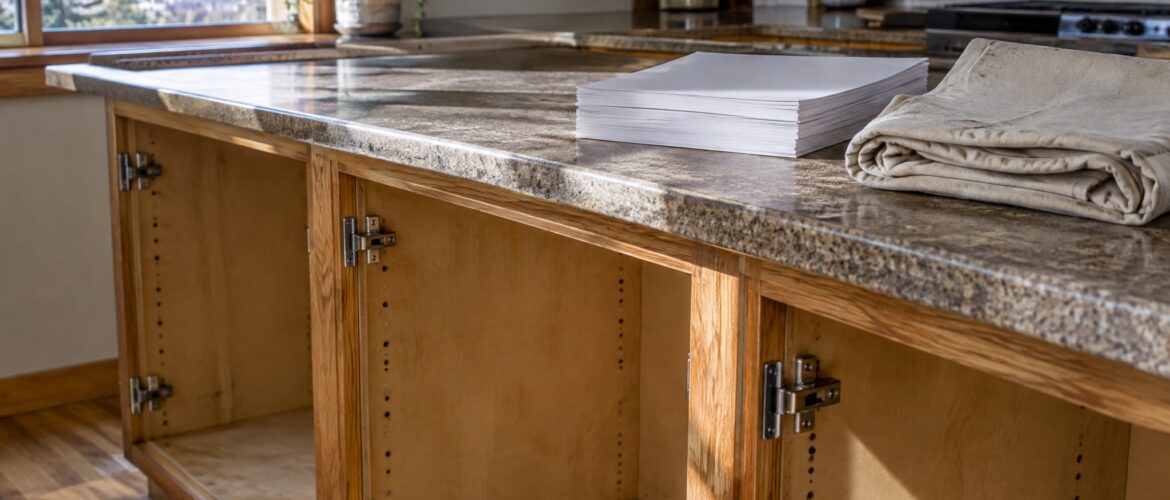
Most dated kitchens fall outside these exclusions and remain strong candidates for refinishing. Solid wood or plywood boxes built decades ago often beat the quality of today’s mid-range replacements, which makes preserving them both economically and practically sensible. The decision comes down to an honest look at condition, not age alone. If your cabinets open smoothly, hold weight without sagging, and show no signs of moisture damage, they likely have decades of useful life left under that outdated finish. That remaining lifespan is real value, and replacement throws it away for nothing.
Frequently Asked Questions
What does cabinet refacing entail?
Cabinet refacing involves replacing door and drawer fronts while applying veneer or laminate to exposed box surfaces, keeping the existing framework intact. It costs more than refinishing because new doors must be manufactured and installed, but less than full replacement since boxes remain. Refinishing differs by spraying new finish directly onto existing doors and boxes without replacing any components.
What kitchen cabinet colors will look outdated in 2026?
Overly gray-toned whites and cool charcoal grays are reading as dated in 2026 as warmer neutrals gain preference in Denver homes. Saturated navy and forest green peaked in popularity around 2023-2024 and now signal a specific moment rather than timeless appeal. Warm whites, soft taupes, and natural wood tones currently offer better longevity for resale value.
What is the most expensive part of redoing a kitchen?
New cabinetry typically consumes 25-35% of total kitchen remodel budgets in Denver, often exceeding $25,000 for average-sized spaces. Labor for demolition and installation adds significant cost on top of materials, especially when layout changes require plumbing or electrical relocation. Countertops and appliances follow as secondary expenses, but neither usually matches cabinetry’s share of the budget.
What colors to avoid in kitchen cabinets?
Avoid highly saturated reds, oranges, and purples that limit buyer appeal and clash with most countertop and backsplash options. Pure black shows fingerprints and dust relentlessly in active kitchens despite its magazine appeal. Trend-driven pastels like millennial pink or mint green date quickly and reduce perceived neutrality for future resale.