
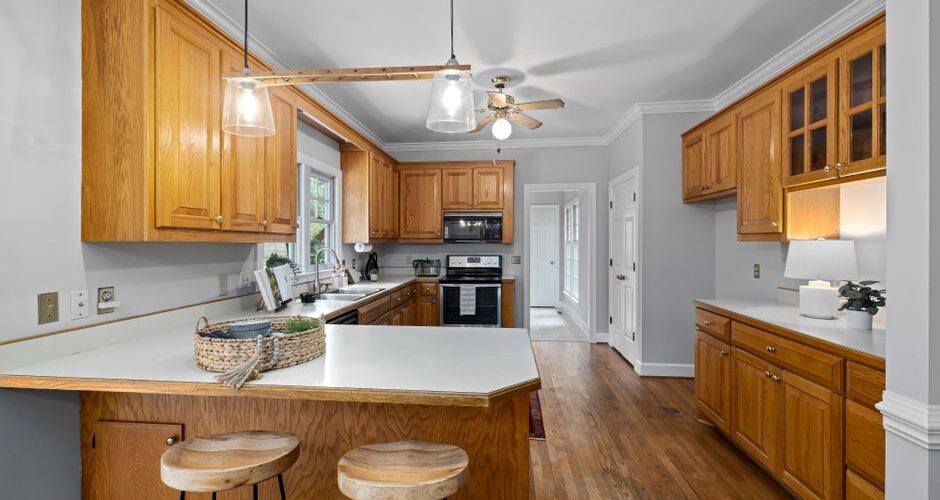
Yes. In Denver, oak cabinets only read as smooth and factory-finished when the open grain is filled before coating. Skipping that step is why so many oak kitchens end up with a textured, latex-telegraphed look. The fix is a two-coat grain filler, sanded to 320, then a 2K poly primer and 2K topcoat sprayed in a booth. This article is money math, not sales talk.
Table of Contents
- Why do Denver oak cabinets look textured after painting?
- What does grain filling actually do to oak before a factory finish?
- How much does grain filling add to an oak refinishing project in Denver?
- Why does 2K poly hold up on oak when latex and urethane coatings fail?
- What is the difference between a filled and unfilled oak cabinet in a Denver home?
- How does Cabinet Refinishing Denver deliver a factory finish on oak cabinets?
- Is grain filling worth the extra cost compared with replacing or refacing oak cabinets?
- Key Takeaways
- References
Why do Denver oak cabinets look textured after painting?
Denver's 1990–2010 build wave left a large share of metro kitchens with oak cabinets, and oak is a ring-porous hardwood. According to Carolina Renew, oak's water-carrying vessels are large enough to see without magnification and open at the surface as long, narrow channels when milled flat.
Those channels telegraph through a thin paint film and read as texture, not as wood character. A homeowner in Highlands or Wash Park sees the grain pattern through the paint and assumes the painter did poor work. The real issue is that the pores were never filled.
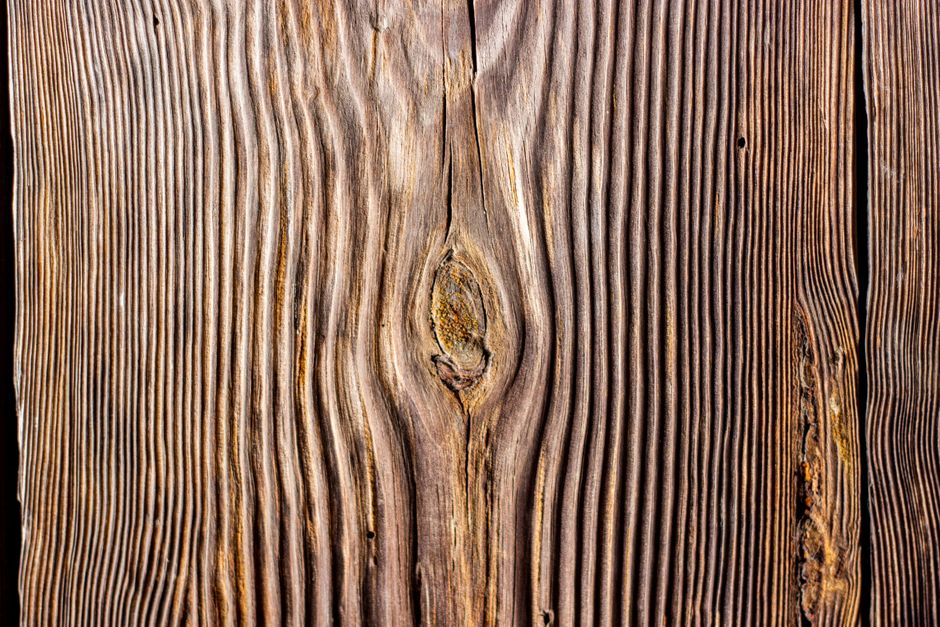
Film build is capped on cabinet systems, so adding more paint cannot hide the grain. Carolina Renew notes that Sherwin-Williams' Sher-Wood Kem Aqua Plus cabinet system is capped at a maximum dry film thickness of 4 mils. A typical primer coat lands near 0.9 to 2.0 mils dry, leaving almost no room to bury oak pores.
The texture is a prep problem, not a paint problem. Cabinetspainting.com lists grain filling on oak among prep steps because open grain telegraphs through a thin film and reads as texture. Denver homeowners who skip grain fill are paying for a finish that will always look rough.
What does grain filling actually do to oak before a factory finish?
Grain filling fills the open pores across the whole surface, while wood filler only repairs defects like dents or cracks. Oak has thousands of tiny channels per square inch, and grain filler is the only product designed to level them before primer and topcoat.
The sequence starts with degreasing and deglossing, then scuff sanding with 180 grit. In a demonstration by a professional cabinet painter active since 2001, the filler was mixed to a peanut butter or pancake batter consistency and applied with a flat mud knife, with excess scraped off before drying.

The dried filler is then sanded. One source uses 220 grit over filler, while Carolina Renew cites manufacturer instructions calling for 320-grit or finer before the next application and before the first coat of paint. Cabinet Refinishing Denver sands to 320 before primer because that leaves the surface flat without pulling filler back out of the grain.
Filler does not shrink and sands smooth, but over-sanding is a real risk. The demonstration source warns that sanding too aggressively pulls the filler back out of the grain, which recreates the exact texture problem the homeowner paid to eliminate.
How much does grain filling add to an oak refinishing project in Denver?
Grain filling adds roughly $400 to $800 on a typical Denver oak kitchen. That figure represents about one extra day of labor plus material, and it is the only path to factory smooth on oak, not an upsell.
The invoice math is direct. A Parker client received a refinish quote of $8,900 against a $52,000 new-cabinet quote. The existing boxes were solid wood and structurally sound, so replacement would have discarded material that did not need to go.
The ROI angle matters in Denver neighborhoods. A $9,000 factory finish can support a $25,000 or higher resale bump in Cherry Creek, Highlands, Wash Park, Capitol Hill, and Baker because kitchens drive buyer perception. Cabinetspainting.com confirms that painting is normally lower-cost than replacement, though it does not publish specific dollar figures.
Homeowners who skip grain fill to save $400 to $800 are not saving money. They are paying for a textured finish that will read as dated and poorly done, which undercuts the resale value the refinish was supposed to create.
Why does 2K poly hold up on oak when latex and urethane coatings fail?
2K poly holds up because it cures by chemical cross-linking rather than solvent evaporation. In 2K terminology, "K" stands for komponent: the coating arrives as a resin part and a hardener or activator part mixed at application, according to Cabinetspainting.com.
Brush-and-roll latex and urethane systems stay flexible after drying. On oak, that flexibility becomes a liability because the film moves along the open grain lines and eventually cracks. The demonstration source used Sherwin-Williams Emerald Urethane in a roller test, which is a quality coating, but it is not a 2K cross-linked system.
The spray schedule for oak is 2K poly primer, sanding, then 2K topcoat in a spray booth. Booth application beats on-site rolling for film consistency because temperature, airflow, and overspray are controlled. A typical Denver kitchen project's on-site portion runs about five to seven days, according to Cabinetspainting.com.
Refinishers who spray 2K polyurethane report that it will not break down from years of touching and cleaning, while ordinary cabinet paint can. Low-VOC 2K systems are available, which matters for Denver homeowners who want durability without a lingering solvent smell.
What is the difference between a filled and unfilled oak cabinet in a Denver home?
The difference is visible in a side-by-side test where one door section is grain filled and another is not, then both receive the same primer and topcoat. The unfilled section shows grain telegraphing through the paint, while the filled section reads as a continuous, smooth surface.
Across Highlands, Wash Park, and Cherry Creek oak kitchens, the same sheen produces two different results depending on prep. A filled door reflects light evenly. An unfilled door scatters light across the grain channels, which makes the finish look rougher and older than it actually is.
The finger test is the practical check homeowners can do themselves. On a cured 2K finish, a filled surface feels flat and slick. An unfilled surface reveals the grain pattern as subtle ridges under the fingertips, even when the color looks acceptable from across the room.
Sheen and color read differently on filled versus unfilled oak because texture scatters light, according to Carolina Renew. A satin finish on filled oak looks richer than the same satin on unfilled oak, where the grain breaks up the reflection.
How does Cabinet Refinishing Denver deliver a factory finish on oak cabinets?
Cabinet Refinishing Denver delivers a factory finish through Cabinet Refinishing with Factory Finish, a professional service for homeowners in Denver, Golden, and Arvada, Colorado. Pricing starts with a free estimate.
The process is two-coat grain filler, sanding to 320, 2K poly primer, sanding again, and a 2K topcoat sprayed in a booth. This sequence addresses the open grain that makes Denver oak cabinets look textured after ordinary painting.
The warranty position is specific: oak work is warranted only when grain is filled and finished in 2K. That is not a sales condition. It is a recognition that unfilled oak with a latex or urethane topcoat will fail along the grain lines, and no warranty can fix a prep problem after the fact.
Turnaround runs 2 to 5 days, and the free in-home oak test shows a filled versus unfilled sample in hand. Homeowners in Denver, Golden, and Arvada can see the difference on their own cabinet door before committing to the full project.
Is grain filling worth the extra cost compared with replacing or refacing oak cabinets?
Yes. The comparison across refinishing with grain fill, replacement, and refacing favors grain-filled refinishing on cost, timeline, dust, and disruption.
| Option | Cost | Timeline | Dust and disruption | Warranty position |
|---|---|---|---|---|
| Refinishing with grain fill and 2K | $8,900 example | 2–5 days | Low, mostly off-site booth work | Warranted when grain filled and 2K finished |
| Replacement | $52,000 example | Weeks | High, full tear-out | New cabinet warranty |
| Refacing | Mid-range | 1–2 weeks | Moderate, new veneers and doors | Varies by installer |
Homeowners keep the solid wood boxes, soft-close upgrade, and new hardware. What is genuinely new is a sprayed 2K factory finish, not latex. The Parker invoice numbers show why replacing solid boxes is waste: the $52,000 quote bought new boxes that were not needed.
The money math is simple. Get a replacement quote first, then compare it against a filled 2K refinish. The difference in Denver is often $40,000 or more, and the refinished kitchen can support the same resale conversation in Cherry Creek, Highlands, Wash Park, Capitol Hill, and Baker.
Key Takeaways
- Oak is ring-porous, and its open surface channels telegraph through thin coatings as visible texture.
- Grain filler fills pores across the whole surface and does not shrink; wood filler only repairs defects.
- Cabinet coating systems are film-thickness capped, so extra paint cannot hide oak grain.
- Grain filling adds roughly $400 to $800 and about a day of labor to a Denver oak project.
- 2K coatings cure by chemical cross-linking, while latex and urethane films crack along open grain.
- A Parker refinish at $8,900 was quoted against $52,000 for new cabinets on boxes that were still solid.
- Cabinet Refinishing Denver warrants oak work only when grain is filled and finished in 2K poly.